







 Watch Full Show

Guests
- Carlos Ronformer Venezuelan diplomat who served as vice minister for North America from 2018 to 2025, co-coordinator of the Nuestra América office of the Tricontinental: Institute for Social Research.
- Francisco RodríguezVenezuelan economist, senior research fellow at the Center for Economic and Policy Research and a professor of public and international affairs at the University of Denver.
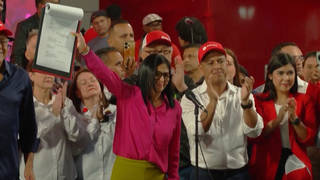
U.S. forces have seized two more oil tankers with links to Venezuela, days after the U.S. attacked Venezuela and abducted President Nicolás Maduro along with his wife, making former Vice President Delcy Rodríguez the new leader of the country. “This is a decapitation without regime change,” says Venezuelan economist Francisco Rodríguez. “The political system in Venezuela remains intact.” In Caracas, former Venezuelan diplomat Carlos Ron says Maduro is a “prisoner of war” and that Venezuelans “are angry and are upset about this incursion from the United States.” This comes as the Trump administration has announced plans to control sales of Venezuela’s oil “indefinitely.”
Related Story
 Web ExclusiveJan 03, 2026Special Report on Venezuela: U.S. Kidnaps Maduro, Trump Says “We Are Going to Run” Oil-Rich Nation
Transcript
AMY GOODMAN: This is Democracy Now!, democracynow.org. I’m Amy Goodman, with Nermeen Shaikh.
NERMEEN SHAIKH: U.S. forces have seized two more oil tankers with links to Venezuela, days after the U.S. attacked Venezuela and abducted President Nicolás Maduro along with his wife. One of the oil tankers was seized in the Caribbean. The other, a Russian-flagged tanker, was intercepted in the North Atlantic. In response, Russia accused the U.S. of violating maritime law, calling for the release of the ship’s crew. This comes as the Trump administration has announced plans to control sales of Venezuela’s oil indefinitely.
AMY GOODMAN: On Wednesday, President Trump told The New York Times, in an extended interview, the U.S. may run the country for years. Trump also claimed the interim Venezuelan government is, quote, “giving us everything that we feel is necessary,” unquote.
This is Secretary of State Marco Rubio speaking Wednesday.
SECRETARY OF STATE MARCO RUBIO: As you’ve seen today, two more ships were seized. We are in the midst right now and, in fact, about to execute on a deal to take all the oil. They have oil that is stuck in Venezuela. They can’t move it because of our quarantine and because it’s sanctioned. We are going to take between 30 and 50 million barrels of oil.
AMY GOODMAN: We’re joined now by two guests.
From Caracas, Venezuela, we’re joined by Carlos Ron, former Venezuelan diplomat who served as vice minister for North America from 2018 to last year under the government of Nicolás Maduro, co-coordinator of Nuestra América office of the Tricontinental: Institute for Social Research. He’s joining us from Caracas. His new piece for CounterPunch headlined “The Current Situation in Venezuela: A Government in Charge, a People Resilient.”
And we’re joined by Francisco Rodríguez, Venezuelan economist, senior research fellow at the Center for Economic and Policy Research, professor of public and international affairs at the University of Denver. He has a piece in The New York Times today, “How Machado Lost Her Chance to Lead Venezuela.” His recent book, The Collapse of Venezuela: Scorched Earth Politics and Economic Decline, 2012–2020. He’s a former head of Venezuela’s Congressional Budget Office.
We welcome you both to Democracy Now! Francisco Rodríguez, let’s begin with you. Start off by responding to the U.S. bombing of Venezuela, killing, according to Venezuela now, about a hundred people, abducting Maduro and his wife. You say this is unprecedented in U.S. history. Can you respond?
FRANCISCO RODRÍGUEZ: Well, yes, I mean, more than U.S. history. The being able to extract a head of state from a country, to essentially kidnap that head of state and take him to another country, is something that there are no clear historical precedents of. There are invasions. There are occupations, like Panama, like Iraq, where the head of state is ultimately captured. Those are essentially wars where there’s a losing side. But this is different. This is a decapitation without regime change. So the political system in Venezuela remains intact. It’s just lost its leader. But these political systems have a capacity to adapt to the losses of leadership.
Of course, you do have a very different component, which is that it’s not just that they lost their leader by chance. It’s that the U.S. is threatening the country that if it doesn’t play according to its plans, it can do that to the current leader, it can — or it can, effectively, use its force. The U.S. has leveled a credible threat, and that is the reason that Venezuelan authorities are acquiescing to U.S. demands of control over the country’s oil revenues.
NERMEEN SHAIKH: Well, you said, Francisco, in another interview, that, quote, you “found it interesting that the United States had such an easy time capturing Maduro and his wife while they slept. That strongly suggests that there was some type of internal collaboration from the Venezuelan forces that were guarding him.” Could you elaborate on that? Who do you think was responsible for working with the U.S.?
FRANCISCO RODRÍGUEZ: Yeah, well, I mean — yes, so, there are protocols. Any government, and much more so the Venezuelan government, that has been dealing with conspiracies, coup attempts for more than two decades, there are protocols for what you do with a head of state when, for example, you’re under military attack. So, the idea that you can actually be bombing a city and then catch the president in his bed sleeping at night says that there was a very basic failure, and this opens up a lot of questions.
Now, we also know that there are about a hundred, by the Venezuelan government’s account, persons who died during this raid. Thirty-two of them are Cubans. And these are part of the security detail that guarded President Maduro. Now, that, to me, also suggests — I mean, that disproportionate rate of Cuban deaths suggests that something happened in the military, where, effectively, one sector decided that it was going to back this.
And then, we have, essentially, less than 48 hours later, the new government saying that it’s going to collaborate with the United States. In fact, it first issued a statement, of course, condemning the abduction of Maduro. But on the second day, it issued a statement that could have been issued by any government in the region, that actually read more like a statement of a center-right or right-wing government of the region, saying, “We want good relations with the U.S., and we’re willing to collaborate.”
So, all of this is the type of pattern — now, I’m not saying that I have proof of this. I’m just looking at patterns, and I’m looking at behaviors, which are very much those that you tend to see when there’s a palace coup.
NERMEEN SHAIKH: And so, Carlos Ron, if you could respond to this raid and the abduction of former President Maduro and his wife, and also the response, what the response has been in Venezuela? Many have been protesting, calling for his release, but many in exile have been supporting what’s happened, because they were opposed to Maduro for various reasons.
CARLOS RON: Well, yes. Thank you. You know, first, I think there’s still a lot of speculation about, you know, this idea of intrigues, or internal intrigues. But what I see from here on the ground in Venezuela is actually a very, you know, cohesive display of the Bolivarian Revolution’s leadership. I mean, you don’t see any fractures. You don’t see — you actually saw every important leader, whether it be political leader, a member of the Assembly or military leader, supporting acting President Delcy Rodríguez.
But also, ever since the attack, there have been demonstrations by different sectors of Venezuelan society in — like you said, in favor of the releasing of President Maduro, bringing him back home, and in support of the government, which is actually — that is what I think is very atypical, in any case, of this type of intervention. I mean, this was an act of war by the United States, with no doubt. I don’t think this is different from an act of war. I mean, I think this was clearly a violation of the U.N. Charter. This is a violation of, you know, Article 51 and Article 1 and 2. You know, there’s — you know, the president of Venezuela is a prisoner of war. Now, I think what is important to see is how Venezuela has united. This has been something that inside Venezuela has helped, I think, bring Venezuelans together, in rejection of this U.S. attack.
You talk about people outside of Venezuela, and these are people that were not — you know, the bombs didn’t fly over their heads. I think that you even see that there’s even people here, in Venezuela, that were not members of the government, that were not government supporters, that are people that have, you know, been opposition leaders or militants. You don’t see them on the streets, you know, celebrating or doing anything of the sort. You actually see a lot of people that are, you know, frustrated, are angry and are upset about this incursion from the United States.
AMY GOODMAN: I wanted to ask Francisco Rodríguez about the oil, about the seizing, most recently, of these latest oil tankers, one with a Russian flag, about President Trump saying that the U.S. is going to run Venezuela for the indefinite future, and it will be funded by taking Venezuela’s oil — the latest, the 30 to 50 million barrels of oil that the U.S. will just take, worth something like $2 billion.
FRANCISCO RODRÍGUEZ: Yeah, well, the details are still unclear as to exactly how it is that this is going to work. Effectively, the Venezuelan economy runs on the revenues from oil sales. Oil is more than 90% of the country’s exports. It’s around half of its fiscal revenue. This economy does not operate, cannot do very basic things, including even feeding its population, without these oil revenues.
Now, President Trump has effectively said that, and his Cabinet have said that, these funds are going to be deposited in offshore accounts and that the U.S. is going to be deciding how they’re going to be spent. But unless they want to cause a famine in Venezuela, this money has to come back to Venezuela to fund Venezuelan imports of essentials, of food, of medicines, of agricultural input, of inputs for restoring the oil sector, its electricity sector.
So, what seems to be taking place is something that is actually similar to the Iraqi Oil for Food program between 1996 and 2003. At that time, it was the U.N. Security Council that imposed it, and it was the United Nations as an organization that effectively ran it. And what that implied was supervision over how the funds were spent. Of course, in that case, the idea was that the role would be to ensure that they were spent on humanitarian goods, on humanitarian imports. Here, President Trump is being much more explicit that he cares about this, these imports, coming from American companies, so that it’s a way to ensure that Venezuela — that the money that comes out of Venezuela is actually spent on contracting the U.S. corporate sector.
NERMEEN SHAIKH: Well, Francisco, I want to ask you about something that The New York Times reported in October, which is that the Maduro regime had offered a deal to the U.S. to avoid conflict, which included, quote, “open[ing] up all existing and future oil and gold projects to American companies, [giving] preferential contracts to American businesses, reverse the flow of Venezuelan oil exports from China to the United States, and slash his country’s energy and mining contracts with Chinese, Iranian and Russian firms.” So, if that’s the case, why do you think Trump refused that deal then, since it seems, effectively, that’s what he’s getting now, because that’s what he wants?
FRANCISCO RODRÍGUEZ: Exactly. And the answer has to be: He wanted to get rid of Maduro. And I think that there were political reasons to get rid of Maduro. Maduro had become, essentially, the symbol of the Latin American — evil Latin American dictator. That’s how he was perceived. Venezuela’s current leader, Delcy Rodríguez, is not perceived that way. She’s just not known. She’s also not linked to allegations of drug trafficking or of crimes against humanity or of political repression to the extent and in the very direct way that Maduro or Diosdado Cabello, for example, were.
So I think that the choice was twofold. One of them is to do this — and President Trump actually was clear about this. He offered Maduro a possibility of leaving the country peacefully, to essentially go into exile. Maduro rejected it. It’s very clear that he wanted Maduro out of the way. And I think also it became a symbolic price. I mean, being able to carry out this operation, extract Maduro, put him behind bars in New York, I think that this is the type of symbolism that President Trump craves and seeks, where he can be seen as a strong and forceful leader who’s able to go after the bad guys or the people who are perceived as being the bad guys.
AMY GOODMAN: I want to turn to a clip of Venezuelan President Maduro in an exclusive interview with Spanish journalist Ignacio Ramonet just days before Maduro’s kidnapping. The interview was filmed December 31st as Maduro drove a car through the streets of Caracas with his wife, Cilia Flores, sitting in the back seat, a red hat with the words “no war, yes peace,” written in white, also resting in the back seat of car. During the interview, Maduro said, quote, “The American people should know that here they have a friend, a friendly, peaceful nation and a friendly government, too.” Let’s go to the clip.
PRESIDENT NICOLÁS MADURO: [translated] The far right and the economic threats and blockade campaigns of the U.S. empire, one of the objectives — now the attacks on oil tankers and Venezuelan oil — is to once again disrupt monetary life and the balance that we have already achieved.
[in English] Not war, no crazy war.
IGNACIO RAMONET: Yes peace.
PRESIDENT NICOLÁS MADURO: No crazy war. Yes peace. [translated] We want peace. We want respect for international law. And we hope that in the coming weeks and months, the American and global society will be able to generate pressure to end these threats.
AMY GOODMAN: So, I wanted to get Carlos Ron to respond to that, and also why President Trump chose to stick with the government that you were part of, of course, the Maduro government — Delcy Rodríguez, part of a revolutionary family: her brother, head of the National Assembly; her father, well-known, assassinated leader, a revolutionary leader — and not go with María Corina Machado. And I’d like to get Francisco Rodríguez’s response to that, as well. You just wrote a piece in the Times about this today. But start with Carlos.
CARLOS RON: Well, just to clarify, I am not a member of the government. I am a researcher for Tricontinental: Institute. I was a diplomat at some point. But I do support President Maduro, and I do support acting President Delcy Rodríguez.
And I think the reason — you know, what President Maduro said in that clip that you just mentioned was important. You know, the position of the Venezuelan government has always been to try to get the U.S. to return to diplomacy. I mean, the U.S. got into this mess in the first place by this maximum-pressure campaign, imposing sanctions. I mean, that was what really drove Venezuela, you know, apart from U.S., because just a few years ago, even during President Chávez, the U.S. was the main trading partner for Venezuela. It was — you know, the relations, even though there was, you know, of course, different political and ideological views, there was a different type of relations. Now, I think President Maduro’s message there has been the consistent message of President Maduro throughout this time, and I think it still is the consistent message now, you know, that peace is something important, diplomacy is something important, and Venezuela is willing to do that under a framework of respect. You know, that was what — that was what Venezuela always sought, you know, at that moment.
I think that the realization also that there is popular support — I mean, you have to understand that for 26 years, there has been a buildup of popular support for the Bolivarian process. This has been a process that has, you know, improved the quality of life of people. It was a process that had remarkable, you know, humanitarian gains, up until the sanctions regime started to implement — to be implemented and hurt the Venezuelan economy and hurt Venezuela’s possibilities. But even then, there were a lot of things that were put into place by the Venezuelan government to help —
AMY GOODMAN: We only have 30 seconds. And so, I wanted to ask Francisco Rodríguez if you could just quickly respond on, basically, Trump dumping Machado, the Nobel Peace winner.
FRANCISCO RODRÍGUEZ: I think Machado could not lead that country. I mean, I think that Trump took a decision that he wasn’t going to get into state-building. He wasn’t going to militarily occupy the country with U.S. troops. So, you have to work with existing state structures. Perhaps another opposition politician could have entered into a power-sharing agreement. But Machado, no, she’s rejected this. Her politics is a politics of moral absolutism. For her — she said this repeatedly — it’s a battle between good and evil.
AMY GOODMAN: We’re going to have to leave it there, but we’re going to do an interview in Spanish. Venezuelan economist Francisco Rodríguez and Carlos Ron, thank you so much for joining us. I’m Amy Goodman, with Nermeen Shaikh.




 Top
Top
Media Options