










 Watch Full Show

A new ProPublica investigation reveals new details about a sprawling ICE detention complex where families describe horrific conditions inside, such as being served contaminated food, with children and parents at times finding worms in their meals. Lights are reportedly left on for 24 hours a day. South Texas Family Residential Center, in the town of Dilley a few dozen miles from the southern border with Mexico, detains an estimated 3,500 people, more than half of them children. “I have never felt so much fear to go to a place as I feel here. … Once I go back to Honduras, a lot of dangerous things could happen to my mom and I,” a 14-year-old detained at Dilley, Ariana Velasquez, told ProPublica. There are also mounting reports of psychological abuse by guards, some of whom have allegedly threatened families with separation. “Many of the children who are now being sent there are being arrested by ICE around the country, and some of them, like Ariana, have been living [in the U.S.] for years,” says Mica Rosenberg, investigative reporter at ProPublica.
Related Story
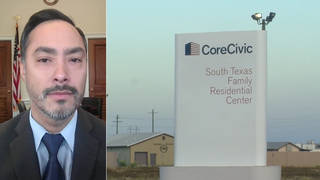
 StoryFeb 10, 2026Rep. Joaquin Castro Slams ICE “Prison” Where Children as Young as 2 Months Old Are Held
Transcript
NERMEEN SHAIKH: This is Democracy Now!, democracynow.org. I’m Nermeen Shaikh, with Amy Goodman.
“The Children of Dilley.” That’s the title of a new ProPublica investigation into the South Texas Family Residential Center, a sprawling ICE detention complex in the town of Dilley, a few dozen miles from the southern border with Mexico. It’s run by the private prison company CoreCivic. Dilley was first opened by the Obama administration in 2014.
In a moment, we’ll be joined by a ProPublica investigative reporter who went inside Dilley. But first we turn to the voices of two children held inside. This is a 9-year-old girl from Venezuela, Susej Fernández, speaking to ProPublica, describing what life is like for her at Dilley, where she’s been held for over 50 days.
SUSEJ FERNÁNDEZ: [translated] Honestly, honestly, I don’t feel good, because there’s always, always an officer around, like, bothering me. I can’t go anywhere. And if I need to go to the bathroom, they won’t let me, because I have to go with my mom. So it’s annoying, and I just have to stay in my room.
AMY GOODMAN: And this is 14-year-old Ariana Velasquez reading a letter she wrote while detained at Dilley. She’s a high school student from Honduras who’s lived in the United States with her mom for seven years.
ARIANA VELASQUEZ: Hello. My name is Ariana V. I’m 14 years old, and I’m from Honduras. I’ve been detained for 45 days, and I have never felt so much fear to go to a place as I feel here. Every time I remind myself that once I go back to Honduras, a lot of dangerous things could happen to my mom and I. My younger siblings haven’t been able to see their mom in more than a month. They’re very young, and you need both of your parents when you’re growing up. Since I got to this center, all you will feel is sadness and mostly depression.
NERMEEN SHAIKH: Those were the words of Ariana Velasquez, a 14-year-old girl from Honduras detained at Dilley.
We’re joined now by ProPublica investigative reporter Mica Rosenberg.
Welcome to Democracy Now!, Mica. Tell us more about Ariana’s story and the children detained at Dilley whom you spoke to.
MICA ROSENBERG: Yeah. Thank you so much for having me.
And I think one of the main takeaways here is that children who are at this center — in the past, the center had mainly been used to hold families who were recently crossing the border, many who — since the Obama administration, it’s been open, and families were coming there in the hopes of coming into the United States for the first time. But now there’s been a real shift, because border crossings have dropped to record lows, and many of the children who are now being sent there are being arrested by ICE around the country. And some of them, like Ariana, have been living here for years. You know, they speak perfect English, as you heard. They were detained sometimes in the middle of their school years. And in some cases, they’re now entrenched American lives. In the case of Ariana, she has two younger U.S. citizen brothers and — a brother and sister, a kindergartner and a toddler, who were not sent to the detention center. So, she was — she and her mother were separated from them.
AMY GOODMAN: Can you talk, Mica, about CoreCivic running Dilley? And talk about who is profiting financially from the locking up of children.
MICA ROSENBERG: Well, the operator of this facility is CoreCivic, as you mentioned. It’s a private prison firm that has operated ICE detention centers for many, many years. The other major private prison firm is GEO Group, and there’s also other firms that run ICE detention centers. And so, these are sort of long-standing companies that have worked in coordination with ICE. They say that they’re subject to a number of audits and oversight, that they take health and safety as a top priority.
But now there’s — you know, because of the huge amount of money that’s being injected into ICE, and especially into detention, these companies are set to earn more money as they expand, and there’s other companies that are interested in sort of getting in the detention game. We’ve written about tent companies to build tent camps. They’re also talking about taking over warehouses and converting those into detention facilities. And so, there’s a lot of companies that are sort of waiting in the wings to make more money.
NERMEEN SHAIKH: Well, Mica, you’ve written another piece titled — investigative piece, ”ICE Sent 600 Immigrant Kids to Detention in Federal Shelters This Year. It’s a New Record.” Are you referring to 2026? And if so, if you could elaborate on that? We just have a minute.
MICA ROSENBERG: Yes, that was a separate piece that we wrote last year. And this is sort of a separate thing that’s happening, where in addition to this family detention center, where parents and children are held together, there’s federal shelters where kids who are unaccompanied are housed. And so, what we found is that ICE arrests inside the United States, in some cases, are separating children from their parents, and those kids are being sent alone to this network of shelters, where before also only housed — usually only housed border crossers are now housing kids who have lived in the United States for many years.
NERMEEN SHAIKH: Mica Rosenberg, thank you so much for joining us, investigative reporter at ProPublica. We’ll link to your new piece, “The Children of Dilley.”
And again, on Monday, February 23rd, Democracy Now! will be celebrating our 30th anniversary at Riverside Church in New York. Guests include Angela Davis, Naomi Klein, Maria Ressa, Michael Stipe, Wynton Marsalis, Mosab Abu Toha, V., Hurray for the Riff Raff and more. See democracynow.org for more information. We look forward to seeing you all there. I’m Nermeen Shaikh in New York, with Amy Goodman in Los Angeles. Thanks so much for joining us.




 Top
Top
Media Options