







 Watch Full Show

Guests
- Jake Johnstondirector of international research at the Center for Economic and Policy Research.
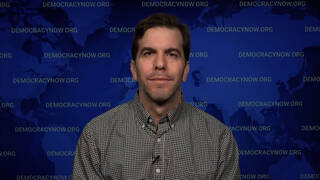
President Trump is hosting right-wing leaders from across Latin America in Miami for a summit discussing his so-called Shield of the Americas initiative. This comes as the U.S. deploys special forces to Ecuador and as Trump hints about regime change in Cuba. “This summit is … an opportunity for Trump to play out a moment of imperial fantasy in front of fans in South Florida,” says Jake Johnston, director of international research at the Center for Economic and Policy Research. The leaders of Argentina, Bolivia, Chile, Costa Rica, the Dominican Republic, Ecuador, El Salvador, Honduras, Panama, Paraguay and Trinidad and Tobago will attend, says the White House.
Related Story
 StoryJan 30, 2026“Hostile Takeovers”: As U.S. Claims Venezuela’s Oil, Trump Seeks “Vassal States” Across the World
Transcript
AMY GOODMAN: This is Democracy Now!, democracynow.org. I’m Amy Goodman, with Juan González.
This weekend, the Trump administration is hosting right-wing leaders from across Latin America in Florida for the, quote, “Shield of the Americas” summit to launch a new security initiative for the Western Hemisphere. The heads of state from Argentina, Bolivia, Chile, Costa Rica, the Dominican Republic, Ecuador, El Salvador, Honduras, Panama, Paraguay, Trinidad and Tobago, and possibly others, are confirmed to attend. The White House said the initiative will be to reinforce the so-called Donroe Doctrine, signaling a level of U.S. intervention in Latin America not seen since the Cold War.
Speaking on Thursday at the Americas Counter Cartel Conference at U.S. Southern Command, Defense Secretary Pete Hegseth urged Latin American countries to take a more aggressive approach against drug cartels, threatening the Trump administration will otherwise be forced to act.
DEFENSE SECRETARY PETE HEGSETH: And today, some 200 years later, we still marvel at the wisdom of President Monroe’s declaration. We, like you, want borders and sovereign territories that are secure. We want unfettered access to key terrain and trade so that our nations can industrialize. And we want to prevent external powers from threatening our peace and independence in our shared neighborhood. This is the essence of the Monroe Doctrine. No external power will interfere in this hemisphere. Ours should be a region of strong sovereign nations. It’s the same principle that animates President Trump’s defense approach today. President Trump and his Department of War are ushering in a new era of homeland and hemispheric defense.
AMY GOODMAN: This comes as U.S. Special Forces are now in Ecuador to conduct joint military operations with Ecuadorian commandos to reportedly target suspected drug traffickers, and as President Trump has suggested regime change in Cuba might be his next target after attacking Iran and Venezuela.
For more, we’re joined by Jake Johnston, director of international research at the Center for Economic and Policy Research, author of the book Aid State: Elite Panic, Disaster Capitalism, and the Battle to Control Haiti. He’s joining us from Washington, D.C.
Can you explain what this meeting is about, and talk about Cuba now in the crosshairs?
JAKE JOHNSTON: Yeah, of course. And thanks for having me.
I mean, I think, you know, on its surface, the show — this summit is a show, right? An opportunity for Trump to play out a moment of imperial fantasy in front of fans in South Florida. But I think, taking a step back, you know, this does fit very much in line with what has been, really, in many ways, a bipartisan and decadeslong strategy of undermining and breaking the left governments in Latin America and consolidating a pro-U.S., right-wing bloc throughout the hemisphere. And so, you see the countries that have sort of appropriately shown their fidelity to the Trump administration and to U.S. policy get invited, and those that don’t face the wrath of the Trump administration. We’ve seen that in Venezuela, in Colombia, in Mexico and in elsewhere, and obviously, as you mentioned, in Cuba.
JUAN GONZÁLEZ: And, Jake, I guess, for more than 80 years, the main sort of international body that the United States supported in Latin America was the OAS, the Organization of American States. What does this say, this attempt to create a right-wing, basically, pole in Latin America say about U.S. policy toward the region?
JAKE JOHNSTON: Yeah, it’s a really great point, right? I mean, for decades, we’ve been saying, “Oh, the OAS is largely controlled by the U.S. It’s run by the U.S. The U.S. is funding more than half of its budget.” And that’s true. It has largely advanced U.S. interests. And for this administration, even that’s not enough, because it is a forum that everyone is invited to, and there are, you know, actual rules, and it’s an institution. That obviously doesn’t suit this administration’s desires, right? Which is to really erode those institutions, erode any concepts of sovereignty and international law.
And we can see, you know, how this is not just about this hemisphere, right? I mean, you mentioned the “Donroe Doctrine,” this Trump corollary to the Monroe Doctrine, right? And this is often interpreted as sort of a retrenchment from the rest of the world. I mean, one, we’ve seen Trump bomb all over the world indiscriminately, and so I don’t think that was ever true. But also, you know, looking at historical parallels here, when the United States has sort of focused internally on the Western Hemisphere, that is largely about consolidating control here, to then export that globally and extend that globally. And you saw, you played in the intro — right? — Trump sort of referencing his intervention in Venezuela now with Iran. You can see him doing this. Now, of course, they haven’t actually consolidated control in Latin America, but you can see that sort of logic, using the hemisphere as sort of a place, as Greg Grandin, a frequent show guest on your show, you know, has called it “the empire’s workshop.” So, we see how this, you know, the targeting of Cuba, the targeting of Venezuela, the indiscriminate bombing and extrajudicial killings with the drug boats in the Caribbean and the Pacific, and all of these things, this is not just about the hemisphere. This is about U.S. power more globally.
JUAN GONZÁLEZ: And also, could you comment about the countries that are absent from this? Well, clearly, countries like Nicaragua and Cuba and, to some degree, even Venezuela would be excluded by the U.S. But the three largest countries in population in Latin America — Brazil, Mexico and Colombia — are also not a part of this effort. How do you feel their governments are dealing, specifically Mexico, with this increased pressure from the Trump administration to lock down and control all of Latin America?
JAKE JOHNSTON: Yeah, I think this is — this is really important, obviously. And we’ve seen, you know, pushback from Colombia, from Brazil, from Mexico. And I think it is, you know, worth noting this represents about half of the population in the hemisphere. So, we can present this, you know, divided region or all of these right-wing governments, but there is still this significant bloc.
But, of course, they’re under extreme pressure, right? What this administration has shown with the bombing of Caracas, the abduction of Maduro, these extrajudicial killings — right? — is that they will go to extreme lengths to punish you if you do not get in line. Mexico, Colombia and Brazil have all faced that — right? — have all tried to face that and are trying to survive. So I think we do have to understand that.
And alone, they are weaker, right? This requires a broader regional and institutional response to check this administration’s sort of total erosion of international law. And what we’ve seen, I think, you know, this effort to gather the right wing is intended to prevent that — right? — is intended to prevent any meaningful opposition to U.S. policy, both in the hemisphere and writ large. And we’ve seen that, right?
So, after the abduction of Maduro, CELAC, which is a regional grouping involving all of the countries in Latin America and the Caribbean, but excluding the United States, met to try and come up with a statement. And actually, a majority of countries did agree to a statement, but a small bloc, nine countries, intervened to stop that statement from coming out. There was no official statement. Now, those nine countries are now, almost all of them, invited to Miami to this summit, right?
And you can see in the run-up to this — the news of the summit came out about three weeks ago, and you’ve seen this sort of rash of decisions from leaders in the region to sort of show their fidelity to the U.S., so ending cooperation with Cuba, you know, and all sorts of other diplomatic decisions. We saw Honduras and Bolivia actually withdraw from The Hague Group, which was a diplomatic and institutional initiative to try and use international law to end the genocide in Gaza, in which a number of countries in Latin America had been a part of, including Colombia, Brazil and Mexico. And Honduras and Bolivia, under left-wing governments, had also been a part of that. They both recently withdrew, just in this last week, as The Hague Group is meeting with 40 countries to try and come up with an institutional response to this.
And so, you can see, again, how this is about using the hemisphere. And I think, sort of ironically — right? — much of international law and these concepts of sovereignty really came out of Latin American thinking, and the administration now sort of using that same region to undermine them globally.
AMY GOODMAN: And finally, Jake, U.S. commandos joining — U.S. Special Forces in Ecuador joining Ecuadorian commandos, in this last 20 seconds?
JAKE JOHNSTON: Yeah, exactly. I mean, look, this is a hypermilitarized and overtly politicized remix of the “war on drugs” and the “war on terror,” right? Ecuador has been begging for the U.S. to get involved in that for — and since Noboa took power. But this is not about drugs. This is not about terror. I mean, the U.S. pardoned Juan Orlando Hernández, the convicted drug-trafficking former president of Honduras. And Noboa in Ecuador, his own family has been accused of involvement in the drug trade. And so, look, this is about politics. This is about power. This is not about drugs, and this is not about democracy or anything else.
AMY GOODMAN: We want to thank you for being with us, Jake Johnston, director of international research at the Center for Economic and Policy Research.
That does it for our show. I’m headed to Savannah, Georgia, where the award-winning documentary Steal This Story, Please!, about 30 years of Democracy Now!, will be at the Hindsight Film Festival at the Ben Tucker Theater at the Otis Johnson Cultural Arts Center. That’s Saturday night at 7 p.m. I’m Amy Goodman, with Juan González, for another edition of Democracy Now!




 Top
Top
Media Options