










 Watch Full Show

Official election results in Hungary show Péter Magyar and his opposition Tisza party won Sunday’s parliamentary election in a landslide, with more than the two-thirds majority needed to amend Hungary’s constitution. Hungary’s far-right Viktor Orbán has been prime minister of the country since 2010, making him the European Union’s longest-serving leader. His campaign was supported by Russian President Vladimir Putin and the Trump administration.
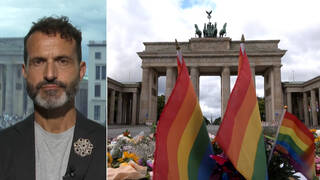
Tens of thousands gathered in Budapest on Sunday to celebrate the victory over Orbán. “Everybody was partying on the streets. Strangers were hugging each other. Music, drinks, cars honking. So, basically, it was like a street carnival for the entire night,” says Hungarian journalist and analyst Szilárd Pap, who also explains the rise of Péter Magyar and Hungary’s new opposition party.
Related Story
 StoryApr 10, 2026Ahead of Hungary Election, JD Vance Campaigns with Orbán in Show of Support for Far Right in Europe
Transcript
AMY GOODMAN: This is Democracy Now!, democracynow.org, The War and Peace Report.
In Hungary, official results from Sunday’s parliamentary elections show opposition candidate Péter Magyar won in a landslide, with more than two-thirds majority needed to amend Hungary’s constitution. Hungary’s far-right leader, Prime Minister Viktor Orbán, was defeated after 16 years in power. Magyar spoke to supporters Sunday night.
PRIME MINISTER-ELECT PÉTER MAGYAR: [translated] In the history of democratic Hungary, never before have so many people voted, and never before has a single party been given such a strong mandate as Tisza. … Thank you for believing that it can be done. Thank you for believing that we change our fate. Thank you for believing that we, ourselves, the Hungarian people, write our own history. Thank you. Thank you. Thank you.
AMY GOODMAN: Viktor Orbán was elected in 2010, making him the European Union’s longest-serving leader. His reelection campaign was supported by Russian President Vladimir Putin and the Trump administration. Last week, Vice President JD Vance traveled to Budapest to campaign for Orbán ahead of the election. Orbán conceded defeat to supporters after vote counting showed he was roundly defeated.
PRIME MINISTER VIKTOR ORBÁN: [translated] Dear friends, the election result is not final yet, but it is understandable and clear. The election result is painful for us, but clear. The responsibility and possibility of governing was not given to us. I have congratulated the winner.
AMY GOODMAN: For more, we go to the Hungarian capital, to Budapest, where we’re joined by the journalist and analyst Szilárd Pap. He is an editor with Partizán, a popular Hungarian independent media channel broadcast on YouTube.
Szilárd, welcome to Democracy Now! Talk about what happened, the significance of Orbán being defeated, and what happened in the streets last night.
SZILÁRD PAP: Yes, so, an entire one-generation rule of Viktor Orbán has ended yesterday. And I walked around after we closed our election night broadcast. I walked around the city for two hours, and everybody was partying on the streets. Strangers were hugging each other. Music, drinks, cars honking. So, basically, it was like a street carnival for the entire night.
AMY GOODMAN: So, talk about what happened, how was he defeated, and who Péter Magyar is.
SZILÁRD PAP: So, in order to understand the Hungarian political situation, I think we have to understand what was the forces that brought Viktor Orbán to this very long period in power. And I think here we have to see — on one hand, we have to see the kind of, like, generalized disillusionment of Hungarian people with the results of the liberal transition after communism in 1989. So, the promises of this democratic transition were not kept up. And afterwards, around the 2008 financial crisis, the signs of generalized economic mismanagement were also seen. And so, basically, Orbán promised to right the wrongs of the first 20 years of Hungarian democracy, to end with technocracy, to end with this kind of austerity politics, and to restore somehow popular sovereignty, to give back voice and give back decision-making power to the people, and also promised security and prosperity.
And it took a lot of time to come out or to become manifest that these promises were not kept up and that he, on the one hand, continued many of the anti-labor, inequality-increasing policies of the earlier period, and he also combined this with generalized graft, corruption, economic mismanagement, plus some kind of a radical-right culture wars politics, demonizing minorities, building a border at the southern border — building a wall at the southern border of Hungary against refugees, making campaigns against LGBT people, and so forth.
And so, basically, for a period of time during the 2010s, the post-crisis global regeneration of the economy, generalized growth within the European Union, also had Hungary. So, in Hungary, there was also an increase of prosperity. Real wages were growing. Factories were opening. So there was a wave of reindustrialization, as well. And all this, for a period of while — for a period, actually managed to hide away the darker side of the government.
So, the corruption that was present, the authoritarianism that was present, and after the COVID crisis — so, the COVID crisis, the war in Ukraine, now the war in Iran, all of them caused more than four years of economic stagnation. And this more than four years of economic stagnation helped somehow disenchant Hungarians. Large part of the population of disenchanted — become disenchanted with the government.
Also, during these 16 years, the government was very much against the reform, against the improvement of public services. So, Hungary has a public education system, a public health system, public railways, buses, so public transportation, and all these infrastructures got deteriorated, active neglect by the government, basically. And by now the situation became untenable both in the state of hospitals, for example, or how the every — every generation of Hungarian students are performing worse and worse on international tests and so forth. So, these different strands came together.
And Péter Magyar, who used to be a politician in Orbán’s party, he used to be the husband of the ex-minister for justice in Orbán’s government. After a public scandal where the government basically — where it turned out that the president of the republic, which also belongs to Orbán’s party, gave pardon to a a convicted criminal who was convicted with aiding and abetting a pedophile crime ring or crime — and so, basically, because of this, this public scandal, it focused all the anger of the population, and Péter Magyar left behind his party and started talking against it.
He’s a very charismatic politician. He promises to fix public services, to fix public infrastructure. And he actually spent the last two years campaigning in the countryside, going around, holding rallies in places where the earlier opposition never actually went, to places that were considered the strongholds of Orbán’s party, and through this systematic work of building up a new movement and using the disenchantment of population with economic and social conditions, managed to defeat in a landslide victory.
AMY GOODMAN: Szilárd, Magyar’s rise began after an interview he gave to Partizán in 2024, which went viral. What did he say in that interview? Why did it get so much traction? You’re the editor of that magazine, Partizán. And then I also want to ask you about Orbán’s crackdown on the press.
SZILÁRD PAP: So, before Orbán could be actually defeated, the old, ineffective opposition had to be defeated. So, by 2022, the separated or fragmented left-wing and liberal opposition parties became unrepresentative. They lost an election for the fourth time, so in a landslide again, in 2022. And so, there was a — in the anti-Orbán camp or the anti-Orbán electorate, there was a generalized disenchantment. And they were looking for a new vessel, a new politician to represent their views, to represent their desire to fight the government. And so, basically, Magyar became this person.
When he came into our studio, he talked about the fact that — the generalized corruption of the system and the unresponsiveness, intransparency, and the unresponsiveness of the government is actually hurting Hungary. And so, basically, what he said is that the original promise of Orbán was not kept. And this was a message that galvanized a lot of people, coupled with the lack of effective opposition for the previous 12 years. And so, these two couple of strands came together and helped Magyar.
But when he came into our interview room, he said that he’s not planning to make an opposition party. And it was a gradual learning process for him, as well. So, initially, he just started as some kind of a whistleblower, a dissident from a party. And gradually, in a couple of months, he realized that the popular forces are pushing him towards actually forming a party, actually forming a movement. And so, by the summer, it became clear that he’s going to form a party.
AMY GOODMAN: Szilárd —
SZILÁRD PAP: This is in 2024.
AMY GOODMAN: Szilárd Pap, I wanted to end by asking you about Trump’s role. You know, he’s a close ally, Orbán was. In the last days, Vance is sent, the vice president. How was he perceived? And what did it mean for Trump to go as a benefit to a liability?
SZILÁRD PAP: Yeah, so, basically, Viktor Orbán was one of the first global politicians to endorse Donald Trump in 2015, and so there was like a very strong relationship, at least in the media. This is how the government media portrayed here.
And the war in Ukraine is a very important problem for Hungarians. It caused a lot of anxieties here. It’s just over the border, Hungary’s neighbor, in Ukraine, so it’s a close issue. And the message that Orbán was transferring, it was that with the return of Donald Trump, peace is going to be reestablished, and all these kind of things. And it turned out that Donald Trump is not the person of peace, not the representative of peace, but he’s actually opening up new fronts, making new global problems that cause Hungarian fuel prices to rise, as well — so, like, just to refer back to your previous discussion about Iran. So, basically, it turned out that the whole Trump myth was a hoax.
And so, this is how it turned around that the majority of the Hungarian population, as the majority of the European population, so different countries in the EU, see Trump and the U.S. more and more as a competitor, as a threat to global security, as opposed to being an ally or a friend.
AMY GOODMAN: Szilárd Pap, I want to thank you for being with us, Hungarian journalist and analyst, editor with Partizán, popular Hungarian independent media channel broadcast on YouTube.
Coming up, the Trump administration fires six more immigration judges, including the judges who blocked the deportation of Tufts student Rümeysa Öztürk and Colombia student Mohsen Mahdawi. Both students advocated for Palestinian rights. Back in 20 seconds.
[break]
AMY GOODMAN: “Hog of the Forsaken” by the late folk musician Michael Hurley in our Democracy Now! studio.






 Top
Top
Media Options