





 Watch Full Show

Guests
- Aaron Glantzjournalist and author.
- Bajun MavalwallaArmy veteran recently convicted on federal conspiracy charges.
Links
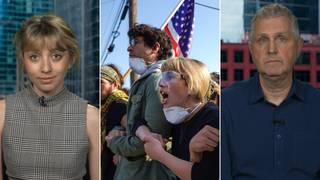
A federal jury last week convicted three people on felony conspiracy charges over their involvement in an anti-ICE protest in Spokane, Washington, last June. The “Spokane Three” are awaiting sentencing and face up to six years in prison for conspiracy to impede or injure ICE officers. They had attempted to block the transfer of a group of detained immigrants by sitting in front of a bus. Six of the nine protesters originally charged took plea deals, but the Spokane Three decided to fight the charges.
“If I had taken a plea deal, it would have essentially been me lying and saying that I did something that I didn’t do. I didn’t assault anybody,” says Bajun Mavalwalla, a U.S. military veteran and one of the Spokane Three.
“What we have here is a really large reach of the conspiracy statute,” adds journalist and author Aaron Glantz, highlighting that no officers were hurt in the June protest. “What happened was a relatively minor demonstration.”
Related Story
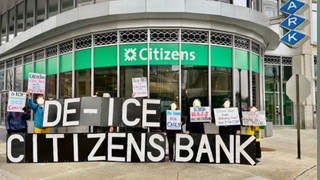
 StoryJun 01, 2026“We Closed Our Account”: Advocates Call for Boycott of Citizens Bank for Financing ICE Jails
Transcript
AMY GOODMAN: This is Democracy Now!, democracynow.org. I’m Amy Goodman.
We end today’s show with President Trump’s escalating crackdown on First Amendment rights. A federal jury last week convicted three people, including a U.S. military veteran, of felony conspiracy charges over their involvement in an anti-ICE protest in Spokane, Washington, last June. The protesters are awaiting sentencing, face up to six years in prison.
For more, we go to Spokane, where we’re joined by one of them. Bajun Mavalwalla is a U.S. military veteran in the war in Afghanistan. We’re also joined by Aaron Glantz, fellow at the Center for Advanced Study of Behavioral Sciences at Stanford University, his recent piece for The Guardian headlined “Federal jury finds army veteran and two other ICE protesters guilty of conspiracy.”
Before we go to Bajun, I’m wondering, Aaron, if you can talk about the significance of this term “conspiracy.” I want to go to a clip first of an interview that you did on PBS’s News Hour. This is former Acting U.S. Attorney General Richard Barker on PBS News Hour.
RICHARD BAKER: Nobody was really hurt. None of the protesters were hurt. Fortunately, none of the law enforcement officers were hurt, either.
AARON GLANTZ: He was aware that other U.S. attorneys had been ousted for refusing to comply with Trump Justice Department orders, and he worried about his ability to act ethically if he stayed on the job, so he resigned.
RICHARD BAKER: I didn’t feel, in this case, that a conspiracy charge, that would carry a six-year term of incarceration, was true to who I was or to who I wanted to be as a federal prosecutor.
AMY GOODMAN: So, that’s former Acting U.S. Attorney General Richard Barker, resigned, speaking to our guest, Aaron Glantz, on PBS News Hour. Aaron, so, talk about the significance of this conspiracy conviction, just before we go to the military veteran who was convicted.
AARON GLANTZ: I mean, what we have here is a really large reach of the conspiracy statute, the charge here conspiracy to impede or injure federal officers. What happened was a relatively minor demonstration at an ICE facility in Spokane, Washington. There was a Facebook post by the former president of the Spokane City Council about two Venezuelan migrants who were going to be, according to him, unlawfully deported. A federal judge ended up freeing one of those migrants, saying his arrest was unconstitutional. A number of demonstrators showed up. Bajun was one of them. He went home. He was going about his life. And then, a month later, the FBI showed up at his door, and a number of other demonstrators, and arrested them for conspiracy.
The individual you just heard from, Richard Barker, was the head of the U.S. Attorney’s Office in eastern Washington state, and he declined to sign the indictment. He resigned. When I spoke with him, he talked about the fact that here you have a case where no protesters were hurt, no ICE agents were hurt, and yet a number of the demonstrators are facing six years in prison, at the same time the killers of Renee Good and Alex Pretti in Minneapolis have not been prosecuted at all, and he did not feel good about that. He talked to me about being a Sunday school teacher and needing to go before, you know, his fellow church members and talk to them about right and wrong, and he didn’t think he could stay in his job.
And I think that that’s ultimately what this case is about and what you’re going to hear from Bajun in a second. I was really impressed with him the whole time I’ve been covering this case over the past year, as somebody who signed up to serve his country in Afghanistan in 2021 when Afghanistan fell to the Taliban, helping individuals come to this country to avoid being killed by the Taliban, who helped the U.S. military, and then standing up for some of his fellow residents in Spokane when the Trump administration tried to unlawfully deport them, always standing up and now facing six years in prison.
AMY GOODMAN: So, let’s go to Bajun Mavalwalla. This is your first interview since your conviction for aiding the conspiracy, for taking part in this ICE protest. Bajun, six of the nine people originally charged took plea deals, but you, Archer and Forral decided to fight. Now you’ve been convicted. Your response and why you decided to go to trial?
BAJUN MAVALWALLA: Yeah, I definitely felt like it was important to go to trial, because if I had taken a plea deal, it would have essentially been me lying and saying that, you know, I did something that I didn’t do. I didn’t assault anybody I didn’t destroy any property. And the protest was largely peaceful. And I felt that it was very important to put that in front of a jury. And I think it’s important to note that I was convicted of aiding and abetting, which was not included in the original indictment that I was arrested for back in July of last year.
AMY GOODMAN: Talk about why you decided to engage in this protest. You’re a former U.S. Army — you’re a U.S. Army combat veteran. You served in Afghanistan. Why put yourself on the line here?
BAJUN MAVALWALLA: I believe very strongly in the importance for people to be able to immigrate to the United States, for asylum seekers to find safety here. And I also very strongly believe in the people’s right to address their government for things that they believe is wrong. And I saw a post on Reddit that said, you know, “Hey, these people are being unlawfully detained.” And I had time, and I said, “You know, what? I’m going to go down and do what’s right. I’m going to go and tell them, 'Hey, I do not agree with this. I think this is wrong.'”
AMY GOODMAN: Inspired by your arrest, your father, who we talked to, announced his congressional run in January, will appear at a forum with other candidates Tuesday night. Have you heard from the incumbent congressman, Michael Baumgartner, since your conviction?
BAJUN MAVALWALLA: I have not heard anything from him. I’m not sure if he’s made a statement or not.
AMY GOODMAN: And can you talk about your involvement since you were in Afghanistan in helping Afghan refugees come to this country, how you got involved with this work, and how it inspired you to stand up against ICE?
BAJUN MAVALWALLA: My dad also deployed to Afghanistan around the same time that I did. And there was a — one of the guys that he had trained while he was there, he managed to get on one of the planes leaving as Kabul was falling, but his wife and young children were not able to. My dad asked if I could help to see if we could find a way to get them out of the country. And it just kind of snowballed from there. I mean, we ended up — at one point, we had about 200 people on the list that we were trying to track, and we had to really significantly pare that down, because we never [inaudible] —
AMY GOODMAN: We have 10 seconds.
BAJUN MAVALWALLA: So, I thought, you know, “Hey, this is something that’s really important to do.” I wanted to help those people.
AMY GOODMAN: Bajun Mavalwalla, I want to thank you so much for being with us, and Aaron Glantz, fellow at the Center for Advanced Study of Behavioral Sciences at Stanford University. We’ll link to your article in The Guardian, “Federal jury finds army veteran and two other ICE protesters guilty of conspiracy.” I’m Amy Goodman.



 Top
Top
Media Options