








 Watch Full Show

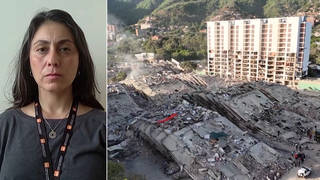
Thousands are feared dead in Venezuela after back-to-back powerful earthquakes struck the country Wednesday evening, collapsing buildings in the capital Caracas and surrounding areas. Venezuela’s acting President Delcy Rodríguez has declared a state of emergency as rescue workers frantically search for survivors in the rubble of “dozens” of collapsed buildings. Historian Alejandro Velasco, who has family in Venezuela, reports that “many Venezuelans abroad are trying to get in touch with their loved ones in Venezuela and are having a hard time doing so.”
The current death toll is at 164, with 1,000 people injured, but the U.S. Geological Survey warns there’s a high chance the death toll could rise into the tens of thousands — or even top 100,000.
Related Story
 StoryJun 30, 2026“Keep Supporting the Venezuelan People”: Thousands Missing as Earthquake Rescue Efforts Continue
Transcript
NERMEEN SHAIKH: We begin today in Venezuela, where thousands are feared dead after back-to-back powerful earthquakes struck the country Wednesday evening, collapsing buildings in the capital Caracas and surrounding areas. Venezuela’s acting President Delcy Rodríguez has declared a state of emergency as rescue workers frantically search for survivors in the rubble of “dozens” of collapsed buildings. The current death toll is at 164, with a thousand people injured, but the U.S. Geological Survey warns there’s a high chance the death toll could rise into the tens of thousands, or even top 100,000.
AMY GOODMAN: The first earthquake registered 7.2 on the Richter scale and was followed less than a minute later by an even more powerful 7.5-magnitude earthquake. It’s the most powerful earthquake to hit Venezuela in a century. This is acting President Delcy Rodríguez speaking on state television earlier today.
ACTING PRESIDENT DELCY RODRÍGUEZ: [translated] I want to inform that the state most affected by this incalculable seismic phenomenon is La Guaira state. There are dozens of collapsed buildings, and we are at this moment working very hard in rescue operations to save the lives that God permits us to save.
NERMEEN SHAIKH: On Wednesday night, Caracas resident Avilio González returned home to find his building completely destroyed.
AVILIO GONZÁLEZ: [translated] Fortunately, my family, my wife, my granddaughter and I, were out of the apartment building. When we got back, we saw it was completely destroyed. Luckily, the neighbors managed to save their lives, too. What can I say? How many families are going to end up like this with destroyed buildings in Caracas?
AMY GOODMAN: Another Caracas resident, María Alejandra, was inside a building when the quakes hit.
MARÍA ALEJANDRA: [translated] I was here when I managed to get dressed. He helped me. And all the walls were cracked. We managed to open the door however we could. There was a cloud of smoke that wouldn’t let us see. And when we went downstairs, the scene was like a horror movie.
AMY GOODMAN: For more, we’re joined by Alejandro Velasco, associate professor at New York University, where he’s a historian of modern Latin America. Velasco is a former executive editor of NACLA Report on the Americas, author of Barrio Rising: Urban Popular Politics and the Making of Modern Venezuela. He was born and raised in Venezuela, has been in touch with his friends and family there.
Thanks so much for joining us as you drive here in the United States. What is the latest you’ve heard, Alejandro?
ALEJANDRO VELASCO: [Thank you] so much for having me and for keeping track of this story.
I mean, the latest is, of course, that things are fast moving, and my friends and family there are just in a state of shock, you know, not only for the images that we’re seeing, but just like the utter devastation on top of what has already been a really difficult six months in Venezuela, or more. And so, the source of concern, people are desperately trying to find loved ones. There’s also, of course, folks — so many Venezuelans are abroad who are trying to get in touch with their loved ones in Venezuela and are having a hard time doing so. It took me about 45 minutes to get a hold of my dad, who lives about an hour and a half west of Caracas. Thankfully, he’s safe. But, yeah, what we’re hearing now is that people are just completely in shock and are desperately trying to find out any news about their loved ones and relatives.
NERMEEN SHAIKH: And, Alejandro, how prepared is Venezuela, in general, for seismic activity? Given its location, it is especially vulnerable.
ALEJANDRO VELASCO: That’s correct. You know, the last major earthquake to hit the capital region was in 1967. At the time, there was upwards of 300 fatalities and over 1,500 injured. Buildings collapsed. This is, as Amy mentioned, the strongest earthquakes that have been recorded in over a hundred years.
And so, in terms of preparation, yes, Venezuela, especially on the Coastal Range region, is not unprepared for seismic events, but, of course, the infrastructure and the security efforts, but also just in terms of the personnel, because of the economic and political crisis that we’ve had in Venezuela for so long, you know, especially for something of the scale that we’re seeing right now, it’s no match for the devastation.
And so, it’s been gratifying to hear from neighboring countries, even those that have had, you know, very significant ideological opposition to Venezuela, like the new government in Chile, saying that they are ready to deploy assistance, whether it be personnel or materiel, to Venezuela. So, that, at least, has been really quite gratifying to see.
NERMEEN SHAIKH: And there have also been reports, Alejandro, of disruptions, understandably, disruptions to the internet. So, is it possible that we don’t really know the extent of the damage in areas outside Caracas?
ALEJANDRO VELASCO: That is absolutely the case. And it is also true that, again, amidst the economic crisis of Venezuela, I’d say it’s been mostly Caracas that has kind of lived in a little bit of a bubble in terms of services, in terms of attention to infrastructure and whatnot, and it’s the outer regions, the provinces, where there’s far less attention paid. And so, you know, some reports that we’re getting out of further-out states, like Bolívar, suggest that there’s significant militarization and control of information, and so it’s certainly possible not only that we don’t know the extent of the damage, but even if we had perfect internet connection, even in that situation, I think the extent of the earthquake and the devastation is going to take us days, if not weeks, to really get a hold of.
AMY GOODMAN: And finally, Alejandro, since we have you on and you’re a historian of modern Latin America, your response to, it looks like, in Colombia, the right-wing candidate, de la Espriella, has been announced the winner of the presidential election there to replace the leftist President Petro, and that Fujimori is poised to take control of Peru?
ALEJANDRO VELASCO: Yeah. I mean, we’re seeing, I think, in Latin America the pendulum swing, which began a few years back with Bukele in El Salvador, and then Milei in Argentina. You know, obviously, the left has been in significant turmoil for some years, and that has affected economic development in several countries. And so, in some ways, what we’re seeing is a kind of shift to the populist right.
I think what’s really significant about Colombia, in particular, of course, is that the election was so tight. And we’re getting reports now that the margin of victory really was held, as in the case of Peru, by Colombians living abroad. And so, I think that’s suggesting something about the shifting dynamics of electoral politics and power plays in Latin America, where it’s not so much the domestic constituencies that are calling the significant shots, but it’s the expatriate constituencies, which have very different interests and alignments that they are motivated by. And, of course, in the case of Colombia, the closeness of the election also suggests that it’s going to be — even beyond the pendulum swing from left to right, it’s already going to be extremely difficult to govern in a situation where the incoming president had such a narrow mandate of victory.
AMY GOODMAN: Alejandro Velasco, we thank you so much for being with us at this breaking news in Venezuela. I hope that your family is OK, your father right near the epicenter of the quakes. Alejandro Velasco, associate professor at NYU, where he’s historian of modern Latin America, former executive editor of NACLA Report on the Americas and author of Barrio Rising. Thanks so much for being there.
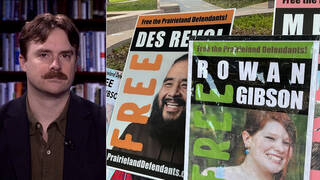
Coming up next, the Prairieland case. A federal judge has handed down prison sentences ranging from 30 to 100 years for a group of anti-ICE protesters. Stay with us.
[break]
AMY GOODMAN: “Contra Todo,” “Against Everything,” by the Puerto Rican singer and songwriter iLe, performing in our Democracy Now! studio.



 Top
Top
Media Options