










 Watch Full Show

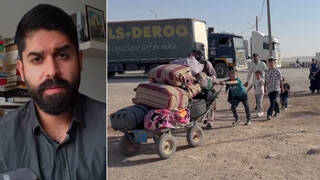
Yemen is at risk of spiraling back into all-out war as Houthi forces and Saudi Arabia exchange new strikes amid a fight over control of the key Bab al-Mandab Strait, through which much of Saudi oil passes on its way to world markets. The Houthis, the Iran-allied force also known as Ansar Allah, has seized Yemen’s entire Red Sea coastline from the Saudi-backed Yemeni government. The United Nations says the latest escalation has displaced 86,000 people in Yemen as the U.S. war on Iran continues to wrack the Middle East and raise oil prices around the world.
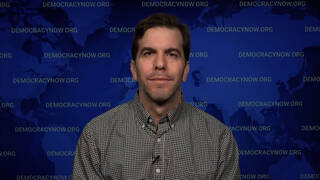
“What’s happening right now is essentially a break in the ceasefire between Ansar Allah … and Saudi Arabia,” says Shireen Al-Adeimi, a Yemeni American associate professor at Michigan State University. “This ceasefire has been in place since 2022, but it has not ended the war in Yemen.”
Related Story
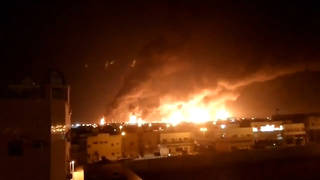
 StorySep 16, 2019Saudi Oil Refinery Attack Raises Fears of “Wider Regional War” Involving U.S. & Iran
Transcript
AMY GOODMAN: This is Democracy Now!, democracynow.org. I’m Amy Goodman.
Fear is growing Yemen is spiraling back into all-out war as Houthi forces and Saudi Arabia exchange new strikes. Earlier today, the Houthis claimed to have launched a drone and missile strike on a military base in southern Saudi Arabia. This comes after the Houthis, who are aligned with Iran, seized Yemen’s entire Red Sea coastline, including the strategic Bab al-Mandab Strait. The area had been controlled by the Saudi-backed Yemeni government. In recent days, Saudi Arabia has repeatedly launched airstrikes in Yemen in an effort to stall the Houthi advance. The U.N. says the latest escalation has displaced 86,000 people in Yemen. This all comes as Saudi Arabia shut down its major East-West pipeline after a drone strike launched from inside Iraq. It moves about 4% to 5% of the world’s global supply, oil supply.
To look at the escalating tensions between the Houthis and Saudi Arabia, we go now to Shireen Al-Adeimi, an associate professor at Michigan State University.
Professor, thanks so much for being with us. Can you explain what’s happening right now in Yemen and the relationship between Yemen and Saudi Arabia as it relates to the U.S.-Israeli attack on Iran?
SHIREEN AL-ADEIMI: Thanks so much for having me.
So, what’s happening right now is essentially a break in the ceasefire between Ansar Allah, who are known as the Houthis, and Saudi Arabia. The ceasefire has been in place since 2022, but it has not ended the war in Yemen. As you know, Yemen has been under a blockade by the Saudi forces, of course fully backed by the United States — the fourth administration now in the United States that’s been supporting the Saudis and has devastated Yemen. They had a bombing campaign that lasted for eight years, and the blockade has not been fully lifted. So, even though flights were operating in and out of Sana’a Airport, it was limited by Saudi Arabia to one flight a week, and everything coming in and out of the country still went through Saudi Arabia. Essentially, the blockade was still in place.
In recent months, there has been an escalation. Saudi Arabia was threatening Yemen to not break the blockade by operating a flight to Tehran, and as a response, they bombed Sana’a Airport. And so, since then, fighting has essentially escalated. And Ansar Allah have now, as you said, taken over the entire west coast of Yemen. They had been controlling Bab al-Mandab, as you know, and there’s an active ceasefire between the United States and Ansar Allah since May of 2015, when they were blocking international shipping as a response to the genocide in Gaza. But now they fully control the coast, and it’s very easy for them to disrupt shipping. But the key point here is that they’re not disrupting international shipping. They say that they are disrupting Saudi ships so that Saudi can finally lift the blockade on Yemen and not continue using Bab al-Mandab Strait as they wish.
AMY GOODMAN: And can you explain the difference between the Yemeni government and the Houthis?
SHIREEN AL-ADEIMI: So, what’s called the Yemeni government is the Saudi-appointed council. This is referred to as the internationally recognized Yemeni government, and that’s a misnomer, because they were not democratically elected. They were appointed. They’re a group of warlords in Yemen who are allied to Saudi Arabia, and some of them are allied to the UAE. And when I say “allied” here, I mean fully funded, completely funded, based in either Saudi Arabia or the UAE, although most of them are now based in Saudi Arabia. So, that is called the internationally recognized government. They are a hodgepodge of groups. They are — some of them are funded by the UAE, as I said, and they want to secede south Yemen from the north, so they’re not interested in capturing, let’s say, areas of northern Yemen that Ansar Allah control. And then there are groups that are allied to the former government that was in Yemen before the Arab Spring and before the war with Saudi Arabia in 2015, and they want to recapture areas that were captured and have remained in control of Ansar Allah. And then there are extremist groups and terrorist groups who are also part of that coalition. So, that is what’s called the Yemeni government.
If you ask 80% of the Yemeni population — that’s over 30 million people — who live in Ansar Allah-controlled areas, they will refer to Ansar Allah as the Yemeni government, because even though they started as rebels back in 2014, 2015, they have essentially built a state in northern Yemen over the last decade and have been running all of the ministries. They represent, it seems like, the will of the majority of the Yemeni people, since the security situation, as an example, in northern Yemen, where they control, is very much stable compared to the south. And they have worked with tribal communities and groups in northern Yemen to secure kind of on-the-ground buy-in. And that’s one of the key reasons they were also able to take over the west coast.
AMY GOODMAN: Shireen Al-Adeimi, I want to thank you for being with us, Yemeni American associate professor at Michigan State University, speaking to us from East Lansing in Michigan.
That does it for our show. I’ll be at the IFC theater on September 22nd for the screening of Steal This Story, Please!, about Democracy Now!, with Tia Lessin and Carl Deal, the directors. Check it out at democracynow.org. I’m Amy Goodman. Thanks for joining us.



 Top
Top
Media Options