





 Watch Full Show

Guests
- Katie Fallowdeputy litigation director at the Knight First Amendment Institute at Columbia University.
News organizations CNN, MS NOW and Politico are suing the Trump administration over the banning of their reporters from the White House on Friday. Their credentials were confiscated or deactivated when they attempted to enter White House grounds over the weekend. Trump’s decision is “sending the message that if you write stories that are critical of the president, you’re going to lose your access,” says Katie Fallow, a deputy litigation director at Columbia University’s Knight First Amendment Institute, where she focuses on threats to freedom of speech and of the press. “The real victims of this war on the press are members of the public, which are entitled to know about what their government is doing.”
Fallow says the White House press briefing room is a “public forum” and that “the courts have said repeatedly the government is not allowed to kick people out of that forum based on their viewpoint.”
Related Story
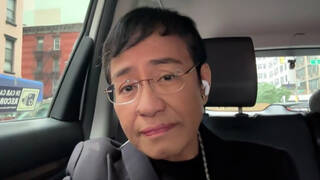
 StorySep 24, 2026Nobel Laureate Maria Ressa on Trump’s Media Ban, Regulating AI & the “Tech Coup in Plain Sight”
Transcript
AMY GOODMAN: MS NOW, CNN and Politico are filing a First Amendment lawsuit today after President Trump banned them from the White House press pool over the weekend. An emergency request to restore their access is set to appear before a federal judge in Washington, D.C. A decision could come as soon as this week.
In a joint statement, the outlets said, quote, “Without notice or process, the White House revoked our journalists’ credentials because it objected to our reporting. … Left unchallenged, this threatens press freedom and the public’s right to independent journalism free from government interference,” unquote.
Meanwhile, it’s been reported this morning Trump has also removed CNN from a pool of TV journalists scheduled to travel with him to the United Nations General Assembly in New York, which starts tomorrow. He’s here today in New York. Trump took to Truth Social Friday to announce the ban, accusing the outlets of reporting ”FAKE NEWS,” ”FICTION and LIES.”
On Saturday, journalists with the outlets confirmed their badges were confiscated when they attempted to enter the White House. This is veteran CNN correspondent Betsy Klein describing what happened.
BETSY KLEIN: So, I walk in. I tap my badge, and it beeps a couple of different times. It turns red, blue and green, and it didn’t accept my PIN number. The Secret Service agent in the guardhouse, with whom I have been friendly in the past, asked to see my badge, and I handed it over to him. He told me that it had been deactivated. I asked him if he could provide an explanation as to why it had been deactivated. He said he had no further information. I asked him once more if he had any more details he could share with me, and he said that I should be referred to the White House Press Office, to the wranglers, for more information. I asked if I could have the badge back. He said he would be keeping it. He did, however, hand me back this clear case with a lanyard that it came in. I also collected my things and then returned out the gate that I had come through. But we had heard President Trump earlier this week say that he was going to ban CNN, MS NOW and Politico from White House grounds, the president clearly following up on that promise.
AMY GOODMAN: President Trump has also threatened to ban other news outlets from the White House, including The New York Times and The Washington Post. NBC correspondent Kelly O’Donnell questioned Trump during a news conference.
KELLY O’DONNELL: Mr. President, earlier today you posted that you intend to ban CNN, Politico and MS NOW from the White House.
PRESIDENT DONALD TRUMP: Yeah.
KELLY O’DONNELL: Every president takes an oath to uphold the Constitution —
PRESIDENT DONALD TRUMP: Yeah, I do, too.
KELLY O’DONNELL: — which includes the First Amendment.
PRESIDENT DONALD TRUMP: I do, too. Much more so —
KELLY O’DONNELL: How do you justify this ban?
PRESIDENT DONALD TRUMP: Much more so than you.
KELLY O’DONNELL: Is this —
PRESIDENT DONALD TRUMP: Because they’re fake news. You get so tired of reading and seeing fake news. … There’s something wrong with a country that can allow people to write purposely negative stories. Now, if they want to write them, that’s fine. But I don’t have to let them into my — into the people’s house. … A very simple ban. I don’t want them in my office. I don’t want them here. I would say the ban would go as far as you can. … So, we are banning them. Yes, we are. And there may be others to follow. …
CATHERINE LUCEY: What do you mean by others to come? And how is this ban going to work?
PRESIDENT DONALD TRUMP: Others to come in terms of fake news?
CATHERINE LUCEY: Yes. And [inaudible] —
PRESIDENT DONALD TRUMP: Well, you know, look, The New York Times is fake news. Washington Post is fake news. They’re crummy papers, both doing very poorly, by the way. But we’ll see. We’re probably not going to display the paper anymore in the White House, those papers, but we haven’t taken the step of throwing them out. But they’re fake news, totally. New York Times is so fake. Washington Post is disgusting. I mean, they’re disgusting. I don’t get it. Why would they be? You know, we’re doing so well, and they’ll take the most positive story and make it as negative as possible.
AMY GOODMAN: That was Bloomberg correspondent Catherine Lucey who asked Trump about his intentions to ban more media outlets, and, before that, NBC News correspondent Kelly O’Donnell questioning President Trump.
Well, for more, we’re joined by Katie Fallow, deputy litigation director at the Knight First Amendment Institute at Columbia University, where she focuses on threats to free speech and a free press.
Talk about what’s happened, the banning of CNN, MS NOW and Politico. At least for now, it’s those three organizations. And now they’re announcing that they are suing the White House today.
KATIE FALLOW: Yeah, exactly. I mean, this latest step on Friday was just the latest in President Trump and his administration’s onslaught against the press. And he obviously had tried to throw out Jim Acosta from CNN during his first administration, but all of his attacks on the press have greatly increased in his second administration. So —
AMY GOODMAN: And in the Jim Acosta case, Ted Boutrous represented him. He got his credentials back. And Ted Boutrous is representing MS NOW, CNN and Politico in today’s lawsuit.
KATIE FALLOW: OK, yes, exactly. And Ted has been involved in a lot of these cases against the administration.
But, you know, what he did is also — follows his excluding the AP from the press pool. I think it’s important to sort of see that there’s two different kinds of press forums that are at issue here. So, there’s the wider press corps, which are the journalists that get hard passes, go into the White House, have certain areas where they can work out of, and then can go into the Brady Press Briefing Room. And then there’s a much smaller group called the press pool, which is allowed to go, at the invitation of the White House, into smaller areas, like the Oval Office, and to travel with the president. And they are potentially different kinds of forums. But in any event, Trump has last year kicked the AP out of the press pool because the AP refused to use the word, the term, “Gulf of America” rather than “Gulf of Mexico.”
AMY GOODMAN: And so, they can’t go into the Oval Office or be on Air Force One.
KATIE FALLOW: Correct. And then, but what the — what Trump did on Friday was even more extreme, arguably, from a First Amendment perspective, because he completely banned CNN, MS Now and Politico from even using — as we saw, using their press pass to go into the White House and even report from the press briefing room. And that area is a public forum, as the Court of Appeals in D.C. has held for decades, that the White House has invited members of the press to come in, to allow them to report to the public. And as the courts have said repeatedly, the government is not allowed to kick people out of that forum based on their viewpoint.
AMY GOODMAN: So, you also have this press pool that CNN was — it’s a rotating pool for the broadcasters, so one camera can, you know, be set up, and they give the video to everyone else. It’s CNN, CBS, NBC, ABC and Fox. Today, CNN was the one, and President Trump’s come here to — is coming here to New York. And the question is: Will the others not replace them, and there won’t be video of President Trump then?
KATIE FALLOW: I mean, I think that’s a question of —
AMY GOODMAN: If they will join in solidarity.
KATIE FALLOW: Exactly. What is the actions of the other news outlets? I mean, you saw when the AP was banned from the press pool, a lot of other news outlets, including Fox, made statements saying, “This is against the First Amendment, and we stand in support of AP.” On the other hand, they’ve still been participating in the press pool and all of the members of the Washington — in the White House press corps.
AMY GOODMAN: And the head of the White House Correspondents’ Association now is Fox.
KATIE FALLOW: Exactly. And she came out very strongly in her statement this weekend, and I think that’s good. And I think you see, over the past year, some more willingness among major news outlets to push back against Trump.
AMY GOODMAN: So, let’s go to one of the statements. On Saturday, the senior White House correspondent for Fox News, the current White House Correspondents’ Association, WHCA, president, Jacqui Heinrich, criticized Trump’s ban. She wrote on social media, quote, “Today’s action revoking access for journalists from CNN, POLITICO, and MSNOW violates the First Amendment. The implications extend beyond these organizations: a standard used to exclude one news outlet because of its coverage could be applied to any outlet in the future… The American people, through a free and independent press, must be able to scrutinize those elected to power, regardless of whether government officials view it favorably… That’s why courts have repeatedly held that once the White House provides access to journalists, it cannot deny that access arbitrarily or based on the content of their reporting. The WHCA calls on the administration to immediately restore our colleagues’ access.” Again, that was Jacqui Heinrich, who is the head of the White House Correspondents’ Association, is with Fox. And it’s just what you said, but what are they going to do about it? Would they clear out of the White House press room and say, “We’re not going to report on President Trump,” which is so important to President Trump? Also, there’s no White House press secretary, and there hasn’t been since Karoline Leavitt stepped down.
KATIE FALLOW: Yeah, I mean, it does feel like things are in disarray, to some extent, in the White House. But I think the main issue is that you have the president, who doesn’t like certain news outlets, because he said it explicitly — he’s not trying to hide it — that he doesn’t like when they report on him negatively. And that’s a problem for several reasons. First of all, obviously, it discriminates against the individual press outlets that are — in their reporting. Second of all, it creates a chilling effect on other members of the news media, which is sending the message that if you write stories that are critical of the president, you’re going to lose your access.
AMY GOODMAN: And let’s remember what happened at Stars and Stripes. A publisher, editor and reporter at the federally funded news organization Stars and Stripes are suing the Pentagon, claiming Defense Secretary Pete Hegseth and other top officials had them fired over their critical reporting. The firings came after Stars and Stripes broke news about poor conditions, low morale and mental health crises aboard the USS Abraham Lincoln during its unprecedented deployment to the Middle East. President Trump called the reports fake news. In April, the White House fired Stars and Stripes independent ombudsman Jacqueline Smith without an official reason. And, of course, we know that Hegseth tried to make reporters sign an oath to be inside the Pentagon, which many reporters across the political spectrum refused to do.
KATIE FALLOW: Yeah, and that’s terrible. And the real, like, victims of this, you know, war on the press are members of the public, which are entitled to know about what their government is doing, particularly on really important issues like how the war is going or what the conditions are on a warship. And Stars and Stripes has, for decades, provided really important reporting on the military. And it is funded by the government, but there’s been a long-standing intention to protect it from this kind of government meddling in what their editorial viewpoint is, because the result, particularly at the Pentagon, is you had all of the Pentagon press corps turn in their badges rather than sign this, you know, pledge that would have required them to only — to essentially agree to only report on things that the Pentagon had authorized. And then, the end result is you essentially have a press corps now in the Pentagon that is made up of just supporters of the Trump administration, like MyPillow guy and Laura Loomer. And again, you know, the public is the one that is suffering the most from this.
AMY GOODMAN: So, that’s the critical point, and I want to end with this point, is that the First Amendment is not just about the freedom of the press. It’s about the public’s right to know.
KATIE FALLOW: Exactly.
AMY GOODMAN: Katie Fallow.
KATIE FALLOW: Exactly. It’s about the public’s right to know, to hear critical information, and to criticize their government and to hold their government representatives to account.
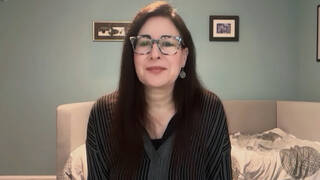
AMY GOODMAN: I want to go to Tatyana Margolin. Democracy Now! reached her, co-director of STROIKA, a nonprofit whose mission is to counter rising authoritarianism globally. This is some of what she said about Trump’s media ban.
TATYANA MARGOLIN: My name is Tatyana Margolin, and I’m the co-founder of an organization called STROIKA. We work on connecting anti-authoritarian movements around the world.
What we just saw President Trump do by restricting access to three U.S. media outlets to the White House is not at all surprising for anyone who has been watching authoritarians around the world. This is a very common tool in the authoritarian toolbox. For example, Vladimir Putin of Russia also gradually restricted journalists’ access, but not only to the truth, but to himself. It began somewhat innocuously by reporters in the Kremlin press pool being excluded for allegedly inappropriate behavior or asking unauthorized questions. But over time, the Kremlin turned the press pool into a kind of theater, where journalists were basically reduced to playing the role of extras to the Putin show. And in recent years, we’ve even heard stories of journalists and reporters filing reports about Putin’s events without even attending them, because it has become unnecessary to even be there. Everything is completely predictable.
AMY GOODMAN: Tatyana Margolin, co-director of STROIKA, speaking to Democracy Now! this weekend. Your final response, Katie Fallow?
KATIE FALLOW: Yeah, I think she exactly points out that Trump is often playing from the authoritarian’s playbook of trying to shut down any negative coverage of him or his policies. And what sets the United States, hopefully, apart from those regimes is the First Amendment and the protection, that is enforced by the judiciary, of the right to report on and to criticize the government. And I’m hopeful that the courts quickly overturn his ban, and I hope that the White House abides by it.
AMY GOODMAN: Katie Fallow, deputy litigation director at the Knight First Amendment Institute at Columbia University, where she focuses on threats to free speech and a free press. To see our interview with the head of the Knight Institute, Jameel Jaffer, go to democracynow.org.
This is Democracy Now! When we come back, we’ll talk about migrants who were sent to a country they have nothing to do with: Equatorial Guinea. Stay with us.
[break]
AMY GOODMAN: “Fenfo,” “Something to Say,” by Fatoumata Diawara, performing in our Democracy Now! studio.



 Top
Top
Media Options