









 Watch Full Show


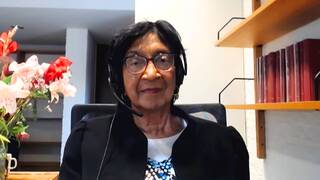
Seydina Moussa Ndiaye is a member of the Global Partnership on Artificial Intelligence, working on a strategy with the African Union to address the risks and benefits of AI for the continent. African countries face the threat of “colonial AI,” says Ndiaye. “When we talk about colonialism historically, that involves the control of resources, the control of knowledge and the control of terms of exchange, and we see that in Africa when we talk about AI.”
Related Story
 StoryOct 15, 2026“Hyperscale”: Paris Marx on Excess of Big Tech Data Empires & His Critique of Bernie Sanders’ AI Bill
Transcript
AMY GOODMAN: This is Democracy Now!, democracynow.org. I’m Amy Goodman, with Nermeen Shaikh.
NERMEEN SHAIKH: For a Pan-Africanist perspective on the risks and benefits of AI for Africa, our next guest is working on a strategy with the African Union for the risks and benefits for the continent. We’re joined now by Seydina Moussa Ndiaye. He’s a member of the Global Partnership on Artificial Intelligence and a senior lecturer at Cheikh Hamidou Kane Digital University in Dakar, Senegal.
So, welcome, Seydina, to the program. If you could just lay out the concerns in Africa about the way in which artificial intelligence is being deployed and may be deployed in the future?
SEYDINA MOUSSA NDIAYE: Thank you. Thank you for the invitation.
And I think that for — in a African perspective, we have what we call, first, the global impact, so we have the same threat than we heard about. We can apply it in each continent. But we have also another threat, which I can call the colonial AI, the colonialism AI, because when we talk about the colonialism historically, that involves the control of resources, the control of knowledge and the control of terms of exchange, and we see that in Africa when we talk about AI, when we could have the control on compute, the control on data flow, on standards, even on talent, which can move out of Africa very easily and leave Africa without talent.
So, in this case, we have a continent we cannot have a control on what’s going on in the ground. If we think about controlling AI solution which can have in Africa, most of the countries cannot do that, because there’s no capacity in Africa. And being permanent consumer is another threat, because if we don’t create also our own AI solution, it could be very, very bad for Africa also.
AMY GOODMAN: Seydina, you are an adviser to the African Union. You’ve said the biggest threat is colonization by AI. What does that mean?
SEYDINA MOUSSA NDIAYE: This means that, you know, when we talk about colonization historically, it could be the control of all resources, knowledges and terms of exchange. And we have it in Africa when we talk about AI, because right now we have a lot of countries in Africa having their own national AI strategy, but the implementation is not here because they don’t have capacity. And the way we have the other countries helping the African continent to implement their own strategy, it’s not the good way, because, how we see, mostly we have partners which we would have control on the data, and we just want to apply technology build elsewhere, and it will not work if we don’t have our culture inside the AI solution we are using and our own way to control it.
NERMEEN SHAIKH: And do you think it has any potential benefits in, for example, agriculture or the health sector?
SEYDINA MOUSSA NDIAYE: Of course. It’s the same than everywhere. We can have precise healthcare. We can have precise agriculture. In education sector, we could have our individual pathway to learn. In cultural also, we can use AI to have cultural preservation. And we are doing it a lot. And so, it’s the same than everywhere else, I think, for the benefit.
AMY GOODMAN: Finally, we just have 30 seconds.
SEYDINA MOUSSA NDIAYE: Yes.
AMY GOODMAN: But this idea of AI with an African perspective, that you’re also bringing to these U.N. side meetings this week, what that means?
SEYDINA MOUSSA NDIAYE: That means that if you think about AI, it’s not — it’s built by bias. You know, it’s built by a lot of data coming from elsewhere. And, you know, that makes Africa using AI with another context. And sometimes you use it, but you’re infusing another culture in your culture, and it’s very difficult for some countries to build their own solutions. So, they’re keeping to use open-source solution, but it’s built with other data.
AMY GOODMAN: Well, interestingly, no African country has a seat on the U.N. Security Council, something that the U.N. Secretary-General António Guterres says should be reformed. We want to thank you so much for being with us, Seydina Moussa Ndiaye, member of the Global Partnership on Artificial Intelligence, has worked with the African Union on the development of the Pan-African AI strategy. We thank you for being with us.
Coming up, Jacob Silverman, author of Gilded Rage: Elon Musk and the Radicalization of Silicon Valley. Stay with us.
[break]
AMY GOODMAN: “The World Turned Upside Down” by the British musician Billy Bragg. I’ll be in London tomorrow, Friday, for the screening of Steal This Story, Please!, speaking afterwards, and also on Monday, and then on to Copenhagen and Berlin. You can check our website at democracynow.org. I’m Amy Goodman, with Nermeen Shaikh.





 Top
Media Options