Sami al-Haj is a free man today, after having been imprisoned by the U.S. military for more than six years. His crime: journalism. Targeting journalists, the Bush administration has engaged in direct assault, intimidation, imprisonment and information blackouts to limit the ability of journalists to do their jobs. The principal target these past seven years has been Al-Jazeera, the Arabic television network based in Doha, Qatar.
Filed under Weekly Column
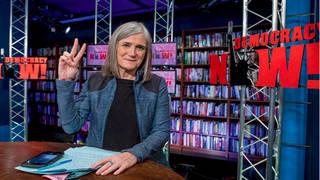
Democracy Now! has been selected as an Official Honoree at the 12th Annual Webby Awards in three categories: News, Political and Podcast.
Filed under D.N. in the News
Food riots are erupting around the world. Behind the hunger, behind the riots, are so-called free-trade agreements, and the brutal emergency-loan agreements imposed on poor countries by financial institutions like the International Monetary Fund.
Filed under Weekly Column
Amy Goodman appeared on The Tavis Smiley Show Thursday on PBS discussing her new book. Watch excerpts of the interview.
Filed under D.N. in the News
As the media coverage of the Democratic presidential race continues to focus on lapel pins and pastors, America is ailing.
Filed under Weekly Column
Sen. Barack Obama is clearly a bad bowler. But it was not too long ago that African-Americans were not allowed in some bowling alleys. In Orangeburg, S.C., three young African-American men were killed for protesting against that town’s segregated bowling alley.
Filed under Weekly Column
The American Psychological Association is in the midst of its own heated presidential campaign. The central issue is whether APA members should be banned from participating in “harsh interrogations.”
Filed under Weekly Column
It has been 40 years since Dr. Martin Luther King Jr. was assassinated in Memphis, Tenn., while standing on the balcony outside his room at the Lorraine Motel. King was there to support striking sanitation workers, African-American men who endured horrible working conditions for poverty wages. While King’s staff was opposed to him going, as they were scrambling to organize King’s new initiative, the Poor People’s Campaign, King himself knew that the sanitation workers were at the front lines of fighting poverty.
Filed under Weekly Column
More Blog Posts »
By Anna Wilde Matthews
Staff Reporter of The Wall Street Journal
March 24, 2003
A few weeks ago, Amy Goodman played master of ceremonies at a peace rally in Washington. Later that day, she attended a different antiwar protest, involving many of the same people, this time doing interviews for the show she hosts on Pacifica Radio—and wound up getting arrested outside the White House.
Her dual identity captures the unique role that Pacifica is playing in the media’s coverage of the war in Iraq.
The nonprofit five-station network, which provides programming for dozens more outlets, is combining reportage and advocacy to provide what its leaders say is a perspective missing from the mainstream news outlets.
“That’s part of the mission, for social justice and peace,” says Verna Avery-Brown, Washington bureau chief of the Pacifica Radio network, which is owned by the nonprofit Pacifica Foundation. “How often do you see these views portrayed by the mainstream media?”
Chief announcer Michael G. Haskins records the 6 o’clock news show on Friday at WBAI, Pacifica Radio’s affiliate in New York City.
Pacifica, founded in 1949 by pacifists in Berkeley, Calif., has long served as an outlet for social activism and antiwar messages. Despite its relatively small listenership, its archives include decades of tapes featuring high-profile figures including Malcolm X, Eleanor Roosevelt and Allen Ginsberg. In recent years, Pacifica had been torn by internal conflicts and financial problems.
The network subsequently reorganized, and its position as an outlet for those opposed to war in Iraq may be boosting its profile. The network announced its most successful fund-raising drive in memory, with more than $4 million in listener contributions this past winter. Just after the initial attack on Iraq, Pacifica went initially to round-the-clock coverage of the war, stepping up its role as a touchstone for the antiwar movement.
Pacifica executives say their programs provide a counterpoint to other coverage. Indeed, Pacifica’s approach stands out on the radio dial, where the most popular talk-show hosts are typically conservative.
After one member of the Dixie Chicks made a remark critical of President Bush, a number of U.S. country-music stations at least briefly stopped playing the band’s songs.
Glenn Beck, whose radio show is syndicated by Clear Channel Communications Inc.’s Premiere Radio Networks, has hosted a series of “Rallies for America” to show support for U.S. troops.
Pacifica shows have provided a showcase for antiwar protests and views, including those of celebrities such as Susan Sarandon and Danny Glover.
The Pacifica Web site (www.pacifica.org) includes links to a “peace resource” page and the slogan, “Pacifica is peace radio.” The network had a correspondent in Iraq until recently, interviewing civilians about the possible hostilities. “They give the opportunity for voices of dissent to be heard,” says Jodie Evans, co-founder of the peace group CodePink. When she recently had to put together an early-morning peace demonstration in Los Angeles on short notice, the local Pacifica station helped get the word out, she notes.
Her group helped pull together the rally in Washington March 8 at which Pacifica host Amy Goodman spoke. Ms. Goodman, whose morning show is called “Democracy Now!” has emerged as perhaps the most high-profile personality on Pacifica’s programs, as well as an in-demand speaker at antiwar events. “Reporters have opinions, we have to be honest about them,” while providing fair and accurate coverage, she says. She adds, “I am an antiwar reporter,” or a “media activist.”
Ms. Goodman dismisses many of the “embedded” reporters for other outlets who are traveling with military units as “in bed” with the U.S. government. “It is very difficult to distinguish the reporter from the military unit they’re with,” she says. On a recent show, she called the American advance on Iraq “unprovoked,” and referred to an attack on a bunker where Saddam Hussein might have been hiding out as an “assassination attempt.”
The reporting was broken up by strains of the chorus, “War … what is it good for?”