











Topics
By Amy Goodman
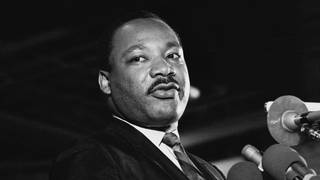
It has been 40 years since Dr. Martin Luther King Jr. was assassinated in Memphis, Tenn., while standing on the balcony outside his room at the Lorraine Motel. King was there to support striking sanitation workers, African-American men who endured horrible working conditions for poverty wages. While King’s staff was opposed to him going, as they were scrambling to organize King’s new initiative, the Poor People’s Campaign, King himself knew that the sanitation workers were at the front lines of fighting poverty.I went to Memphis on Dr. King’s birthday. There I interviewed Taylor Rogers, one of the striking sanitation workers who marched with King. He told me:
“Back in 1968, 1,300 sanitation workers—we were tired of being mistreated, overworked and underpaid. We decided that we were just going to stand up and be men and do something about our condition. And that’s what we did. We stood up, and we told [Mayor] Henry Loeb in the city of Memphis that ‘I am a man.’ ”
While he was organizing against poverty, King also came out forcefully against the Vietnam War, alienating his erstwhile ally, President Lyndon Johnson. Exactly one year before his assassination, on April 4, 1967, King gave his “Beyond Vietnam” speech at Riverside Church in New York City. He said: “A few years ago, there was a shining moment in that struggle. It seemed as if there was a real promise of hope for the poor, both black and white, through the poverty program. There were experiments, hopes, new beginnings. Then came the buildup in Vietnam, and I watched this program broken and eviscerated as if it were some idle political plaything of a society gone mad on war. And I knew that America would never invest the necessary funds or energies in rehabilitation of its poor so long as adventures like Vietnam continued to draw men and skills and money like some demonic, destructive suction tube. So I was increasingly compelled to see the war as an enemy of the poor and to attack it as such.”
He went on, “I could never again raise my voice against the violence of the oppressed in the ghettos without having first spoken clearly to the greatest purveyor of violence in the world today: my own government.”
Time magazine called the speech “demagogic slander that sounded like a script for Radio Hanoi.” The Washington Post declared that King had “diminished his usefulness to his cause, his country, his people.”
King made an essential link between poverty at home and war-making abroad. The connection, sadly, is as relevant today as it was the last year of King’s life. A new report from the Institute for Policy Studies, “40 Years Later: The Unrealized American Dream,” lays out key elements of the inequality that African-Americans experience in the United States around education, employment and wealth accumulation.
On education, the IPS report states that African-American college graduation rates will not be on par with white graduation rates for another 80 years. The income gap between blacks and whites will not disappear for more than 500 years at current rates. More than one-third of African-Americans earn less than $20,000 annually, before taxes.
African-Americans are also far behind in the accumulation of wealth. Add to all this higher incarceration, less access to health insurance and shorter life expectancy. King’s Poor People’s Campaign went beyond race, as he reached out to poor whites in places like Appalachia. Today, one in five residents of West Virginia is on food stamps, as is one in 10 Ohioans, and, according Jim Weill, president of the Food Research and Action Center, one in three children in Oklahoma has been on food stamps at some point in the past year. It is clear that Dr. King’s goal of bringing people “to the promised land” is still far off.



 Top
Top