










By Amy Goodman with Denis Moynihan
Our daily weather reports, cheerfully presented with flashy graphics and state-of-the-art animation, appear to relay more and more information.
And yet, no matter how glitzy the presentation, a key fact is invariably omitted. Imagine if, after flashing the words “extreme weather” to grab our attention, the reports flashed “global warming.” Then we would know not only to wear lighter clothes or carry an umbrella, but that we have to do something about climate change.
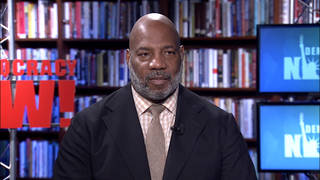
I put the question to Jeff Masters, co-founder and director of meteorology at Weather Underground, an Internet weather information service. Masters writes a popular blog on weather, and doesn’t shy away from linking extreme weather to climate change:
“Heat, heat, heat is the name of the game on planet Earth this year,” he told me, as the world is beset with extreme weather events that have caused the death of thousands and the displacement of millions.
Wildfires in Russia have blanketed the country with smoke, exacerbating the hottest summer there in 1,000 years. Torrential rains in Asia have caused massive flooding and deadly landslides in Pakistan, Kashmir, Afghanistan and China. An ice shelf in Greenland has broken off, sending an ice island four times the size of Manhattan into the ocean. Droughts threaten Niger and the Sahel.
Masters relates stark statistics:
- 2010 has seen the most national extreme heat records for a single year: 17.
- The past decade was the hottest decade in the historical record.
- The first half of 2010 was the warmest such six-month period in the planet’s history.
- The five warmest months in history for the tropical Atlantic have all occurred this year (likely leading to more frequent and severe Atlantic hurricanes).
“We will start seeing more and more years like this year when you get these amazing events that caused tremendous death and destruction,” Masters said. “As this extreme weather continues to increase in the coming decades and the population increases, the ability of the international community to respond and provide aid to victims will be stretched to the limit.”
And yet the U.N. talks aimed at climate change seem poised for collapse.
When the Copenhagen climate talks last December were derailed, with select industrialized nations, led by the United States, offering a “take it or leave it” accord, many developing nations decided to leave it. The so-called Copenhagen Accord is seen as a tepid, nonbinding document that was forced on the poorer countries as a ploy to allow countries like the U.S., Canada and China to escape the legally binding greenhouse-gas emissions targets of the Kyoto Protocol, which is up for renewal.
Bolivia, for example, is pursuing a more aggressive global agreement on emissions. It’s calling for strict, legally binding limits on emissions, rather than the voluntary goals set forth in the Copenhagen Accord. When Bolivia refused to sign on to the accord, the U.S. denied it millions in promised aid money. Bolivia’s United Nations ambassador, Pablo Solon, told me: “We said: ‘You can keep your money. We’re not fighting for a couple of coins. We are fighting for life.’”
While Bolivia did succeed in passing a U.N. resolution last month affirming the right to water and sanitation as a human right, a first for the world body, that doesn’t change the fact that as Bolivia’s glaciers melt as a result of climate change, its water supply is threatened.
Pacific Island nations like Tuvalu may disappear from the planet entirely if sea levels continue to rise, which is another consequence of global warming.
The U.N. climate conference will convene in Cancun, Mexico, in December, where prospects for global consensus with binding commitments seem increasingly unlikely. Ultimately, policy in the United States, the greatest polluter in human history, must be changed. That will come only from people in the United States making the vital connection between our local weather and global climate change. What better way than through the daily drumbeat of the weather forecasts? Meteorologist Jeff Masters defined for me the crux of the problem:
“A lot of TV meteorologists are very skeptical that human-caused global climate change is real. They’ve been seduced by the view pushed by the fossil-fuel industry that humans really aren’t responsible … we’re fighting a battle against an enemy that’s very well-funded, that’s intent on providing disinformation about what the real science says.”
It just may take a weatherperson to tell which way the wind blows.
Amy Goodman is the host of “Democracy Now!,” an independent, daily global TV/radio news hour airing on more than 950 stations in the United States and around the world. She is the author of “Breaking the Sound Barrier,” recently released in paperback and now a New York Times best-seller.
© 2011 Amy Goodman
Related Story
 StoryNov 25, 2025Assassinated Amazonian Rubber Tapper Chico Mendes Tried to Save the Rainforest. Meet His Daughter



 Top
Top
Media Options