Tuesday, December 27, 2011
Headlines
- Obama Administration to Allow Yemeni President to Enter U.S. for Medical Treatment
- Arab League Observers Arrive in Syria amid Fresh Violence
- Justice Department Blocks Controversial South Carolina Voter ID Law
- Republican Presidential Hopefuls Campaign in Iowa
- Report: Gap Between Americans, Congressional Representatives Grows Considerably Over Last 25 Years
- Obama Signs Two-Month Extension on Payroll Tax; Decision on Tar Sands Pipeline Now Required
- Afghan Government to Allow Opening of Taliban Office in Qatar
- Egypt Releases Prominent Blogger Detained for Nearly Two Months
- Russia: Putin Rejects Calls for Parliamentary Election Reviews as Massive Protests Persist
- Secret Memo Suggests Pakistani Military May Attempt to Oust President Zardari
- Report: Lack of Preparation, Communication Contributed to Fukushima Nuclear Disaster
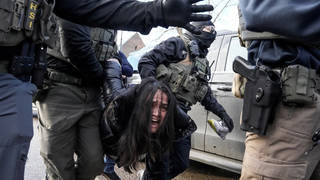
- Israeli Woman Draws Rosa Parks Link After Refusing to Give Up Bus Seat to Ultra-Orthodox Jewish Man
- Hacker Group Anonymous Claims Responsibility for Breaking into Global Intelligence Company Website
- More Headlines…
-
U.S. Grants Entry to Yemen President "In Principle" As Arab Spring Protesters Demand Accountability, Regime Change
The New York Times reported Monday the Obama administration has decided in principle to allow embattled Yemeni President Ali Abdullah Saleh to enter the United States to receive "legitimate medical treatment." If the report is true, the United States will have agreed to Saleh’s arrival hours after his forces killed nine people demanding he be tried for deaths of protesters over the past year. Over the last several months, hundreds of thousands of Yemenis have been demonstrating across the country demanding Saleh face trial for charges ranging from corruption to deadly crackdowns on protests. Saleh agreed last month to step down in return for immunity from prosecution for himself and his family. "[The U.S.] has continued to sort of attempt to hedge its bets and go a little bit down one road and a little bit down another road, and the result being that we have this mess in Yemen where the country is in danger of fragmenting and falling apart," says Gregory Johnsen, a former Fulbright fellow in Yemen. "If that happens, if the country of Yemen breaks into four or five different Yemens, then the security threat that the United States and the international community will face from the tip of South Arabia is going to be much greater than it has been up to this point." [includes rush transcript]
-
The War at Home: Militarized Local Police Tap Post-9/11 Grants to Stockpile Combat Gear, Use Drones
A new report by the Center for Investigative Reporting reveals that since 9/11, local law enforcement agencies have used $34 billion in federal grants to acquire military equipment such as bomb-detection robots, digital communications equipment and Kevlar helmets. "A lot of this technology and the devices have been around for a long time. But as soon as they have, for instance, a law enforcement capability, that’s a game changer," says George Schulz, with the Center for Investigative Reporting. "The courts and the public have to ask, how is the technology being used by a community of people—police—who are endowed with more power than the rest of us?’" Local police departments have also added drones to their toolkit. In June, a drone helped local police in North Dakota with surveillance leading to what may be the first domestic arrests with help from a drone. The American Civil Liberties Union has issued a new report that calls on the government to establish privacy protections for surveillance by unmanned aerial drones, especially of people engaged in protests. "We believe that people should not be targeted for surveillance via drones just because they’re they are engaged in First Amendment-protected activity," says Catherine Crump, a staff attorney with the American Civil Liberties Union. [includes rush transcript]
-
Oil Slick from Massive Spill in Nigeria Threatens Coastline, May Be Largest Spill in a Decade
Communities along Nigeria’s Niger Delta have been put on alert following a major oil spill from the oil giant, Shell. The massive oil slick is making its way to the Nigerian coast, threatening local wildlife and massive pollution along the shore. Much of the available information about the spill comes from the company responsible for it, Royal Dutch Shell, which says less than 40,000 barrels have leaked so far. But Nigeria’s National Oil Spill Detection and Response Agency says the spill could be three times as large. It comes just four months after the United Nations said it would take 30 years and around $1 billion for a small section of the delta to recover from environmental damage caused by Shell and other companies. We get an update from Nnimmo Bassey, executive director of Environmental Rights Action in Nigeria, which monitors spills around the country’s oil-rich southern delta. [includes rush transcript]
Recent ShowsMore Shows
Stories
Headlines
- Egyptians Vote in 2nd Day of Presidential Election
- EU Summit Split on Bonds, Shared Debt
- Suspect Arrested in Mexico for Murder of U.S. Journalist Brad Will
- Obama Hails "New Era of American Leadership" in Speech to Air Force Grads
- Pakistan Faces U.S. Warning for Sentencing of Doctor Who Aided CIA
- Poll: U.S. Support for Same-Sex Marriage at All-Time High
- Facebook, Morgan Stanley Face Lawsuits over IPO
- Hewlett-Packard to Fire 27,000 Workers
- Secret Service Head Apologizes for Prostitution Scandal
- Journalist: CNN Host Piers Morgan Boasted of Phone Hacking
By Amy Goodman with Denis Moynihan
Gen. John Allen, commander of U.S. Forces Afghanistan, spoke Wednesday at the Pentagon, four stars on each shoulder, his chest bedecked with medals. Unlike Allen, many decorated U.S. military veterans left the streets of Chicago after the NATO summit without their medals.
In an extended interview, David Bronner, president of Dr. Bronner’s Magic Soaps, discusses the history of the company, why they put sustainability and social justice ahead of profits, the organic and GMO labeling movements, the U.S. war on hemp, and why they refuse to sell out. [includes rush transcript]
Human Rights Watch’s Kenneth Roth examines why the U.S. has not pressured Bahrain to release pro-democracy activists. He also discusses Syria and the conditions in Israeli jails and courts that prompted 1,550 Palestinian prisoners to go on a hunger strike. [includes rush transcript]