Monday, May 2, 2011
Headlines
- U.S. Forces Kill Osama bin Laden in Pakistan
- Eleven People Killed as Taliban Announces Spring Offensive in Afghanistan
- Libya: Son of Gaddafi Killed in NATO Strike, Preschool for Down Syndrome Children Bombed
- Scores Killed in Syrian Security Crackdown, Hundreds Arrested in House Raids
- Yemen President Ali Abdullah Saleh Refuses to Sign Resignation Deal
- Israel Withholds $90 Million in Tax Revenue Owed to Palestinian Authority
- Left-Leaning Party Threatens Conservative Power in Canadian Election
- U.S. Tornado Death Toll Tops 350
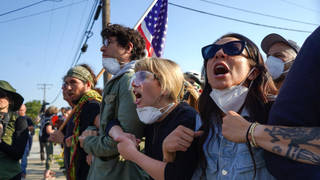
- Thousands Call for Immigrant and Labor Rights in Nationwide May Day Protests
- Egypt Celebrates International Workers’ Day for First Time Since 1952
- San Francisco Newspaper Accuses Obama Administration of Intimidation
- More Headlines…
-
Jeremy Scahill on Killing of Bin Laden: Obama Has “Doubled Down on Bush Administration Policy of Targeted Assassination”
The manhunt for Osama bin Laden is over. Nearly 10 years after the attack on the World Trade Center and Pentagon, U.S. forces are said to have assassinated the Saudi-born founder of al-Qaeda inside Pakistan. The U.S. operation was reportedly carried out by 25 Navy SEALs under the command of the Joint Special Operations Command. At the time of his death, bin Laden was reportedly living in a heavily fortified mansion just a mile from the Pakistani army’s principal military academy. We speak with Jeremy Scahill, the national security correspondent for The Nation magazine, who has followed the Iraq and Afghanistan conflicts closely as well as reported on the covert war inside Pakistan. [includes rush transcript]
-
Talat Hamdani, Mother of 9/11 Victim: I Hope Death of Bin Laden Moves Country Toward Peace, Away from Revenge and Killing
New York City Police Cadet Mohammed Salman Hamdani died on Sept. 11 after he raced to the Twin Towers to help survivors. He earned a mention in the USA PATRIOT Act for his bravery, yet because he was a Muslim immigrant, the New York Post and others considered him a suspect until his DNA was discovered. We speak to his mother, a member of September 11 Families for Peaceful Tomorrows, about the killing of Osama bin Laden. [includes rush transcript]
-
Did Pakistani Gov’t Know Where Osama bin Laden Was Hiding?
"The idea that bin Laden got from Tora Bora to that house over the last seven or eight years without a single element of the Pakistani state knowing about it just doesn’t ring true," said Pakistani journalist Mosharraf Zaidi, who has been reporting in Abbottabad. "What rings even more hollow is the notion that somehow U.S. military choppers and gunships could fly into Pakistan undetected." Pakistani writer Tariq Ali questions how bin Laden could have been living inside a fortified compound within a mile of Pakistan’s premier military academy. [includes rush transcript]
-
"One Killer Killing Another": Journalist and Activist Allan Nairn on Obama’s Targeted Killing of Bin Laden
“Bin Laden is dead, but the world is still governed by bin Ladens. People cheer because they thought they saw justice, but this was not justice delivered by victims. This was one killer killing another,” says Allan Nairn. “I think we need an American uprising, if we’re to put a stop to this kind of killing of innocent people. And we need an American Romero, someone like Archbishop Romero of Salvador.” [includes rush transcript]
-
Military Intelligence Analyst Joshua Foust: Death of Bin Laden Will Not Have Enormous Impact on Operations of Al-Qaeda Affiliates Worldwide
In addition to Afghanistan, the United States is fighting al-Qaeda in the Arab Peninsula. We discuss the impact of Osama bin Laden’s death on al-Qaeda across the globe with Joshua Foust, a fellow at the American Security Project and former Defense Intelligence Agency analyst. "From an operational standpoint, Osama bin Laden doesn’t maintain very tight operational control over the different al-Qaeda franchises that are out there, including in Yemen, including in Somalia, and other places as well. So, this is mostly a symbolic victory," says Foust. [includes rush transcript]
-
Ex-State Department Official Matthew Hoh: With Killing of Bin Laden, Why Are 50,000 U.S. Troops Still in Afghanistan?
After two tours of duty in Iraq and serving in the State Department in Washington, D.C., Matthew Hoh became the United States’ senior civilian representative and political adviser in Afghanistan. He resigned five months into his contract, making him the highest-ranking U.S. government official to publicly quit over the war in Afghanistan. He joins us from Washington, D.C., to discuss whether the death of Osama bin Laden means the end of that war. “Everybody should be asking themselves today in the United States, if Osama Bin Laden was hiding in an upscale villa an hour or two drive north, northeast of Islamabad, then why did we put 50,000 troops in Afghanistan over the last two years?” says Hoh. [includes rush transcript]
Recent ShowsMore Shows
Stories
Headlines
- Egyptians Vote in 2nd Day of Presidential Election
- EU Summit Split on Bonds, Shared Debt
- Suspect Arrested in Mexico for Murder of U.S. Journalist Brad Will
- Obama Hails "New Era of American Leadership" in Speech to Air Force Grads
- Pakistan Faces U.S. Warning for Sentencing of Doctor Who Aided CIA
- Poll: U.S. Support for Same-Sex Marriage at All-Time High
- Facebook, Morgan Stanley Face Lawsuits over IPO
- Hewlett-Packard to Fire 27,000 Workers
- Secret Service Head Apologizes for Prostitution Scandal
- Journalist: CNN Host Piers Morgan Boasted of Phone Hacking
By Amy Goodman with Denis Moynihan
Gen. John Allen, commander of U.S. Forces Afghanistan, spoke Wednesday at the Pentagon, four stars on each shoulder, his chest bedecked with medals. Unlike Allen, many decorated U.S. military veterans left the streets of Chicago after the NATO summit without their medals.
In an extended interview, David Bronner, president of Dr. Bronner’s Magic Soaps, discusses the history of the company, why they put sustainability and social justice ahead of profits, the organic and GMO labeling movements, the U.S. war on hemp, and why they refuse to sell out. [includes rush transcript]
Human Rights Watch’s Kenneth Roth examines why the U.S. has not pressured Bahrain to release pro-democracy activists. He also discusses Syria and the conditions in Israeli jails and courts that prompted 1,550 Palestinian prisoners to go on a hunger strike. [includes rush transcript]