
Haiti Earthquake

Haiti-banner-2

On January 12th, 2010, Haiti was devastated by a massive 7.0-magnitude earthquake, causing of one of the worst natural disasters in history. Up to 300,000 were killed and more than 1.5 million left homeless. See all of our coverage below, from the immediate aftermath of the disaster to recovery and reconstruction efforts and the long-term effects of the disaster.

  • Button_2

    Haiti: Leaked Cables Expose U.S. Suppression of Min. Wage, Election Doubts and Elite’s Private Army

    June 24, 2011 | Story

    Drawing on almost 2,000 classified U.S. diplomatic cables on Haiti released by WikiLeaks, a partnership between The Nation magazine and the Haitian weekly, Haïti Liberté, exposes new details on how Fruit of the Loom, Hanes and Levi’s worked with the United States to block an increase in the minimum wage in the hemisphere’s poorest nation, how business owners and members of the country’s elite used Haiti’s police force as their own private army after the 2004 U.S.-backed coup that ousted President Jean-Bertrand Aristide, and how the United States, the European Union and the United Nations supported Haiti’s recent presidential and parliamentary elections, despite concerns over the exclusion of Haiti’s largest opposition party, Lavalas, the party of Aristide. We speak with the reports’ authors, longtime Haiti correspondent Dan Coughlin and Haïti Liberté editor, Kim Ives. [includes rush transcript]

  • Play_camps_haiti3

    Haitians Face Imminent Eviction from Displaced Persons Camps

    March 30, 2011 | Story

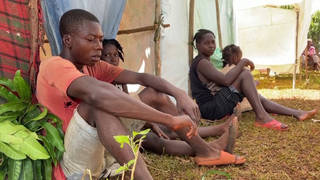
    Reconstruction efforts in Haiti have barely begun 15 months after a devastating earthquake killed thousands and left more than 1.5 million people homeless. Hundreds of thousands of people still live in makeshift shelters in hundreds of tent camps across Haiti. Democracy Now!’s Sharif Abdel Kouddous reports from one of those camps and speaks with residents who face imminent eviction by landowners even though they have nowhere else to go. [includes rush transcript]

  • "Aristide’s Return to Haiti: A Long Night’s Journey Into Day" By Amy Goodman

    March 23, 2011 | Blog Post

    Late at night on March 17, former Haitian President Jean-Bertrand Aristide boarded a small plane with his family in Johannesburg. The following morning, he arrived in Haiti. It was just over seven years after he was kidnapped from his home in a U.S.-backed coup d’etat.

  • Babydoc

    Did Baby Doc Duvalier Return to Haiti to Pressure Préval in the Election?

    January 19, 2011 | Story

    We speak to journalist Kim Ives, editor of Haiti Liberté, about former dictator Jean-Claude "Baby Doc" Duvalier’s return to Haiti. Ives argues Duvalier’s presence will allow the United States and France to install their preferred candidate in a run-off election set for February against the wishes of President René Préval. The international community has threatened Préval with exile if he does not comply with their interpretation of the disputed results of last November’s election. "Préval, after bowing to U.S. and French and Canadian dictates over the past decade of his presidencies, is now finding out that once he begins to resist a little bit or try to do something his way, that he’s going to be quickly dispensed with," Ives says. [includes rush transcript]

  • 1anniversary

    Tè Tremblé: Remembering the Earthquake in Haiti

    January 12, 2011 | Story

    One year ago today, Haiti was devastated by a massive earthquake. Up to a quarter of a million people were killed and more than 1.5 million were made homeless. It was one of the worst natural disasters in history. We go back to January 12, 2010, and to the aftermath of the earthquake — what Haitians call Tè Tremblé, the earth trembles. [includes rush transcript]

  • Clinton

    Wesleyan Professor Alex Dupuy: Haiti Transformed into the "Republic of the NGOs"

    January 12, 2011 | Story

    One year after the massive 7.0-magnitude earthquake that devastated Haiti, reconstruction efforts have barely begun. We speak with Alex Dupuy, a professor of sociology at Wesleyan University. "There is a dramatic power imbalance between the international community — under U.S. leadership — and Haiti. The former monopolizes economic and political power and calls all the shots," Dupuy writes. "This unequal relationship is reflected in the Interim Haiti Recovery Commission." The IHRC is co-chaired by Bill Clinton. [includes rush transcript]

  • Elie

    Haitian Activist Patrick Elie: "Haiti is Controlled by Foreign Governments and Foreign Interests"

    January 12, 2011 | Story

    On the first anniversary of the earthquake in Haiti, we go to Port-au-Prince to speak with Patrick Elie, a longtime Haitian democracy activist and Haiti’s former Secretary of State for Public Security. "I don’t think, truly, that the Haitian people have to be pitied or mourned. They have to get true solidarity in their endeavor to rebuild," Elie says. "We must resist the impulse to rebuild Port-au-Prince the way it was: a city of exclusion, of hyper-concentration and of shanty towns, which contributed very, very much to the high toll that we’ve paid after the earthquake." [includes rush transcript]

  • Child

    Haitian Writer Jean Saint-Vil: One Year After Earthquake, Haitian Population Treated as a Threat, Not an Asset

    January 12, 2011 | Story

    On the anniversary of the earthquake in Haiti, we speak with Ottawa-based Haitian writer and activist, Jean Saint-Vil. "One year after the earthquake, we are seeing the Haitian population being treated and seen as a threat, rather than as an asset," Saint-Vil says. "That’s the major paradigm shift that must occur if we have to get out of this mess." [includes rush transcript]

  • Danticat

    Novelist Edwidge Danticat: "Haitians Are Very Resilient, But It Doesn’t Mean They Can Suffer More Than Other People"

    January 12, 2011 | Story

    On the anniversary of the earthquake in Haiti, we go to Carrefour to speak with Haitian-American novelist Edwidge Danticat. "Haitian people are very resilient, but it doesn’t mean they can suffer more than other people," Danticat says. [includes rush transcript]

  • Coffin

    Haitians Barricading Streets with Coffins as Protests against U.N. Continue over Cholera Outbreak

    November 18, 2010 | Story

    Protests are continuing in Haiti over the cholera outbreak that has now killed more than 1,100 people and infected some 17,000. On Wednesday, residents in the city of Cap-Haïtien clashed with U.N. troops for the third consecutive day. Crowds have taken to the streets expressing anger at the Haitian government and the United Nations for failing to contain the disease. We go to Cap-Haïtien to speak with independent journalist Ansel Herz. [includes rush transcript]