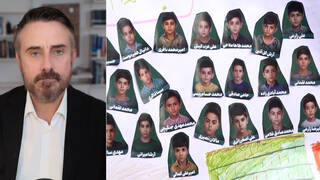
Eight youths, tending their flock of sheep in the snowy fields of Afghanistan, were exterminated last week by a NATO airstrike.
The Pulitzer Prize-winning New York Times foreign correspondent Anthony Shadid died of an apparent asthma attack today while covering the conflict in Syria. One of the most celebrated journalists covering the Middle East, Shadid, 43, had been a guest on Democracy Now! several times over the past decade reporting on Libya, Tunisia, Iraq and Lebanon.
Part 2: "Who Killed Che? How the CIA Got Away with Murder": New Book Ties Johnson Admin to Che Death
In an extended interview, co-authors Michael Ratner and Michael Steven Smith discuss the life of Cuban revolutionary Ernesto "Che" Guevara and the chilling story behind his murder by the Bolivian military. In their book, "Who Killed Che?" Ratner and Smith draw on previously unpublished U.S. government documents to argue the CIA played a critical role in the killing. [includes rush transcript]
Start 2012 off right with a contribution to Democracy Now!
Topics
Democracy Now! archive of reports about Rupert Murdoch, the media scandal that is engulfing his media empire from Britain to the United States, and his Fox News Network.
Millions of British Public Sector Workers Take to the Streets in Historic General Strike
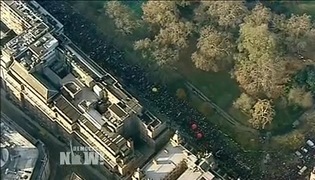
In Britain, up to two million workers have marched in the streets during the largest mass protest in generations. Teachers, hospital staff, garbage collectors, firefighters and border guards are participating in a 24-hour strike organized by a coalition of 30 trade unions. About a thousand demonstrations and rallies are being held across the country. Public sector workers say proposed pension "reforms" will force them pay more and work for longer before they can retire. We go to London to speak with Richard Seymour, who writes one of Britain’s most popular blogs, "Lenin’s Tomb." Seymour examines how the Murdoch-owned conservative press has shaped coverage of workers’ rights even as it faces fallout from the latest developments in the phone-hacking scandal. "Rupert Murdoch’s ideological power, his ability to project an image of these strikes as unnecessary, as militant, as aggressive and belligerent and so on and so forth, comes from his economic power. And he spent decades building that up in the U.K.," Seymour notes. He also discusses how the U.K. has withdrawn diplomatic staff from Iran after protesters, upset over newly implemented sanctions, stormed the British embassy in Tehran, overrunning the diplomatic buildings, chanting "Death to Britain." [includes rush transcript]
Occupy Wall Street Protest Heads to Millionaire’s Row, Home to Murdoch, Koch, and JPMorgan CEO
Hundreds of Occupy Wall Street protesters participated in a "Millionaires’ March" Tuesday that wended its way through New York City’s wealthy Upper East Side neighborhood, calling for an end to the concentration of wealth in the hands of a few. [includes rush transcript]
British Rocker Billy Bragg on Labor Strikes and Songs, Activism, and the Murdoch Hacking Scandal
We spend the hour with legendary British rocker and activist, Billy Bragg. His music career began in the late 1970s in London when he formed the punk rock band Riff Raff. His 1984 album, "Brewing Up with Billy Bragg," included the song "It Says Here," a critique of politics and tabloid newspapers that still rings true today in the wake of the News of the World phone-hacking scandal. In 1998 and 2000, he participated in two well-known albums — Mermaid Avenue, Volumes 1 and 2 — that gave voice to another folk troubadour who sang about the poor and working class: Woody Guthrie. Bragg composed music for lyrics written by Guthrie and performed many of the songs alongside the album’s other main contributor, Wilco. But to speak of Bragg simply as a singer-songwriter misses his passion for speaking out against injustice and fighting for many causes. In the 1980s, he called for support for the 1984 strike by the National Union of Mineworkers, one of the most significant chapters in Britain’s trade union history. It was ultimately defeated under the watch of then-Prime Minister Margaret Thatcher, and Bragg went on to organize for the defeat of Thatcher and her Conservative government. He joins us for an extended interview and performance. He reflects on his long history of activism and sings several songs, including his latest, "Never Buy The Sun," about the phone-hacking scandal engulfing the Rupert Murdoch media empire. [includes rush transcript]
Billy Bragg: British Rocker on Norway Attacks, Activism & His Song on Murdoch, “Never Buy The Sun”
We spend the hour with legendary British rocker and activist, Billy Bragg. His music career began in the late 1970s in London when he formed the punk rock band Riff Raff. His 1984 album, "Brewing Up with Billy Bragg," included the song "It Says Here,” a critique of politics and tabloid newspapers that still rings true today in the wake of the News of the World phone-hacking scandal. In 1998 and 2000, he participated in two well-known albums — Mermaid Avenue, Volumes 1 and 2 — that gave voice to another folk troubadour who sang about the poor and working class: Woody Guthrie. Bragg composed music for lyrics written by Guthrie, and performed many of the songs alongside the album’s other main contributor, Wilco. But to speak of Bragg simply as a singer-songwriter misses his passion for speaking out against injustice, and fighting for many causes. In the 1980s, he called for support for the 1984 strike by the National Union of Mineworkers, one of the most significant chapters in Britain’s trade union history. It was ultimately defeated under the watch of then-Prime Minister Margaret Thatcher, and Bragg went on to organize for the defeat of Thatcher and her Conservative government. He is on tour now in the United States and joins us for an extended interview and performance. He reflects on his long history of activism and the attacks in Norway, and sings several songs, including his latest, "Never Buy The Sun," about the phone-hacking scandal engulfing the Rupert Murdoch media empire. [includes rush transcript]
The British Watergate: A Backgrounder on the Murdoch Hacking Scandal
The London-based journalist Richard Gizbert, host of the Al Jazeera program "The Listening Post," chronicles how the Murdoch phone-hacking scandal has shaken the British government, media system and public. A must-watch interview on how the scandal has unfolded and what it means for people in the United States. [includes rush transcript]
British PM Cameron Refuses to Apologize for Murdoch Scandal, But Acknowledges BSkyB Takeover Talks
Media mogul Rupert Murdoch has returned to the United States as his media empire faces a growing number of challenges over the phone-hacking scandal that’s led to a number of arrests in Britain and prompted an investigation here in the United States. British Prime Minister David Cameron appeared before an emergency session of Parliament on Wednesday to address the scandal. Cameron refused to apologize for hiring Andy Coulson, a former Murdoch employee who recently served as Cameron’s communications chief at Downing Street, but admitted that he had talked to Murdoch executives about News Corp.’s attempt to take over the satellite company BSkyB. [includes rush transcript]
Murdoch Empire "Pummeled" by Phone-Hacking Scandal Exposed by Guardian Journalist Nick Davies
To talk more about the phone-hacking scandal and what it reveals about the Rupert Murdoch media empire, we speak with the British journalist who has been most responsible for exposing the widening story. Nick Davies has been covering the phone-hacking case at The Guardian newspaper with 75 stories over the past three years. He has been described as Britain’s one-man Woodward and Bernstein, a comparison to the legendary Washington Post reporters who exposed the Watergate scandal in the 1970s. Just over two weeks ago, Davies revealed the Murdoch-owned News of the World had illegally hacked into the phone of the missing schoolgirl, Milly Dowler, and her family in March 2002, interfering with police inquiries into her disappearance. "The Milly Dowler story was fantastically powerful… But I never foresaw this extraordinary chain reaction of emotion, which just pummeled the entire Murdoch camp," Davies says. "Within three days, it reached a point where nobody could be seen to be Murdoch’s ally anymore. For years, the opposite has been the case, that nobody could been seen to be Murdoch’s enemy." [includes rush transcript]
VIDEO: Rebekah Brooks Testimony Raises More Questions About Responsibility for Phone Hacking Scandal
Former News International executive Rebekah Brooks testified before the British Parliament July 19 as the phone hacking scandal engulfing the Murdoch media empire continues to grow.
"Rupert Murdoch Doesn’t Eat Humble Pie." By Amy Goodman
“People say that Australia has given two people to the world,” Julian Assange told me in London recently, “Rupert Murdoch and me.” Assange, the founder of the whistle-blowing website WikiLeaks, was humbly dismissing my introduction of him, to a crowd of 1,800 at East London’s Troxy theater, in which I suggested he had published perhaps more than anyone in the world. He said Murdoch took that publishing prize. Two days later, the Milly Dowler phone hacking story exploded, and Murdoch would close one of the largest newspapers in the world, his News of the World, within a week.
British PM David Cameron, Media Mogul Rupert Murdoch Face Parliament on Phone-Hacking Scandal
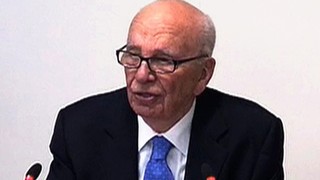
British Prime Minister David Cameron is facing questions from lawmakers today on his handling of the widening News International phone-hacking scandal implicating the British police and top government officials. Cameron’s appearance comes one day after an unprecedented hearing that saw media mogul Rupert Murdoch testify before British lawmakers for the first time. Murdoch expressed regret for what he called "sickening and horrible invasions" of privacy committed by his company, but refused to accept responsibility. His son, James Murdoch, and former News International executive Rebekah Brooks also testified. [includes rush transcript]