Occupy Wall Street

Occupy_wall_st_med_banner

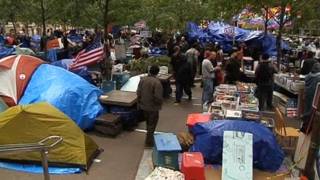
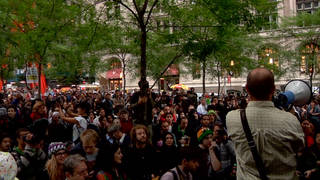
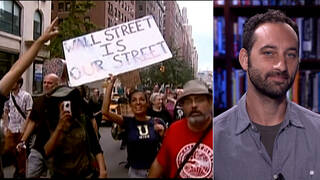
Inspired by the massive public protests in Cairo’s Tahrir Square and Madrid’s Puerta del Sol Square, hundreds have camped out in Zuccotti Park near Wall Street since Sept. 17, 2011, as part of a campaign dubbed "Occupy Wall Street." Developing a common slogan "We are the 99 percent," solidarity encampments and demonstrations have been organized across the United States and the world to call for financial, political and social change. A global day of action on Oct. 15 drew protests in 1,500 cities world-wide, including more than 100 in the United States. #OWS #OccupyWallStreet

  • Greece_protests_showbutton

    As Greece Erupts, BBC’s Paul Mason on "The New Global Revolutions" over Austerity, Inequality

    February 22, 2012 | Story

    Greece is bracing for protests after eurozone finance ministers concluded a deal that will provide a $170 billion bailout in return for another round of deep austerity cuts. The bailout is opposed by several unions and left-wing groups in Greece over new cuts and layoffs imposed on public sector workers. We’re joined by Paul Mason, economics editor at BBC Newsnight and author of the new book, "Why It’s Kicking Off Everywhere: The New Global Revolutions." He has just returned from Greece. "What makes the headlines are, of course, the riots," Mason says. "What doesn’t make so many headlines is what is happening to real people... We are living in a time where the world has, in the last couple of years, erupted in a way that many people thought they would never see again since the 1960s... The underpinnings of this new global unrest are that...people are sick of seeing the rich get richer during a crisis." [includes rush transcript]

  • Whokilledche_book2_showbutton

    "Who Killed Che? How the CIA Got Away with Murder": New Book Ties Johnson Admin to Guevara’s Death

    February 07, 2012 | Story

    Michael Ratner and Michael Steven Smith are the co-authors of a new book about the U.S. role in the killing of Cuban revolutionary, Ernesto "Che" Guevara. Born in Argentina in 1928, Che rose to international prominence as one of the key leaders of the 1959 Cuban Revolution that overthrew U.S.-backed dictator Fulgencio Batista. After a period in the new Cuban government leadership, Che aimed to spark revolutionary activity internationally. On October 8, 1967, he was captured by Bolivian troops working with the CIA. He was executed one day later. In their book, "Who Killed Che?" Ratner and Smith draw on previously unpublished government documents to argue the CIA played a critical role in the killing. "The line of the [U.S.] government was that the Bolivians did it, we couldn’t do anything about it. That’s not true," Smith said. "This whole operation was organized out of the White House by Walt Whitman Rostow. And the CIA, by this time, had become a paramilitary organization." On Che’s significance, Ratner says Che became "a symbol for revolutionary change... He still remains, of course, that today. If you go to Occupy Wall Street, if you go to Tahrir Square, you will see people who are wearing Che T-shirts, because they understand that their obligation, their necessity, is to take on the 1 percent. And that’s what Che was about. And that’s why I think he remains such a hero for people in the streets today." [includes rush transcript]

  • Superbowl_showbutton-1

    Occupy the Super Bowl: Indiana’s New Anti-Union Law Sparks Protest at Sport’s Biggest Spectacle

    February 03, 2012 | Story

    Occupy protesters in Indianapolis are gearing up to use the media spotlight on Sunday’s Super Bowl XLVI to rally for union rights outside the statehouse. Earlier this week, Indiana Gov. Mitch Daniels signed a so-called "right to work" measure into law that critics say will result in lower wages and diminished collective bargaining rights. Indiana workers have received the backing of the National Football League Players Association, which has called "right to work" "a political ploy designed to destroy basic workers’ rights." We’re joined from Indiana by Tithi Bhattacharya, an associate professor of South Asian History at Purdue University and a protester who is taking part in Occupy the Super Bowl. "It is absolutely shameful that the legislature passed a law that condemns unions and is now using the city to showcase Indianapolis while ordinary people in Indiana are completely opposed to this law," Bhattacharya says. [includes rush transcript]

  • Santos_showbutton

    Ex-Marine Reoccupies His Own Foreclosed Home in Fight Against Freddie Mac, JPMorgan Chase

    January 31, 2012 | Story

    As Freddie Mac comes under scrutiny for betting billions on investments that profit if homeowners they issued loans to are locked into high-interest mortgages, we speak with Arturo de los Santos, a U.S. Marine veteran who was evicted last year in Riverside, California, after Freddie Mac and JPMorgan Chase foreclosed on his house last June. "We were trying to get the bank’s attention to review our case again. We couldn’t believe that after they had evicted us, they modified our loan," de los Santos says. "I called, and I told them, 'I thought we were doing the loan modification.' And they go, 'Well, we have a loan modification department and a foreclosure department, and the foreclosure department decided to sell the house.' So they sold the house." De los Santos and his family reoccupied their home in December with help from the Occupy movement, but face eviction again this week. [includes rush transcript]

  • Oakland-button

    Occupy Oakland: Over 400 Arrested as Police Fire Tear Gas, Flash Grenades at Protesters

    January 30, 2012 | Story

    Police have arrested more than 400 Occupy Oakland protesters, as well as a number of journalists, in one of the largest mass arrests since the nationwide Occupy protests began last year. When protesters attempted to convert a vacant building into a community center on Saturday, witnesses say police used tear gas, bean bag projectiles and flash grenades. Several hours later, police said some of the protesters broke into City Hall. However, demonstrators claim they found the door to City Hall already ajar. We play a video report from Oakland filed by John Hamilton of KPFA. We get a response from Occupy Oakland member, Maria Lewis, to Oakland City Council Member Ignacio De La Fuente’s accusation that the Occupy movement is engaging in "domestic terrorism." "They are more interested in protecting abandoned private property than they are the people. And the idea that opening up a social center is terrorism is very telling of the narrative of the police state," Lewis says. [includes rush transcript]

  • Occupydc-button

    National Park Service Threatens to Evict Occupy D.C. Encampments at Two Parks Near White House

    January 30, 2012 | Story

    The National Park Service says it will begin enforcing a ban today on Occupy protesters camping overnight in McPherson Square and Freedom Plaza, two parks near the White House where they have been living since October. Members of the Occupy encampment say they will resist eviction. "We are going to do our best to make sure that they’re protected from what is effectively a criminalization of poverty and a criminalization of homelessness. By choosing to evict the people who have no place else to sleep, they’re effectively criminalizing those among us who are disenfranchised," says Justin Jacoby Smith, a member of the Occupy D.C. media team, who joins us live from McPherson Square. [includes rush transcript]

  • "Obama’s Late Payment to Mortgage-Fraud Victims." By Amy Goodman

    January 26, 2012 | Blog Post

    Does Obama’s formation of the new task force aimed at investigating the shoddy mortgage-lending practices that contributed to the financial crisis signify a move to more progressive policies, as MoveOn suggests?

  • Nader_button

    "He Says One Thing and Does Another": Ralph Nader Responds to Obama’s State of the Union Address

    January 25, 2012 | Story

    Responding to President Obama’s State of the Union address, longtime consumer advocate and former presidential candidate Ralph Nader says Obama’s criticism of income inequality and Wall Street excess fail to live up to his record in office. "[Obama] says one thing and does another," Nader says. "Where has he been for over three years? He’s had the Justice Department. There are existing laws that could prosecute and convict Wall Street crooks. He hasn’t sent more than one or two to jail." On foreign policy, Nader says, "I think his lawless militarism, that started the speech and ended the speech, was truly astonishing. [Obama] was very committed to projecting the American empire, in Obama terms." [includes rush transcript]

  • Obama_sotu_button

    Fmr. Obama Adviser: Focus on U.S. Inequality in Election-Year SOTU Has Occupy Wall Street’s Imprint

    January 25, 2012 | Story

    In his last State of the Union speech before the November election, President Obama defended his record addressing the financial crisis and called for greater economic fairness. He warned that Wall Street would no longer be allowed to play by its own set of rules. But the bulk of the speech dealt with the economy. We get reaction from Jared Bernstein, former chief economist and economic adviser to Vice President Joe Biden and past member of President Obama’s economic team. Bernstein says that Occupy Wall Street "had a lot to do with" Obama’s message of economic fairness: "These issues, I mean, they’re called populist now. Frankly, I think they’re just basic fairness. I don’t know why it’s populist to argue that middle-class people should pay a fair tax rate and one that’s certainly no higher than that paid by millionaires and billionaires, or for that matter, that economic growth should not be a spectator sport for people in the middle class. [These ideas] haven’t broken through in the way that Occupy Wall Street did in a matter of months. So I give them a ton of credit." [includes rush transcript]

  • Occupy_usa_gop_democrat_99

    Rivals’ Attacks on Romney’s Corporate Record Display Occupy Wall Street’s Wide Reach

    January 11, 2012 | Story

    The New Hampshire primary brought fewer than 50 percent of voters to the polls. The candidates are "addressing issues that aren’t really connecting with a whole bunch of Americans, especially blue-collar Americans," says Dale Kuehne, a New Hampshire political science professor. "I don’t know that they see a whole lot of reason to go out and vote for either Obama or out to vote for Romney or some of the others." Many undeclared New Hampshire voters lent their support to the libertarian-leaning Republican candidate, Ron Paul, who veers from the mainstream GOP platform by calling for the withdrawal of U.S. troops from Iraq and Afghanistan and has spoken out against the military-industrial complex. Meanwhile, Paul’s fellow challengers have attacked Romney for the jobs lost while he was head of the venture capitalist firm Bain Capital. "Occupy Wall Street has to understand, not only have they changed the conversation in the country, but now that conversation is going to be reinforced in South Carolina by two people that you would think would be the least likely: Rick Perry and Newt Gingrich," says Arnie Arnesen, longtime New Hampshire radio and TV host. [includes rush transcript]