In the wake of the successful pushback against the Susan G. Komen Race for the Cure’s decision to defund Planned Parenthood, the Obama administration should listen to the majority of Americans: The United States, including Catholics, is strongly pro-choice.
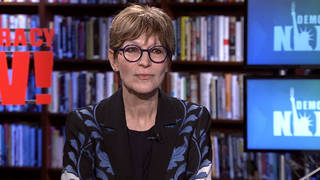
Democracy Now! Host Amy Goodman joined a panel of journalists, analysts and academics on MSNBC’s "Up w/ Chris Hayes" to discuss topics of the day, ranging from the Susan G. Komen Foundation’s Planned Parenthood reversal to the Republican Primaries.
Part 2: "Who Killed Che? How the CIA Got Away with Murder": New Book Ties Johnson Admin to Che Death
In an extended interview, co-authors Michael Ratner and Michael Steven Smith discuss the life of Cuban revolutionary Ernesto "Che" Guevara and the chilling story behind his murder by the Bolivian military. In their book, "Who Killed Che?" Ratner and Smith draw on previously unpublished U.S. government documents to argue the CIA played a critical role in the killing. [includes rush transcript]
Watch a 2011 interview with Spanish Judge Baltasar Garzón, who is on trial in Spain after right-wing groups objected to his investigation of atrocities committed by supporters of the dictator Francisco Franco. Garzón is known for seeking to indict members of the Bush administration for their role in torturing prisoners.
Start 2012 off right with a contribution to Democracy Now!
Topics
"America’s Pro-Choice Majority Speaks Out." By Amy Goodman
In the wake of the successful pushback against the Susan G. Komen Race for the Cure’s decision to defund Planned Parenthood, the Obama administration should listen to the majority of Americans: The United States, including Catholics, is strongly pro-choice.
Santorum Wins GOP Contests in 3 States as Evangelical Vote Surges and Pro-Romney Spending Dips
Former Pennsylvania Senator Rick Santorum has surged in the Republican presidential contest with wins in the Minnesota and Colorado caucuses, as well as a nonbinding primary in Missouri. Santorum’s win appears to have been fueled by evangelical voters, emboldening his claim to be the "true conservative" in the Republican race. The contests in Minnesota, Colorado and Missouri notably differed from earlier states in the absence of a flood of spending backing front-runner Mitt Romney. We get reaction to Santorum’s victories from Michael Brendan Dougherty of Business Insider and The American Conservative and Jon O’Brien of Catholics for Choice. [includes rush transcript]
As Contraceptives Rule Enters GOP Race, Will Reproductive Rights Affect 2012 Election?
Rick Santorum’s three-state victory comes after a week of heavy Republican campaigning against a new Obama administration rule requiring health insurance plans, including those provided by Catholic-affiliated hospitals and universities, to offer free birth control methods. Reproductive rights groups have hailed the measure, which was fueled by research showing birth control is necessary for women’s health and well-being. The row over contraceptives comes as a top official at the breast cancer charity Komen has resigned after a controversial decision to defund Planned Parenthood backfires. We look at how reproductive rights could become major issues in the 2012 race with three guests: Michael Brendan Dougherty of Business Insider and The American Conservative, Loretta Ross of the SisterSong Reproductive Justice Collective, and Jon O’Brien of Catholics for Choice. [includes rush transcript]
After Right-Wing Campaign, Leading Breast Cancer Charity Komen Drops Funding for Planned Parenthood
The nation’s leading breast cancer charity is under intense scrutiny for its decision to cut off funding for breast cancer screening programs run by Planned Parenthood. Susan G. Komen for the Cure has confirmed it is withdrawing support for 19 of Planned Parenthood’s 83 affiliates, citing a new policy barring funding for any groups under investigation by local, state or federal authorities. Planned Parenthood’s finances are currently the subject of a probe led by anti-abortion Republican Rep. Cliff Stearns of Florida. "If you look at all the government reports which have already been done on Planned Parenthood, they’re completely cleared of any of the charges that Cliff Stearns claims he’s looking for. So this is a witch hunt," says Jodi Jacobson, the editor-in-chief of RH Reality Check, who recently wrote the article, "The Cancerous Politics and Ideology of the Susan G. Komen Foundation." We also speak with Patrick Hurd, the CEO of Planned Parenthood of Southeastern Virginia and a recipient of a 2010 grant from Komen, and his wife, Betsi Hurd, who has participated in several Komen fundraising events and is currently battling breast cancer. "This isn’t about fundraising," says Patrick Hurd. "This is about making sure that we provide access to women, that we continue to provide education to women, that we continue to serve the women in the communities where Planned Parenthoods are located." [includes rush transcript]
The Invisible War: New Film Exposes Rape, Sexual Assault Epidemic in U.S. Military
On the heels of a new military survey that the number of reported violent sex crimes jumped 30 percent in 2011, with active-duty female soldiers ages 18 to 21 accounting for more than half of the of the victims, we speak with Trina McDonald and Kori Cioca, two subjects of "The Invisible War,” a new documentary that examines the epidemic of rape of soldiers within the U.S. military, which won the Audience Award at the 2012 Sundance Film Festival in Park City, Utah. "Not only was I astounded by the numbers, but when I started talking to the women and men who had experienced this, I was just so devastated by their stories," says the film’s Academy Award-nominated director, Kirby Dick. "These are women and men who are very idealistic. They joined the military because they wanted to serve their country. They were incredible soldiers. And then, when they were assaulted, they had the courage to come forward, even though many people advised them not to," Dick says. [includes rush transcript]
Iraqi Women’s Activist Rebuffs U.S. Claims of a Freer Iraq: "This Is Not a Democratic Country"
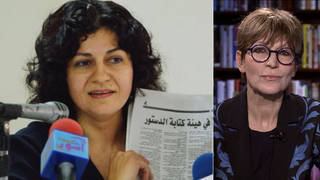
Yanar Mohammed, president of the Organization of Women’s Freedom in Iraq, joins us to discuss the impact of the nearly nine-year U.S. occupation, particularly on Iraqi women. "The Iraqi cities are now much more destroyed than they were, I would say, like five years ago," Mohammed says. "In the same time, we have turned to a society of 99 percent poor and 1 percent rich, due to the policies that were imposed in Iraq." Mohammed decries the repression of Iraqi protesters that joined the Arab Spring in a February 25th action. "The women are the biggest loser in all of this. We went to the Iraqi squares. We demonstrated. The Arab Spring was there very strongly but got oppressed in ways that were new to Iraqi people. Anti-riot police of the American style was something that we witnessed there... This is not a democratic country." [includes rush transcript]
Tawakkul Karman, Yemeni Nobel Peace Laureate, Pays Tribute to Women Activists Worldwide
The 2011 Nobel Peace Prize was presented this weekend to three women: Liberian activist Leymah Gbowee, Liberian President Ellen Johnson Sirleaf, and Yemeni peace activist and journalist, Tawakkul Karman, the first Arab woman to win the prize, as well as its youngest winner to date. We featured highlights from their acceptance addresses this week. Today we play a final excerpt from Karman, the mother of three who has led rallies in the protests against the rule of the longstanding U.S. ally, President Ali Abdullah Saleh. "I see the great number of Arab women, without whose hard struggles and quest to win their rights in a society dominated by the supremacy of men I would not be here," Karman says. "This supremacy has caused a lot of injustice to both men and women. To all those women, whom history and the severity of ruling systems have made unseen, to all women who made sacrifices for the sake of a healthy society with just relationships between women and men, to all those women who are still stumbling on the path of freedom in countries with no social justice or equal opportunities, to all of them I say, Thank you. This day would not have come true without you." [includes rush transcript]
"The Arab People Have Woken Up": Yemeni Activist Tawakkul Karman Accepts Nobel Peace Prize
The 2011 Nobel Peace Prize was presented this weekend to three women for "their non-violent struggle for the safety of women and for women’s rights to full participation in peace-building work." Democracy Now! aired highlights on Monday of the acceptance speeches of Liberian activist Leymah Gbowee and Liberian President Ellen Johnson Sirleaf, the first democratically elected female head of state on the African continent. Today we complete our coverage with the acceptance speech of Tawakkul Karman from Yemen, the first Arab woman to win the Nobel Peace Prize, as well as its youngest winner to date. Karman, a 32-year-old mother of three and an outspoken journalist and activist, has agitated for press freedoms and staged weekly sit-ins to demand the release of political prisoners from jail. She founded Women Journalists Without Chains and has played a leading part in the struggle for women’s rights and for democracy in Yemen. Most recently, she has led rallies in the protests against the rule of the longstanding U.S. ally, President Ali Abdullah Saleh. "The Arab world is today witnessing the birth of a new world, which tyrants and unjust rulers strive to oppose. But in the end, this new world will inevitably emerge," Karman says. "Our oppressed people have revolted, declaring the emergence of a new dawn in which the sovereignty of the people, and their invincible will, will prevail. The people have decided to break free and walk in the footsteps of civilized free people of the world." [includes rush transcript]
Leymah Gbowee, Ellen Johnson Sirleaf of Liberia Share Nobel Peace Prize with Yemeni Tawakkul Karman
On Saturday, the 2011 Nobel Peace Prize was presented to three female activists and political leaders for "their non-violent struggle for the safety of women and for women’s rights." The trio of laureates follow only a dozen other women among 85 men, as well as a number of organizations, to have won the peace prize over its 110-year history. We play excerpts from their acceptance speeches. "The Nobel Committee cannot license us, our three laureates, to speak for women, but it has provided us a platform from which to speak to women," notes Liberian President Ellen Johnson Sirleaf, who was awarded the prize for her human rights work and the progress her country has made since she took office in 2006 as the first democratically elected female head of state on the African continent. "There is no time to rest, until our world achieves wholeness and balance, where men and women are considered equal and free," notes Leymah Gbowee. Her "Women for Peace" movement is credited by some for bringing an end to the civil war in 2003. The movement started humbly in 2002 when Gbowee organized a group of women to sing and pray for an end to fighting in a fish market. "The Nobel Prize did not come only as a personal prize for Tawakkul Abdel-Salam Karman, but as a declaration in recognition of the whole world for the triumph of the peaceful revolution of Yemen and as an appreciation of the sacrifices of its great, peaceful people," says Tawakkul Karman, the first Arab woman to win the Nobel Peace Prize and the youngest winner of the peace prize to date, slightly edging out the Irish activist Mairead Corrigan, who won in 1976. Both were 32. [includes rush transcript]
"Deadly Monopolies": Medical Ethicist Harriet Washington on How Firms are Taking Over Life Itself
One of the major themes raised by the Occupy movement is the increasing power of large corporations over more and more aspects of our lives. We spend the hour looking into the issue of the corporate control of life itself. Our guest, Harriet Washington, is a medical ethicist and has just published a book that examines the extent to which what she calls the medical-industrial complex has come to control human life. In the past 30 years, more than 40,000 patents have been granted on genes alone—many more patents are pending. Washington argues that the biotechnology and pharmaceutical companies patenting these genes are more concerned with profit than with the health or medical needs of patients. Her new book is called "Deadly Monopolies: The Shocking Corporate Takeover of Life Itself—And the Consequences for Your Health and Our Medical Future." [includes rush transcript]