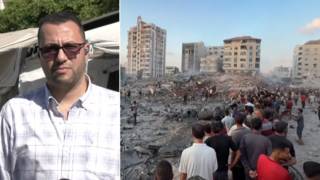

As President-elect Barack Obama focuses on the meltdown of the U.S. economy, another fire is burning: the Israeli-Palestinian conflict. You may not have heard much lately about the disaster in the Gaza Strip. That silence is intentional: The Israeli government has barred international journalists from entering the occupied territory.
Filed under Weekly Column
Evo Morales knows about “change you can believe in.” He also knows what happens when a powerful elite is forced to make changes it doesn’t want.
Filed under Weekly Column
Alice Walker is the first African-American woman to win the Pulitzer Prize for fiction. But Monday, I called her to talk about a true story. The Obamas had just visited the White House. The first African-American elected president of the United States had visited his soon-to-be residence, a house built by slaves.
Filed under Weekly Column
Filed under D.N. in the News
Democracy Now! producer Anjali Kamat writes, “To all those for whom America has represented generations of racial injustice, the election of America’s first Black president marks the beginning of a new era…But unless the inspired millions who brought him to power continue to believe their demands matter and insist on holding him accountable each step of the way, it will be Obama’s corporate and hawkish friends who determine the domestic and foreign policies of the coming administration and our collective future.”
Filed under D.N. in the News
You could almost hear the world’s collective sigh of relief. This year’s U.S. presidential election was a global event in every sense. Barack Hussein Obama, the son of a black Kenyan father and a white Kansan mother, who grew up in Indonesia and Hawaii, represents to so many a living bridge—between continents and cultures.
Filed under Weekly Column
The legendary radio broadcaster, writer and oral historian Studs Terkel has died at the age of 96 in Chicago. Over the years Terkel has been a regular guest on Democracy Now!
In 2005, Studs Terkel appeared on Democracy Now! shortly after undergoing open heart surgery. He told Amy Goodman, “My curiosity is what saw me through. What would the world be like, or will there be a world? And so, that’s my epitaph. I have it all set. Curiosity did not kill this cat. And it’s curiosity, I think, that has saved me thus far.”
Filed under DN Archives
Election Day approaches, and with it a test of our election system’s integrity. Who will be allowed to vote; who will be barred? Who will get paper ballots; who will use electronic voting machines? Will polls be open long enough to accommodate what is expected to be a historic turnout?
Filed under Weekly Column
More Blog Posts »
“The Good War And Those Who Refused To Fight It” tells the story of US conscientious objectors who refused to fight"the good war," the most popular war of the 20th century. Many of these COs were Quakers or others whose religiousbeliefs interpreted the commandment “Thou Shalt Not Kill” to include war; others were passionate pacifists who feltmorally incapable of cooperating with a violent conflict.
Refusing to fight during WWII was considered cowardly and unpatriotic. Many conscientious objectors performed"alternative service" to prove their patriotism, risking their lives as fire jumpers and medical guinea pigs onexperiments on human starvation. Thousands of other COs volunteered to work in mental institutions under CivilianPublic Service, a national system of work camps administered and paid for by the “peace” churches, like the Quakers,Mennonites and Brethren.
Thousands, however, refused to cooperate with the war effort at all, and spent the war years in prison, often workingto reform the federal prison system by hunger striking. But all COs lived with the scorn of a nation, family andfriends. Filmmakers Rick Tejada-Flores and Judith Ehrlich, who both opposed the war in Vietnam, created “The Good Warand Those Who Refused to Fight It,” which airs tonight and throughout this week on PBS. Today, we’ll speak to theco-producer of the film and we’ll see hear from some of the men whose memories inspired it.
Guest:
Tape:
Related link:
Doug McKinlay, freelance reporter who writes for the London Guardian.
Tom Squitierri, USA Today reporter speaking from Kabul.
Pratap Chatterjee, Democracy Now! correspondent reporting from Uzbekistan.
The original content of this program is licensed under a Creative Commons Attribution-Noncommercial-No Derivative Works 3.0 United States License. Please attribute legal copies of this work to democracynow.org
. Some of the work(s) that this program incorporates, however, may be separately licensed. For further information or additional permissions,
contact us.