









 Watch Full Show


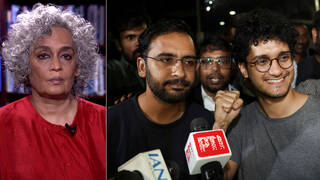
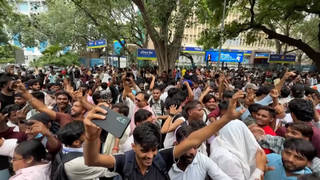
A court in India on Wednesday ordered the release of two leaders of the Cockroach Janta Party, the youth-led movement that has led historic waves of protests in India since the summer. Ashutosh Ranka and Saurav Das were detained amid massive protests last week after they scaled a barricade to enter a site popular for protest, unfurled the national flag and called for the resignation of Chief Election Commissioner Gyanesh Kumar. Kumar oversaw the deletion of 130 million names from the voter rolls in India since June of last year. Opposition parties say those impacted are primarily Muslims and other minorities less likely to support the BJP, the Hindu nationalist ruling party of Prime Minister Narendra Modi.
“You have a deep and wide — an ideologically wide — historical culture of resistance in India,” says acclaimed writer and activist Arundhati Roy. At the same time, the Modi government “has three things in its playbook: One is false-flag attacks, two is engineering communal riots, and the third is massive repression. And I don’t think we’ve seen its hand yet.”
Related Story
 StoryJul 29, 2026India Unleashes “Massive Crackdown” on Youth-Led Cockroach Movement After Education Minister’s Ouster
Transcript
AMY GOODMAN: This is Democracy Now!, democracynow.org, The War and Peace Report. I’m Amy Goodman in Los Angeles. Nermeen Shaikh is in New York.
On Wednesday, a court in India ordered the release of two leaders of the Cockroach Janta Party, the youth-led movement that’s led historic waves of protests in India since May. Ashutosh Ranka and Saurav Das were detained amidst massive protests last week after they scaled a barricade to enter a site popular among protesters, unfurled the national flag, called for the resignation of the chief election commissioner, Gyanesh Kumar. Kumar has overseen the deletion of 130 million names from the voter rolls in India since June of last year. Opposition parties say those impacted are primarily Muslims and other minorities less likely to support BJP, the ruling Hindu nationalist party of Prime Minister Narendra Modi.
This is Kamta Prasad, 53-year-old tailor in New Delhi, whose name was deleted from the rolls.
KAMTA PRASAD: [translated] My name should not have been omitted from the electoral roll, and the reason for deleting my name should have been made known to me. Why have they deleted it? My name was deleted during the Special Intensive Revision process. Also, they have declared me dead. There was no inquiry or investigation, and my name was randomly deleted. And I am very worried now because of this.
NERMEEN SHAIKH: And this is Kamal Lal, who lives in a settlement under a highway in New Delhi and works as a teacher. He’s concerned about losing access to welfare benefits now that his name has been struck from the voter rolls.
KAMAL LAL: [translated] If our voter identity card becomes invalid, we won’t be eligible for facilities like free food, rations and subsidies, which are based on this address on the card. We have been getting all these facilities. And now if the government won’t recognize us as voters, they might also demolish our homes.
NERMEEN SHAIKH: The Indian Express newspaper revealed in an investigation last month that two election commissioners had raised repeated internal concerns over the voter roll revisions, leading to the most recent wave of demonstrations calling for the chief commissioner to resign and the subsequent state crackdown.
Meanwhile, U.S. Secretary of State Marco Rubio was in India this week, where he met with the foreign minister and business leaders.
To discuss all of this and more, we’re joined now in studio by the acclaimed writer and activist Arundhati Roy. Her latest essay is about artificial intelligence and just out in Equator magazine. It’s headlined “Apocalypse Now and Then.” The essay formed part of her remarks at the People’s AI Assembly here in New York City on Monday. Her critically acclaimed memoir, Mother Mary Comes to Me, came out in paperback last month.
Welcome back to Democracy Now!, Arundhati.
ARUNDHATI ROY: Thank you.
NERMEEN SHAIKH: We look forward to talking about your AI piece. But if you could just respond to this latest news from India, the Cockroach Janta Party leaders being released, and then this 130 million people erased from voter rolls?
ARUNDHATI ROY: So, you know, for a long time, some years now, we’ve known that there’s been something terribly wrong with how elections are conducted in India. And you can see it, you know, in state after state, especially after the BJP lost the majority in the ’24 elections. Every even — you know, very clued-in local reporters would be reporting on elections in Maharashtra, Haryana, in all the states, and they would all be completely wrong. The BJP would win in sort of Saddam Hussein style, you know, like massive, sweeping majorities.
And now this exposé by Indian Express shows the process by which names have been deleted. And really, this is something that was happening in the state of Assam — many of us have written about it in detail — you know, where people are just declared doubtful voters. The government tried to bring in the Citizenship Amendment Act, and that was actually now coming through the back door, after the massive protests against it, as this new SIR, you know, the Special Intensive Review, where millions of names have been left out. So, it’s almost like the government is electing the people, you know, rather than the other way around. And the documents that the government asks for from people to prove that they have the right to be citizens, I think the last time that happened was in Nazi Germany, you know, a set of approved documents that nobody has. Even I don’t have them, you know?
So, you’re basically putting a whole country of millions of people into a kind of — you’re just removing the ground from under their feet. And as the person who was speaking just before me said, you know, they’ve — there’s been so little employment, so millions are on these rations, and those whose names are not on the list are now no longer eligible for that. So they have no rights. They don’t know what’s going to happen next. It’s not just about whether you can or cannot vote in the elections. It’s watching your whole life just slide into chaos, a whole country, really, slide into chaos.
NERMEEN SHAIKH: But the number is also extraordinary: 130 million people. So, can you — like, how did this Special Intensive Review begin, and what was the internal justification for it?
ARUNDHATI ROY: So, basically, I mean, that number, whether it’s 130 million or, you know, 100 million or however many million, some of them are people who were — died and whose names were still there. Then there are phantom people added on.
How did it begin? I mean, this is really very interesting, that basically they digitized the electoral rolls, and then, in this massive country — it’s a continent more than a country — you locked the local election officials out of access to those rolls, so it was all being controlled by the center. So, people, even electoral officers, who were saying, “Look, these are — these deletions are not right. These people are documents. They’re regular voters,” just wouldn’t get a reply. So, it was the centralization of the electoral rolls, as the centralization of the economy. You know, India has been a federal country, but now it’s just become everything is in the hands of two corporations and two men, you know, Modi and the home minister. So, they’re just doing what they like.
AMY GOODMAN: Arundhati, I wish I was in the studio with you and Nermeen there in New York.
ARUNDHATI ROY: I do, too, Amy.
AMY GOODMAN: Alas, I am in Los Angeles. But we’re talking about 10% of the Indian population, and the similarities to what is being attempted here in the United States in cutting people off the voting rolls and federalizing trying to take power. But I wanted to ask you about the resistance, which you so celebrate, the Cockroach Janta Party, youth-led political movement, satirical name originated after a judge described unemployed youth and activists as cockroaches, and so they took the name. Satire and art has shown up in many ways during these protests. Recently, a video game developer released a web-based game called Jantar Mantar Chalo, inspired by the recent protests. The game has gone viral. Jantar Mantar, a popular barricaded protest site. This is a clip of a game developer named Suraj Kushwah describing the game. He uses the Hindi words for procession, kafila, and for a sit-in protest, dharna.
SURAJ KUSHWAH: So, I was watching a lot of news, and there were so many people who were, you know, dodging police, trying to reach Jantar Mantar. So, I thought, like, it should be a game. … Goal is making a big kafila. OK, so, more people join you as a protester when you play, the bigger the kafila. And you can break the barricades. You have to reach the center of Jantar Mantar and do the dharna. As long as, like, you do it — like, the longer you do it, the more points you will get. So, and if you are playing as a police, you have to try to stop them.
AMY GOODMAN: Arundhati Roy, you have said that India is a country with such a deep culture of resistance, of intellectual thinking, unusual thinking, unusual kinds of dissent. And you’ve said, “How can you not have hope?” Describe the future, what you see, of both the resistance, these mass protests, and of Narendra Modi, the prime minister, a close ally now of President Trump.
ARUNDHATI ROY: So, I just want to complicate the whole thing a little bit, which is that, you know, it started off, as you said, as this satire where young people said, “OK, if you’re going to call us cockroaches, we’ll be cockroaches,” and that later sort of spark, which was so exciting, and young people who are not really affiliated to any political party began to show up. But then you had the entry of these very, very disciplined, inventive and serious left party students, you know, and they stabilized that protest, you know, because it’s not easy to maintain a protest for that many days. They’re the ones who had the songs and the slogans and all of that. So, there was a spark from the cockroaches. Then there was the stabilization from the left parties.
And now the big boys have entered, like the opposition, serious opposition parties. So, because — you know, spontaneity is not enough to face down this very, very hardcore regime, that has shown itself, I mean, to be capable of an incredible amount of violence. Right now they’re a little — even though the violence and repression is massive, and the police have been poured into Delhi, the fact is that, you know, like when the — when the anti-citizenship law, amendment laws, protests happened, you had BJP people literally calling for the death of protesters. And many people did die. You know, we had the image of these young Muslim men lying on the street, being kicked and prodded and forced to sing the national anthem, and they died.
Right now the government doesn’t know what to do, because this generation, for the most part, are the children of their own constituency, you know, so they’re really sort of on the back foot. And you have — as I said, yes, you have a deep and wide — you know, an ideologically wide — wide historical culture of resistance in India. And so, you have, you know, left parties who can be quite ideological. Then you have the Congress Party, which is more or less a hold-all, which — you know, which sort of includes the diversity of India, a party which I have criticized a lot, but now I think Rahul Gandhi is showing a different way of doing politics. I don’t know what will happen.
But having said that, this government is capable — I mean, it has three things in its playbook: One is false-flag attacks, two is engineering communal riots, and the third is massive repression. And I don’t think we’ve seen its hand yet.
Yesterday, the ideologue of the RSS, which is the mothership of the BJP, came out, and basically all of them closed ranks, you know, what are called the Sangh Parivar. So, they’ve closed ranks, and they are trying to say, “Look, Modi has saved India from becoming France,” whereas there was absolutely no violence at all from these young students or from anyone. But they’re trying to put a spin on it.
So, it’s going to be a long confrontation. The script is still being written, and I’m hesitant to say what’s going to happen, because I’m glad that I don’t know, you know? It’s something inventive and new that’s happening, and wonderful, but I do think they are a little puzzled.
And I will say that what happened in what we call season one of the Cockroach uprising was that these kids stripped Modi of this fake sort of glory that he had clothed himself in, and I don’t think any politician or individual has been so mocked ever in the history of time. You know, so that was a huge contribution. I don’t think losing an election or, you know, an essay by Arundhati Roy could have possibly achieved what that achieved. He’s just been cut down to size.
NERMEEN SHAIKH: So, we want to ask, before we conclude, about your piece on artificial intelligence, “Apocalypse Now and Then,” and perhaps one way to connect it to the protests now in India. Could you talk about the way in which tech, in general, and AI, in particular, have been deployed by many of the young people who are participating in the protests?
ARUNDHATI ROY: So, there were, obviously, a lot of very, very irreverent videos made on AI that sort of sparked the whole thing. It was, in some ways, an Instagram revolution. But that has been shut down. It has been shut down. You will not be seeing those reels that easily now, you know?
NERMEEN SHAIKH: Because they also —
ARUNDHATI ROY: Yeah.
NERMEEN SHAIKH: — turned off the internet, right? The Modi government.
ARUNDHATI ROY: They turned off the internet. But the other side of it is that they used facial recognition, which is absolutely illegal. You know, the police were there with facial recognition and surveillance software to identify individual protesters. And, you know, I write so much about what happened in Kashmir or what happened in Manipur, where they shut it off for three and four months together. So, it’s a double — you know, it’s a double-edged knife. You know, it is something you use for mobilization, but it’s also something that they shut down very easily, and it’s also something that they use for mobilization and spreading fake news.
NERMEEN SHAIKH: So, it’s not the case — sorry, we just have 20 seconds — that they just shut off particular sites, like turning off Instagram or blocking sites.
ARUNDHATI ROY: Yeah, they do. I mean, they target people, and they turn them off. They summon the Facebook officials. They are always, you know, suspending Twitter accounts and so on, I think more so than any other country in the world.
AMY GOODMAN: Arundhati Roy, we have to wrap here, but we want to continue with you, and we’ll post online at democracynow.org, acclaimed writer and activist from India. And we’ll link to your new essay, “Apocalypse Now and Then.” Her critically acclaimed memoir, Mother Mary Comes to Me, is out in paperback.
That does it for our show. Tonight, I’ll be at Temple Israel at 6:30, the screening of Steal This Story, Please! I’ll be speaking afterwards with the film’s director, Tia Lessin. It’s a film about Democracy Now! Tomorrow at Stanford University at CEMEX Auditorium, also at 6:30. That is free, folks, and I hope a lot of students come out. We’d love to talk about the importance of independent journalism. Check our website. Monday and Tuesday, Monday we’ll be at CU Boulder, University of Colorado Boulder, at 3:30 at the Dal Ward Athletic Center, screening the film and speaking after. And Tuesday at Fort Collins. That does it for our show. I’m Amy Goodman, with Nermeen Shaikh.



 Top
Media Options