



 Watch Full Show

Guests
- Amitabh Beharexecutive director of Oxfam International.
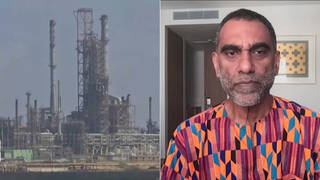
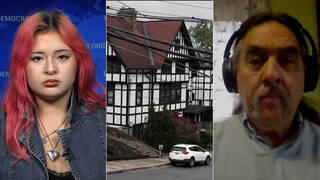
As world leaders prepare to head to New York for the United Nations General Assembly and Climate Week, Democracy Now! speaks with Amitabh Behar, executive director of Oxfam International. “We live in a very different world from 1945,” when the U.N. was formed, says Behar. “You cannot continue with the veto power.” And with António Guterres soon stepping down, Behar stresses that the United Nations’ next secretary-general must be a woman — “a fundamental shift we need to make.”
He also argues that while the world is “torn apart” by inequality, “there are real possibilities of change.” Behar cites the G20’s International Panel on Inequality and “movements across the world” aimed at “changing regimes,” including in Sri Lanka, Nepal, Bangladesh and India.
Related Story
 StoryApr 28, 2026Colombia Hosts First Global Summit on Transitioning from Fossil Fuels in Attempt to Break U.N. Deadlock
Transcript
AMY GOODMAN: As world leaders prepare to head to New York for the United Nations General Assembly, known as UNGA, U.N. Secretary-General António Guterres has warned the world has entered, quote, “an era of deep uncertainty,” unquote. He identified three existential threats confronting the global community: runaway artificial intelligence, the climate crisis and deepening inequalities.
The U.N. General Assembly is also taking place amidst the ongoing U.S. war in Iran, which has destabilized the Middle East and disrupted global energy markets, leading to higher fuel prices around the world. A new report by the Climate Solutions Lab at Brown University has found Americans have spent over $100 billion more on fuel due to the war in Iran. The soaring fuel prices have sparked protests in many countries, including Syria, Guatemala, Portugal, France, the Philippines, Indonesia, Bangladesh and Sri Lanka.
We’re joined now by Amitabh Behar, executive director of Oxfam International.
You’ve just come into New York for the U.N. General Assembly. It’s also Climate Week. Your focus is the deepening inequality in the world. Lay out what your message is, Amitabh.
AMITABH BEHAR: Absolutely. Let me start on a personal note. I grew up in India, and U.N. was all about hope, hope of a just and a peaceful future. But at the moment, what we are seeing is that the world is torn apart by the inequality emergency, the climate crisis, the wars all around. Just look at the obscenity of inequality. At the moment, 3,000 billionaires have a combined wealth of $18.3 trillion. That’s almost the GDP of China. And this is the time when the quarter of the global population actually lives with food insecurity. Almost 780 million sleep hungry. They don’t get three square meals a day.
But I think what is really important is that we need to reclaim our agency. We need to ensure that there are solutions. And there are solutions. And there are positive steps being taken at this moment. And that’s really the message to the U.N., that U.N. cannot continue to live with this fragility. It needs decisive action. It needs to give moral leadership. It needs to ensure accountability, ensure impunity is not tolerated. So, there’s multiple expectations from the U.N., and that’s the message from us.
JUAN GONZÁLEZ: But, Amitabh Behar, how would you — what precisely would you expect the United Nations to do, especially given the reality that in the current U.S. government, there’s more of a continued move toward unilateralism, to ignoring the U.N. and ignoring international agreements?
AMITABH BEHAR: So, let me start by talking of, say, inequality, because it’s about rebuilding our future. And on inequality, I actually see more than glimmers of hope. One of those big ideas that emerged from the G20 in South Africa is the idea of the International Panel on Inequality. And that’s being backed now by several member states: Brazil, South Africa, Spain, Norway. The entire Africa Union has agreed to back this. So there are different initiatives where specific countries are coming together to fight inequality and also for a better future. And this is really the moment where we do need to look at major reforms. So, I’m glad that U.N. is talking about U.N. reforms, U.N. at 80.
So, the reforms need to look at some of those changed geopolitics of the world. We live in a very different world from 1945 when we saw the U.N. come in. You cannot continue with the veto power, particularly the penholder power. We need to really, really change that. The realities of the world in terms of where — you have a far stronger Global South. That needs clearer representation.
And I would say one of the most important things is we must go back to the opening lines of the U.N. Charter, which is about “We the people.” The people get often missing in these conversations. So, it’s bringing the people’s voice. At the moment, you are seeing a shrinking of civic space. More than 90% of global population actually lives in closed contexts. So, there are different challenges, but, as I started, there are real possibilities of change.
And let me just add that while I talked of the member states and them coming together, I also take huge inspiration — for me personally, I’m hugely inspired by the movements across the world. And, Amy, you were talking about it. You know, I come from India, so I’ve seen movements in Sri Lanka, in Bangladesh, in Nepal changing regimes. In India, it’s the first time the Cockroach Janta Party, a students’ movement, was able to get a union minister dismissed. So, let’s not underestimate people’s power. People’s power is here, and they will certainly move towards a more just and equal society.
JUAN GONZÁLEZ: And a key change that the U.N. will make very soon is the selection of a new secretary-general, as António Guterres is scheduled to step down. What is Oxfam calling for in terms of a decision on who will lead the world body?
AMITABH BEHAR: It is really odd that in all these 80 years of the U.N., we have not had a woman secretary-general. We must ensure that we have a woman secretary-general. But let me also say, it is not just having a woman secretary-general; what we are talking of is feminist politics. It is a feminist worldview leading the U.N. And that’s a fundamental shift that we need to make.
The new secretary-general is going to have an extremely full plate, starting with tackling the emergency of inequality, the climate crisis and the wars growing everywhere. So, there is — this is a moment, pretty much, of a fundamental reboot for the world, and we need that decisive, moral, normative leadership coming from the secretary-general.
AMY GOODMAN: Oxfam is warning that artificial intelligence, AI, can accelerate global inequality. Talk about what you’re demanding there.
AMITABH BEHAR: Yeah, so, I think it’s very clear, and now you are seeing in the last few days the AI companies themselves are saying, that they need regulation. It is really important that there is some multilateral initiatives to govern the AI. We’ve seen over the years technology when it comes in. We often say that, “Oh, it’s going to be a huge boon for people.” But often we see how it ends up actually accentuating inequalities. We saw it during COVID. It was really heartbreaking to see that you actually had vaccine apartheid. Even for something of the scale of the COVID pandemic, there were pharmaceutical companies who wanted to make profits out of that pandemic. So, it is really important that we take a decisive multilateral action in terms of the AI.
But the story goes bigger. This is also about who owns these AI companies. It’s those tech billionaires who are pretty much now — you know, a report earlier this year at Davos talked of now the super-rich are not just happy being wealthy; this is about buying political power. So, we are shifting from this extreme inequality to oligarchies. It’s the same people who own AI are the people who are buying political power. These are oligarchies. They are the ones who also control media. They’re the ones who have full control of narratives. And then you have, essentially, state capture by these oligarchs. So, it is — AI, it is about our future. It is about the future of democracy. And this needs decisive action.
JUAN GONZÁLEZ: I also wanted to ask you about the issue of Palestine, and Israel’s genocidal war against the Palestinians. You recently released a statement titled “Palestinians Should Lead the Rebuilding of Gaza.” How would you compare how Oxfam views what needs to be done versus President Trump’s so-called Board of Peace?
AMITABH BEHAR: The Board of Peace came into existence in November '25. And it has a lot of legislative powers, executive powers, but what do you see? The continued killing of civilians over the last one year, so even after the Peace Board has been created. You're at the moment seeing in Gaza 90% of the people being water insecure. Sixty-six percent of the people do not even get the basic minimum standard of six liters of drinking water. This is not what we expected from any kind of a new executive party. What we really need is the Palestinian people building, rebuilding and leading their own future.
AMY GOODMAN: Finally, in this last minute, climate. We are moving into Climate Week this week in New York, and then, of course, the U.N. Climate Summit, which will be taking place in Turkey. What are the immediate demands? You spend much of your time in Nairobi, in India. We see the devastating effect of the breaking away of the glacier, the melting of the glacier in Nepal, and they have thousands.
AMITABH BEHAR: Yeah. The pictures from Nepal — I’m sure everybody has seen them — heartwrenching. And what we need to recognize is that the burden of climate crisis is borne by the most vulnerable and marginalized people. It’s the poorest of the poor, it’s women, who are the ones who are actually facing the burden of this climate crisis. We again need serious action, not just empty words.
I say, look, look at the question of climate financing. Even according to the estimates made by G77 and China, what we actually have, it’s not even 10% of their expectations. So, we need decisive action. But let me also further add, again, this is about the actions that the states need to take, but this is also linked to inequality. It’s the super-rich.
Let me just give you another interesting data point. The 0.1% of the top in terms of the wealth emit carbon in one day which is more than 50% of the bottom. So, that’s the — you know, in one day, they’re able to emit that carbon, which is more than anybody living in the bottom 50%. This is about the inequality crisis. We need to understand that the inequality crisis, the climate crisis, the crisis of democracy, they are interlinked. They’re different dimensions of the same fundamental problem of an unequal political economy that we have created.
AMY GOODMAN: Amitabh Behar, Oxfam International executive director, here for the U.N. General Assembly next week.
Coming up, the Pulitzer Prize- and Grammy-winning artist Rhiannon Giddens. She’s out with a new album today, Hope Is the Thing with Feathers. She’ll talk about Macklemore being kicked off Ed Sheeran’s tour. She’ll talk about what’s happening with the arts in the United States, and her own work. Stay with us.
[break]
AMY GOODMAN: “Walk with Me,” a duet by Rhiannon Giddens and her sister, Lalenja Harrington, from Rhiannon’s latest album, released today, Hope Is the Thing with Feathers.



 Top
Top
Media Options