









Guests
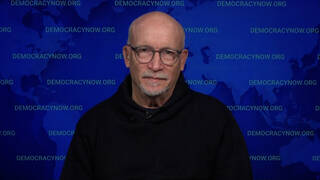
- Gil DuránBay Area-based journalist and author.
Part 2 of our interview with Gil Durán, author of the new book, The Nerd Reich: Silicon Valley Fascism and the War on Democracy.
Transcript
AMY GOODMAN: This is Democracy Now!, democracynow.org, The War and Peace Report. I’m Amy Goodman, with Anjali Kamat, as we bring you Part 2 of our conversation with Gil Durán, author of The Nerd Reich: Silicon Valley Fascism and the War on Democracy.
Gil Durán, in this Part 2 of the discussion, just start off by talking about: What is tech fascism?
GIL DURÁN: Tech fascism is like classic fascism in most respects. It’s a cult of grievance and self-victimization that seeks to return to a mythical greatness by purging its demonized enemies, using propaganda focused on law and order, gender and sexuality, in order to impose a permanent hierarchical structure on the world. This hierarchy is what they consider the moral order of the world. And in their idea, it’s basically that rich white men should rule the world and the universe, and that’s the things — the way things should be.
AMY GOODMAN: It’s very interesting. At the end of his presidential term, President Biden warned about the tech billionaires. Talk about what he said.
GIL DURÁN: In his final speech as president, Biden said that the democracy was in danger from what he called a tech-industrial complex that had become radicalized and powerful and that was rising in our midst. And it’s not clear why he waited ’til his final speech to warn everybody, because this thing was growing in plain sight for a few years.
But I start my book with that, because I want people to understand this is not just one journalist with a newsletter saying this. This is something that the president of the United States declared in his final speech, clearly intending to warn people about what was coming.
And a few days later, Elon Musk stood behind the presidential seal at an inaugural event for Trump and threw a Hitler salute. And we’ve seen the rest of this regime, since then, follow these terrifying, scary contours of history, with masked, armed goons roaming around targeting immigrants, people being prosecuted for protesting, etc. So, I think that the president’s warning was important, but it came far too late.
ANJALI KAMAT: Yet many of these same tech billionaires had supported President Obama before. What changed their mind and sort of cemented this fascist turn?
GIL DURÁN: It was in their interest at the time, because Democrats had power.
And, look, no one should be happier than the tech billionaires. They have won our system. They have all the money. They have tremendous influence and power. A lot of these guys, like Elon Musk and Peter Thiel and David Sacks, they’re immigrants. They weren’t even born here. They came to our country, and they became massively successful and wealthy.
And now they’re full of anger, and they feel like it’s not enough, and they want more. And with Trump, they see now, in their own self-interest, or so they think, the opportunity to completely change how our country works, to disrupt democracy. This is largely what venture capitalists do: They bet on disruptive technologies that can provide a massive return of some kind in terms of profit. And they’ve bet on Trump and on fascism as a way to destroy democracy and make sure billionaires don’t have to worry about other people and the threat of the vote in the future. That’s very much the project they’re working on.
AMY GOODMAN: Talk about the men who stood behind President Trump, and how unusual it was, in his second inauguration.
GIL DURÁN: Definitely. You had Mark Zuckerberg, who had previously banned Trump from Facebook, at his inauguration. You had the head of Google, Sundar Pichai, there. You had Elon Musk, which is really no surprise; Jeff Bezos, who for many years seemed like a heroic guy to some people, the guy who was going to save The Washington Post, and now it’s become the opposite of that. The Washington Post editorial page, which in normal times would be a watchdog against corruption and excess, is now a lapdog for Donald Trump’s regime.
AMY GOODMAN: Of course —
GIL DURÁN: And — yeah.
AMY GOODMAN: — it was Bezos who intervened when they were going to endorse Kamala Harris, and said there would be no endorsement.
GIL DURÁN: Yeah, that’s where it started. And we’ve seen the results since then. It’s hard to even recognize the Post. I mean, there are good reporters there on the news side still, but the editorial page has become a complete lapdog for Donald Trump. And this is how that works, that it’s money chasing power, and power chasing money.
AMY GOODMAN: So, for example, how did Zuckerberg change?
GIL DURÁN: Zuckerberg is just doing what he thinks is in his own self-interest. I see Zuckerberg largely as a follower. The thing to keep in mind about Zuckerberg, though, is that the first major investor in Facebook was Peter Thiel. Wherever you look in the story of how Silicon Valley billionaires have become radicalized against democracy, you find the influence of Peter Thiel lurking not far away.
If Kamala Harris had won the election, we would see an entirely different behavior out of these people. You know, they would be promoting diversity and putting people of color in important positions and espousing progressive values. But now the mask is fully off, and we see what these people truly are. You can’t go this hard in favor of an authoritarian regime and expect to ever recover your reputation. So they’re kind of locked in now, which makes them desperate and, I think, makes them more dangerous.
ANJALI KAMAT: And who do they turn to for inspiration? Who are the world leaders in other countries that inspire them? And they’ve also set their sights beyond the United States, as well, their projects in Honduras, in Greenland.
GIL DURÁN: Yeah, I mean, they love authoritarianism, because it’s more — especially authoritarianism that is open to capital investment, where you can buy what you want. I mean, it was Mark Zuckerberg who asked the dictator of China to name his child, and he refused. I mean, this is bizarre behavior from a tech CEO.
In Honduras, though, they’ve created this project called Próspera, which is supposed to be this new territory, a wannabe nation where they make their own rules, laws and regulations. And you’re starting to see this idea pop up in different parts of the world. There’s one now being built in Kazakhstan, where the government plans a crypto megacity.
And this comes from this same group of ideas, which some call the “network state cult,” this idea that we should invest in creating new territories that will become independent countries in the 21st century and give all of these billionaires escape routes when their prophesied apocalyptic collapse of democratic nations takes place.
And Trump himself has promised to build 10 new “Freedom Cities” in the United States. These would be new private cities built by corporations on federal land. It was part of his 2024 platform. And what was interesting to me in my reporting was that, though people like Politico and others reported superficially that Trump had promised to build these cities, no one has ever explained: What’s a Freedom City? Why do we need Freedom Cities? And where does the idea come from? It comes from these crazy, radical Silicon Valley network state ideas.
AMY GOODMAN: Can you talk about Peter Thiel both as founder of PayPal, but then Palantir, and the role Palantir has played, how it’s been used by militaries, domestic and foreign, for example, to spy on people?
GIL DURÁN: What’s interesting about Peter Thiel is that for many years people described him as a libertarian. But for most of the time that Peter Thiel’s been in the public eye, he’s actually been a government surveillance and military intelligence contractor through Palantir, a company named after this all-seeing stone wielded by an evil wizard in The Lord of the Rings. And Palantir has quickly become one of the most well known and, I’d say, most hated tech companies in the country, because it’s being embedded in the military, in intelligence, in ICE operations, and as part of this massive surveillance apparatus coming out of Silicon Valley that is now partnering with an authoritarian regime.
And something interesting about Peter Thiel, back in 2010, he gave a speech in which he said government was fundamentally evil. And this guy, he’s talking to a group of libertarians. He’s a government surveillance contractor, which is about as far away from the libertarian idea as you can get.
And so, what you see is a group of men who opposed government until they saw the chance to claim government power for themselves. And Palantir is raking in billions of dollars in government contracts under Donald Trump as Silicon Valley pumps billions of dollars into the Trump family. It’s a tower — technology has proved to be a weapon of mass corruption in Washington. If you look at how much the crypto cartels are spending in our elections, they’re now the biggest spender in politics. Ten years ago, they weren’t even in existence in the political game.
AMY GOODMAN: And explain what they are.
GIL DURÁN: Yeah. Crypto? Crypto is a fake, digital, wannabe currency that’s mostly useful for scams, human trafficking, drug trafficking and crime, and gambling. And a very small percentage of Americans use crypto, less than 20%. Pew reported a few years ago it was 14%. But they are now the biggest moneyed force in American politics, basically holding our political system hostage by promising to spend tens of millions of dollars against any politician who dares to challenge crypto and doesn’t support crypto in any way. This would be like if a drug cartel suddenly entered American politics and threatened anybody who refused to legalize cocaine or heroin. This is what we’re watching here. Yet it’s become completely normalized.
AMY GOODMAN: And how does President Trump and his family fit into that picture?
GIL DURÁN: President Trump spent years describing crypto as a scam against the dollar. And on the day he returned to the White House, he became a crypto billionaire. And he is now the country’s crypto-bro-in-chief. His entire family is cashing in with bitcoin mining, with coin scams. Even Melania had a coin, that sucked money out of dummies and then enriched the Trump family. So, it’s amazing. At one point, The Wall Street Journal reported that the Trump family’s fortune had increased by $5 billion thanks to crypto. But because crypto’s so scammy and volatile, it’s now down to about 1.2, I think, in today’s news reporting.
ANJALI KAMAT: I want to go back to Palantir. You were banned from X for criticizing Palantir? Can you talk about what happened?
GIL DURÁN: In April, I was banned from X for criticizing Palantir’s manifesto, that they published, as fascism. I just said ”TLDR: Fascism,” Too long, didn’t read: Fascism.” But that follows a weird trend. The year before, Facebook banned links from my newsletter from being posted. And when I asked why, a representative said it’s because I write about the network state and I criticize tech figures, which was an amazing thing for a rep from Facebook to say. And after that got media attention, they reversed it. I was also banned by X when Elon Musk first bought it.
And right now YouTube is threatening to take down my little podcast, because I’m being targeted by a campaign of false copyright claims, which is a tactic that’s emerging now. You can pay people, often emanating out of India, to just file constant copyright strikes. And YouTube’s answer to this problem is to just remove your channel permanently. And by Saturday, we’re supposed to be offline. So, I think my book is upsetting some people.
AMY GOODMAN: You know, ABC reported last week that a Trump-appointed national bank regulator granted a wing of the Trump family’s crypto business conditional approval to establish a bank charter, opening the door to larger clients and potentially heightened profits. The decision marks the first time in U.S. history that a company owned by the sitting president’s family has been granted bank status.
GIL DURÁN: A weapon of mass corruption, that’s what crypto is. We are basically living right now in a crypto banana republic. And it’s not clear why any Democrat or any Republican, for that matter, who loves this country is supporting crypto, taking crypto, legitimizing crypto. If you look at the history of crypto, it is openly designed as a way to undermine government authority and power. It was seen by cypherpunks as a way to escape from democracy, from rules and from law. So, why now do we have the president and his family starting a crypto bank, going into cryptocurrencies? You know, people are losing millions and billions of dollars to these scams. And, you know, it used to be that crypto was only useful for drug dealing, human trafficking, gambling and crime. Now it’s being used to buy power in order to break the country. And I think there has to be a real reckoning with the role of this pernicious technology, that is so — I mean, the corruption is so staggering, it’s almost hard to explain in words.
AMY GOODMAN: So, the question is: Where does government fit into this picture? You quoted President Biden’s last speech, warning about the tech-bro-industry complex, the technology-industry complex, or TIC. But what are Democrats doing right now in Congress? And what are Republicans doing?
GIL DURÁN: Largely not going after the Silicon Valley oligarchs who are behind Trump. You know, a lot of people are attacking Trump and criticizing his family, criticizing Vance. But we don’t see a lot of direct criticism of these billionaires who are enabling the entire thing. The way I look at it, Donald Trump is being paid billions of dollars to do these things, right? When’s the last time we had a president make billions of dollars while in office? This is direct transfer, including from foreign governments that are buying into and investing in his companies to curry favor.
I think we need to see Democrats speaking directly against billionaire power, against tech billionaire power, against the crypto takeover of our country. You see all these Democrats trying to say, “Oh, AI innovation, Silicon Valley innovation.” Those are outdated talking points. Silicon Valley is no longer about innovation. Silicon Valley is about fascism and a race to control the future. And that future will not be good for most people. And it’s the job of our elected officials, especially on the Democratic side of things, to stand up for the people.
There are a few people doing it. You see Bernie Sanders, James Talarico, Jasmine Crockett and others who have spoken directly to this, Chris Murphy, Ron Wyden. But people like Gavin Newsom and others are suspiciously avoiding any critique of Silicon Valley. And I don’t think we can have that going forward. People are waking up to this threat. We see it all across the country. And we need politicians who match the energy of the people, or we need those people to be the new politicians.
ANJALI KAMAT: We’re seeing this massive movement against data centers, right? Across the country, people are opposing data centers. What’s happening in Silicon Valley? Is there some resistance to this massive takeover and this kind of ideology?
GIL DURÁN: A little bit. Nothing too noteworthy. Most of the resistance is coming from communities that are being targeted by data centers, that are being targeted by Palantir surveillance and fascism aided by ICE. You see people resisting and rising up. There are also movements like Purge Palantir, which is boycotting any company that has Palantir products, raising awareness of the role of this company in our government, and putting a lot of pressure on the company. Same thing is happening to Flock surveillance, where people are starting to militate against putting these Big Brother facial recognition, license plate recognition cameras in every aspect of our lives.
So, you see people waking up to that. And it’s not just Democrats, by the way. It’s also Republicans and independents. And it’s also people who are not activists. It’s people who are just becoming activated by the threat of this alien invasion of our country by these surveillance-mad, power-hungry billionaires. And it’s pretty inspiring to watch. It’s the grassroots, and I think the politics are going to have to catch up with that.
AMY GOODMAN: As we begin to wrap up, what is missing from the whole debate around artificial intelligence?
GIL DURÁN: The question is why we are pursuing this idea that we have this dangerous technology that is going to kill all of our jobs and potentially wipe out all of humanity. This is the marketing of the AI industry itself. And why is that being made to seem inevitable? I don’t think it’s inevitable at all. I think we have the right to reject this dystopian future that’s being imposed on us. How does it make sense to destroy our economy to enrich a handful of oligarchs who are already wealthy and whose wealth has driven them insane and hasn’t made them very happy?
You know, we have this problem where it’s becoming a competition between democracy and capitalism, and which one is more important. You know, even before the tech bros came along, we were destroying the planet for a handful of fossil fuel companies. How does that make any sense? There has to be a different way to do this.
And the same thing with AI. AI is being marketed as this destructive, terrifying force, and we all have to invest in it and adopt it or else. And I don’t think it has to be that way, and I think people need to push back harder on a policy level and stop trying to ingratiate themselves to the AI moguls, which is largely what’s happening now. Even the best politicians among us are playing along with this idea that this is an intelligence, which it’s not, and that this is inevitable, which it’s not.
And so, I think we need to backtrack a bit and get off of this idea, and question the narrative that we have no choice except to bow down to this AI god these guys claim to be building, that it’s a religion. It’s a myth. It’s not real. I don’t think LLMs are completely useless. I think there’ll be some good applications for AI.
ANJALI KAMAT: Explain what LLMs are.
GIL DURÁN: Large language models, like Claude, etc. I don’t think these things have to be useless. I just don’t understand why they have to eat everything. They don’t. This is — this is the marketing for the investors. This is convincing people that you have to spend trillions of dollars on this, so we can create this massive thing that will then suck all of the value out of the economy and render every worker useless. This is absurd, it’s ridiculous, and it’s an apocalyptic cult.
ANJALI KAMAT: You know, you’ve been spending time reading the statements and writings of all of these figures. What scares you the most?
GIL DURÁN: What scares me is that you can be as anti-American and anti-democratic as Peter Thiel and still be a government contractor with investment from the CIA. I mean, Palantir was created with investment from the CIA. And I worked in government for many years for Democrats. I worked for Senator Feinstein when she was chair of the Intelligence Committee. And it boggles my mind that you can say that kind of stuff and believe these radical things and still be that deep in our intelligence infrastructure. I have a lot of questions about what went wrong there. I mean, to get into government, you have to pretend like you never smoked marijuana, and here you are smoking the most anti-American, anti-democratic dope in the world and becoming a billionaire off of government contracts. That’s what scares me.
How did no one catch this? You know, trying to talk about what’s happening to our country without talking about these tech fascists is like trying to explain 9/11 without talking about al-Qaeda. This cult of dangerous billionaires has a very pronounced idea of what our future is, and it’s not going to have democracy in it. And I don’t understand how they got this far, this fast. Nobody — and even today, most people in the media and the political establishment aren’t really addressing it. And I hope my book can help change that.
AMY GOODMAN: The name of the book is The Nerd Reich: Silicon Valley Fascism and the War on Democracy. The author, Gil Durán. To see Part 1 of our conversation, go to democracynow.org. I’m Amy Goodman, with Anjali Kamat. Thanks for joining us.



 Top
Top
Media Options