










Guests
- Wolfgang Kalecklawyer and founder of the European Center for Constitutional and Human Rights.
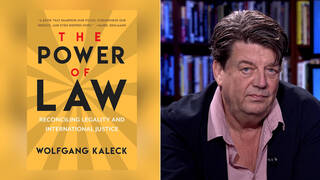
Part 2 of our discussion with Wolfgang Kaleck, German human right lawyer and founder of the European Center for Constitutional and Human Rights. Kaleck was an attorney for NSA whistleblower Edward Snowden and now represents the family of Patrice Lumumba. His new book is The Power of Law: Reconciling Legality and International Justice.
Transcript
AMY GOODMAN: This is Democracy Now!, democracynow.org, The War and Peace Report. I’m Amy Goodman in Berlin, Germany, with Anjali Kamat in New York.
ANJALI KAMAT: As the United States escalates its attack on the International Criminal Court, we continue our discussion with the German human rights attorney Wolfgang Kaleck, the founder of the European Center for Constitutional and Human Rights. Wolfgang Kaleck’s new book is titled The Power of Law: Reconciling Legality and International Justice.
Wolfgang, why did you choose to write this book at this moment?
WOLFGANG KALECK: Because, of course, the attacks against international law are well known. And what really shocked me was how little the support for international law was, and that, of course, we have, you know, the realpoliticians, in the line of Henry Kissingers and others, we have the far right, represented internationally by President Donald Trump and Javier Milei from Argentina, but, unfortunately, many liberal, democratic and even leftist people did play down the role international law played in the last couple of years and can play.
And so, that was my starting point, to bring another perspective into the public discourse, in particular in Germany, because Germany — you know, despite all the critiques that Germany, the German government and German politicians deserve, they played an important role in the establishment of rules and institutions in international law.
ANJALI KAMAT: Germany is one of the biggest funders of the International Criminal Court. Do you believe Benjamin Netanyahu would be arrested if he came to Berlin?
WOLFGANG KALECK: He wouldn’t come to Berlin, because he knows that — he knows it. And so, it’s a fake discussion. It’s a stupid discussion. And I think even Chancellor Merz, whom you quoted when he was saying — before he was chancellor, he was saying that Benjamin Netanyahu would be allowed to visit Germany without being arrested. He, Chancellor Merz, rode back, because it’s very clear it would be unlawful.
And this is also the — but this is one of the problems of German foreign politics right now. It’s not principled enough, because if you defend an institution, you have to defend the institution when it’s attacked. And I’m happy to have heard that our foreign minister went to The Hague. The minister of justice was there before. They are defending the court, and the court needs defense.
You have to say one thing, you know, about the chilling effect of sanctions and everything. The court became very, very active and is very courageous since they learned about the first sanctions against judges and prosecutors. It’s not that they shied back. And that is something I would really — that is also something encouraging. You know, when you go to The Hague these days, the people are working more than ever and are struggling more than ever to fight impunity wherever it is necessary.
ANJALI KAMAT: Now, one of the things you do in this book is you give us the longer view of the attacks on international law. This isn’t something that is new with the Trump administration. So, tell us a little bit about that history. And, you know, we’re also — you know, this is the 25th year since the 9/11 attacks here in New York. What role did the September 11th attacks play in the weakening of international norms?
WOLFGANG KALECK: It’s about narratives. And so, one narrative is that the post-Second World War liberal world order was actually, you know, fair and just for all people in the world. And this was definitely not the case. The world was in disorder for many people in many parts of the world for many decades. And this is why I remind us from all the crimes, only the Western crimes. I could have mentioned the crimes of the Soviet Union and others, but I’m focusing on the West, not because they’re worse or better, because we live in a Western country.
And one thing is, what I’m — what I’m really writing against and what I’m speaking against is this notion of, you know, there were better times. No, the times were not better. I mean, you live in a country where, you know, the Vietnam War was fought, and it went impune. You know, they bombed the country. They committed war crimes, crimes against humanity, and then Latin America, Central America, and it went all impune.
But I think a main difference between back then and now is that many people lost the hope, and many people feel powerlessness also in the light of the many crises we’re experiencing right now. And this is why I want to write. You know, I want to write an assessment which is, you know, as ambivalent and as contradictory as our life and the political situation is. Yes, there were strokes, there were violations of international law in history, and there are strokes and violations of international law now. But there were always people who fought against it, and we gained some achievements, and that should not be forgotten.
AMY GOODMAN: So, if you could talk, Wolfgang Kaleck, about what gives you the most hope at this point? I mean, we have never seen such a frontal assault on the International Criminal Court. I mean, President Trump, the Secretary of State Marco Rubio clearly trying to completely dismantle it. But you also talk about protests and actions that followed the U.S. response to 9/11, from the wars in Afghanistan and Iraq to Guantánamo, to the prison in Iraq, Abu Ghraib. So, talk about what is happening. And do you feel they could succeed, President Trump, in dismantling it and pressuring countries to do that, and what the resistance, the most effective forms of resistance over the years?
WOLFGANG KALECK: Yeah, you mention 9/11, 2001, in this country. And, I mean, I want to remind us that the Bush administration, which seems now to be a well-respected government in the global opinion, which I find incredibly wrong, because they installed a worldwide torture system, and they started the completely blatant Iraq War in 2003, which led to 1 million lives and to much more instability and insecurity in the whole region.
So, the interesting thing is that law made a difference by that time. When the Center for Constitutional Rights — and they were really the avant-garde, the icebreakers of that time — when they started their Guantánamo litigation, they were attacked. They received hatred mails. And a couple of years later, you know, in the early 2000s, they were joined by pro bono law firms in this country. They were joined by many other NGOs. And that’s an expression of hope and resistance, because lawyers in this country, including lawyers from the administration, realized that this is a frontal attack against the rule of law, and they acknowledged the importance of rule of law.
And so, the idea of making Guantánamo a model, you know, to exterritorialize torture in order to close completely access to justice, that model failed. And that is due to the resistance in this country, but also outside this country. And this is, for me — of course, it’s insane that Guantánamo is still open, and most of the people who tortured there and elsewhere went impune. But still, it was an important step forward. It could have been worse. And it was also an expression of the hope that the law can be applied against the powerful in the world. And so, that’s how I read the story. I completely understand people who read it in another way.
And then, of course, you mentioned the protests. There were millions of people all over the world protesting against the Iraq War. And I’m deeply missing that right now. I’m deeply missing that right now. Things have even become more difficult. We know that. But, you know, only to mention these two situations: the Ukraine and Gaza. We have the Ukrainian civil society documenting the Russian war crimes from day one, with all the costs. And even under very much worse conditions, the Palestinian organizations, journalists, photographers, human rights lawyers are documenting Israeli crimes in Gaza — and, of course, please don’t forget the West Bank. They are documenting these crimes in order to bring cases, in order — and that is inspired by the hope that someday there will be something like justice.
And I call my own people in Germany, but also here in New York. I mean, it’s irresponsible to leave them alone. You know, if they do this work under these conditions, we have the obligation, you know, to stay in solidarity, rather than lamenting, drinking wine and going on to our country houses and play music and yoga.
ANJALI KAMAT: Wolfgang, you invoke Gramsci’s famous edict: “pessimism of the intellect, optimism of the will.” You know, how has that guided this book and your life’s work?
WOLFGANG KALECK: I mean, we have to be very clear in the assessment of the current political situation. It’s not good. It’s not good at all. But remember, Antonio Gramsci, the Italian communist, wrote this famous quote and all his thoughts in a fascist prison, you know? And this guy, you know, guided us all over the years, because he and many other thinkers of that time were very clear. The time will come when, you know, we have again the possibility to establish a free and just society. And that is also something, you know.
With all humility, we have to understand that others were struggling for the same goals a while ago — the workers’ movement, the feminist movement, the U.S. civil rights movement and many others. And we stand on their shoulders. You know, it means that we have to acknowledge that the times are difficult, but the times were difficult before, as well, and people didn’t give up to fight. And that’s what makes me so sad, that many people, you know, are not willing and able to fight. I can understand that as a personal decision, and I’m not criticizing any individual, but that’s not a collective answer. The collective answer must be to challenge injustice.
And when I say the law of — the power of the law, it does not mean that law is the solution, the only solution. No, law is one tool. Mobilizing international law meant in the last decades democraticizing international law. It was the domain of diplomats, of states, of corporations. And now we came into the play, and that’s an important step forwards. And that’s why we can continue on in this regard.
ANJALI KAMAT: Wolfgang, you were quite involved in some of the struggles for accountability and justice in Syria. Can you give us an update on what’s happening with that?
WOLFGANG KALECK: Yeah, that was a very striking example, what justice can achieve and what not. I mean, we have a 1-million-people diaspora community of Syrians in Germany. And with this community, we worked out, you know, a strategy of bringing cases in Germany and elsewhere in Europe against the Assad regime in the last 10 years, and it resulted in a number of judgments. The most important, in the beginning of 2022, the high court of the provincial town in Koblenz convicted a torturer, a torturer colonel. And the wonderful thing was that we, as European Center for Constitutional Rights, the lawyers, as well as our clients, were very clear that this is not justice. You know, this is not justice in the sense of comprehensive justice. This was not the end of impunity. But it was an important step forward. And because we had the privilege to work with the diaspora community, this was communicated back to Syria.
So, you saw the pictures after the overthrow of the Assad regime, you know, the opening of the infamous torture prison, Sednaya. The accountability question, the question of truth and justice, was on the table from the very beginning, and you didn’t see that 20, 30 years ago in other parts of the world. That’s something new, and that’s an achievement.
Of course, there are always setbacks. So, we cannot — we cannot support trials like in Syria, in Damascus, last month, where members of the Assad regime and others were, in a very short and quick trial, convicted to the death sentence. That is U.S. style. I mean, that’s the way how the U.S. set on trial on Saddam Hussein, the former dictator of Iraq. And that’s not in accordance with human rights standards. The accused, even the torturer, accused of torture and war crimes, they have the rights to a fair trial. And, of course, the death sentence is not in accordance with international human rights standards, despite the practices in China or in this country.
AMY GOODMAN: You say, Wolfgang, you — last November, you hosted Syria’s National Commission for Transitional Justice here in Berlin, Germany. If you can explain what that is, and then tell us about the ceremony you witnessed in Paris last year honoring Syrian opposition figures associated with the photographer who smuggled out images of tortured bodies from Syria? It’s so interesting. Just before we talked to you, we talked to Mahmoud Khalil, who ultimately left Syria, he, himself, as a teenager, taking on the Assad regime.
WOLFGANG KALECK: I mean, the Assad regime, father and son, ruled Syria over decades. And one of the — one of the most important tools they used was torture. So they installed a system of torture prisons. And so, in the moment when the democracy movement in the Arab Spring gained more and more support in Syria, the oppression went more and more brutal, including forced disappearances and including torturing and killing people.
But there were — and that is also something we have to remind. You know, there were really courageous individuals, and one of them was the military photographer “Caesar,” who was supposed to photograph and document the dead corpses, dead of torture, and he, with the help of his group, smuggled these photographs out of Syria, and this allowed us, the worldwide human rights community, to go public and say, you know, “Here, we have a documentation of the crimes. There is no excuse. There is no legitimation.” And so, they laid, to a certain extent, the ground for the trials and also for the condemnation of the Assad regime.
And they — in this ceremony you just mentioned of last year, they promised to continue, and that is also something. You know, they didn’t say, “OK, now the power in the Assad regime is overthrown, and now we’re facing a new era.” No, they know that this is another struggle. Another struggle began.
And so, I understood also the position of the commission, which was installed by the new government. There are a lot of controversies. A friend of us, a colleague of us, was called to join the commission, and she left it earlier this year, because she says, “This is only one-sided. The new government doesn’t look into the crimes of all factions involved in the war in Syria of the last years, but only looks into the crimes of the Assad regime.” But this is what happens. This is the kind of struggles which are — you know, which are quite normal after the overthrow of a decadelong dictatorship. But it’s incredible, and this is the kind — also the kind of thing.
You know, yesterday, I was speaking at Columbia University, and one student asked me, “Have you experienced surprises in your life?” Obviously, I have. And one of the surprises was, you know, five years ago, if you would have said that in Syria the Assad regime is overthrown, we wouldn’t have thought about it, and that there is a talk of accountability, that there is a commission, that there is a — they opened the prison. They search for truth. And that is also history. History is open in all directions. And that is something people have to realize again. And the question is: Do you want to throw yourself into these struggles, or do you want to be a bystander?
ANJALI KAMAT: Wolfgang Kaleck, thank you so much, German human rights lawyer and founder of the European Center for Constitutional and Human Rights. His new book is titled The Power of Law: Reconciling Legality and International Justice. I’m Anjali Kamat in New York, with Amy Goodman in Berlin. To see Part 1 of our discussion with Wolfgang Kaleck, please go to democracynow.org.




 Top
Media Options