



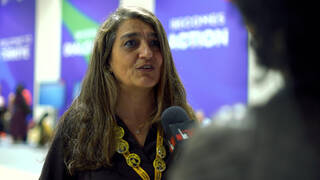




Democracy Now! recently broadcast from the U.N. climate summit in Antalya, Turkey, where co-host Anjali Kamat spoke to Milena Büyüm, a senior campaigner on Turkey for Amnesty International.
Related Story
 StoryFeb 13, 2023“Crisis on Top of a Crisis”: Syrians Displaced by War Now Dealing with Earthquake Devastation
Transcript
AMY GOODMAN: This is Democracy Now!, democracynow.org, The War and Peace Report. I’m Amy Goodman.
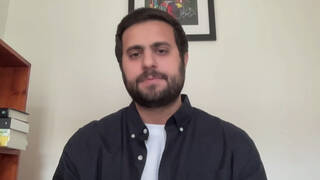
We turn now to look at Turkey’s crackdown on human rights. Democracy Now! recently broadcast from the U.N. climate summit in Antalya, Turkey. We were there from November 13th through the 20th, the second week of the COP31, conference of parties. While we were there, Democracy Now!’s Anjali Kamat spoke to Milena Büyüm, a senior campaigner on Turkey for Amnesty International. She began by talking about the state of human rights in Turkey.
MILENA BÜYÜM: Well, I think there is a crisis of human rights in Turkey. It’s a deepening crisis. It’s not new. It hasn’t just started on September 12th, when there was a huge wave of crackdown on LGBTI people and organizations. It didn’t even start when the opposition party was being roundly subjected to a criminal investigation, and the mayor of Istanbul, presidential candidate Ekrem İmamoğlu, was imprisoned 18 months ago. It didn’t even start, actually, after the coup attempt in 2016. You know, there was a huge wave of protests in 2013.
I’m wearing badges of prisoners of conscience around my neck, because Osman Kavala, a leader of civil society in Turkey, has been in prison for over nine years now. The other four are — and he is in prison for life without parole for allegedly attempting to overthrow the government, completely fabricated allegations. And there are three European Court of Human Rights judgments demanding he be released, and yet he’s still in prison.
This is Çiğdem Mater. She is a film producer, and she’s supposed to be one of the other four. All of them are facing 18 years in prison. They’ve been in prison since April 2022. And she is — essentially, one of the key accusations against her was that she planned to do a documentary about the Gezi Park protests, the 2013 Gezi Park protests, a documentary that was never made, actually. So —
ANJALI KAMAT: And these were protests for what?
MILENA BÜYÜM: The protests began to protect Gezi Park in central Istanbul, one of the few green spaces in that overbuilt area of Istanbul.
ANJALI KAMAT: It was an environmental protest.
MILENA BÜYÜM: It started as an environmental protest, because they wanted to build a mall, a shopping mall, in place of the park, and people defended the trees. And they were actually successful. You know, this is one of the things that is incredible, because there was an occupation of the park that spilled over to Taksim Square, which was heavily repressed. There was a lot of people involved in it. And the park still stands. So, you know, there is a bitterness from the part of the government, I think, also to the fact that they didn’t — they were — they had to abandon that plan for the park.
Mine Özerden is also involved in media. She was involved in an organization called Taksim Solidarity, and she is facing the same conviction. She had the same conviction as the other — the other three.
This is Tayfun Kahraman, an urban planner, who was actually — during Gezi Park protests, was part of the negotiations with the authorities. He went and spoke to government representatives. He is accused, as the others, of helping Osman Kavala, trying to overthrow the government.
And finally, Can Atalay, he’s a lawyer, and he was the lawyer of one of the big umbrella organizations during the Gezi Park protests. A very outspoken lawyer, he’s been on the side of a lot of struggling people, like the Soma mine workers who perished in a mining disaster some years ago, and other big campaigns like that. So, all five of them are prisoners of conscience for Amnesty International.
ANJALI KAMAT: The mayor of Istanbul is under arrest.
MILENA BÜYÜM: Yes, the mayor of Istanbul is facing a range of accusations. The trial, the Greater Istanbul Municipality trial, started in March this year. If found guilty, he could face over 2,300 years in prison. I don’t know what your viewers might think of that. It’s, you know — he was basically about to be chosen as the presidential candidate of the main opposition party, CHP. First, his university diploma was removed, was canceled. Then he was in prison — he was arrested and put in prison in pretrial detention. And this, you know, along with 400-plus other elected CHP representatives, activists, etc., allegations of corruption, allegations of misuse of public funds, etc., on the basis of, you know, statements from others who are being accused of criminal conduct, who have since — some of whom since have withdrawn their statements, etc.
I mean, it’s a complete mess and a situation, a landscape, which, actually, with the crackdown on the media, most Turkish people are not able to properly know about, think about, question, demand action, etc. And, you know, without a free and diverse media, the ability of people to both share information and receive it is completely impaired.
ANJALI KAMAT: What is the state of media freedoms here in Turkey? Just a few days ago, another opposition TV channel was raided.
MILENA BÜYÜM: Yes, Sözcü TV was briefly taken off air. A number of people from Sözcü TV were detained. It’s now still broadcasting, but under strict instructions that it should not go outside a certain way of reporting news or, you know, debating issues. Questions are not really allowed. I mean, last month, Halk TV, the biggest of the opposition TV stations, was also shut down and taken over by state-appointed trustees, which is a huge blow to media freedom. Again this week, we saw a very similar action by the state authorities. There is barely any — I mean, in the last two years, this is the 11th TV station that has been closed down. It was already a narrow space for alternative views, alternative platforms for discussion. Now that space has narrowed down. An online news portal, which has been hailed as a good place for verifying news and information, T24, was shut down, you know.
And the space for actually activists, human rights defenders, anyone who wants to raise questions about what’s going on in the country has been — you know, it’s a blackout, actually. It’s a media blackout. And it’s terrible, because it impacts everything — our ability to question the state of the country, you know, politically, on human rights, on every level, and climate, you know, Turkey’s role in this COP. And questioning what they are doing, what the government is doing, is made impossible with this narrowing of the media space.
ANJALI KAMAT: I mean, you’ve outlined this grim picture of the crackdown on dissent here in Turkey, but we also saw a very vibrant Turkish civil society participating in the People’s Climate March and the Global Day of Action over the weekend. And it seems that Turkish civil society, Turkish groups, are resisting.
MILENA BÜYÜM: Oh, there is huge levels of resilience in Turkish civil society. There is no question about that. This country has gone through a brutal military regime in the aftermath of the 1980 military coup, when there was the death penalty. Obviously, we don’t have the death penalty anymore. Civil society recovered from that. All associations were shut down. All political parties were shut down. Something new came out of it in the 1990s. But through sheer perseverance, literally blood and sweat of activists, who have tried to create that civic space for expression. And now we are seeing a complete shutting down, a shrinking of that civic space, which is very scary.
It’s great to see — I mean, I was not here for the march, but it was amazing to see people being able to, you know, exercise their right to peaceful assembly, a right that has been almost inexistent for anyone that’s critical of the government. Pride marches have been banned since 2015. Even small groups of people cannot gather together, if they have rainbow colors on them, to read out a press statement in a public space. There is a huge attempt to erase any expression of dissent or any self-expression of groups like LGBTI people and others.
ANJALI KAMAT: And at this march, you had a small group of people unfurling Pride flags.
MILENA BÜYÜM: Yes. Yes, they did. But that was a whole operation, you know? It wasn’t easy to do that. And they took risks, because, I don’t know if you noticed, but there are facial recognition cameras everywhere. At the People’s Climate Summit, at the venue, there were these white cameras. They are for recording everyone’s face for — you know, I think the eyes of the international media protected the march, but now those eyes must not be averted, because I think the risky period is post-COP, what will happen to civil society and activists and human rights defenders once everyone has gone home. And I hope that that doesn’t happen, that there is that — still that international attention to what’s going on in this country for human rights defenders and human rights in general.
ANJALI KAMAT: You’re a senior campaigner for Amnesty International working on Turkey and on other countries. How safe do you feel speaking out so openly about repression here in Turkey?
MILENA BÜYÜM: That’s a really difficult question. I am from this country. I have family in this country. I want to still come to this beautiful country and do my work, just like people who live here and don’t feel safe, but still continue to struggle for human rights. I mean, I think, you know, sometimes you don’t have a choice. I have a choice of not being permanently here, so I have that privilege. But I feel also the responsibility to use that privilege and speak out.
So, you know, I hope that I won’t face any repercussions for speaking to you. That would be quite shocking. But again, you know, sometimes you really have to face those risks, because the alternative is self-censorship. It’s the chilling effect. Everybody shuts down. And then Amnesty’s candle isn’t lighting the huge crisis of human rights in this country or elsewhere. I think there are other colleagues who take much bigger risks than me, but I think I haven’t said anything that’s untrue. So, I’m quite happy with that.
AMY GOODMAN: That was Milena Büyüm, a senior campaigner on Turkey for Amnesty International. She was speaking to Democracy Now!'s Anjali Kamat at the U.N. climate summit in Antalya, Turkey. To see our full week's coverage from COP31, the conference of parties, go to democracynow.org.



 Top
Media Options