






 Watch Full Show


Guests
- Maung ZarniBurmese dissident, scholar and human rights activist.
- Philippe Sandsinternational human rights lawyer who served on The Gambia’s legal team in the Myanmar genocide case at the International Court of Justice.
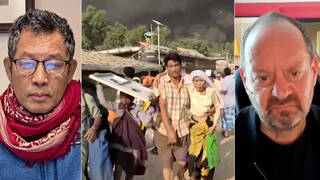
The world’s top court has ruled that Myanmar committed genocide against the country’s Rohingya Muslim minority in a 2017 military crackdown that killed about 10,000 people and drove more than 730,000 refugees into Bangladesh. The landmark ruling is the first time the International Court of Justice has held a nation directly responsible for violating the 1948 Genocide Convention. “This is a vindication of what Rohingyas have been saying for the last almost 50 years, since 1978, when the first wave of genocidal expulsion was conducted by the very same perpetrating institution,” says Burmese dissident scholar Maung Zarni. By recognizing Myanmar’s “identity-based group destruction” of the Royinghas, he says, “the court vindicated [the] Rohingya’s collective articulation, memory and suffering.”
“For the first time in its history, the court has set up a process for restitution and reparation for the members of the Rohingya community,” explains Philippe Sands, an international human rights lawyer who served on the legal team for The Gambia, which first brought the legal case against Myanmar to the ICJ six years ago. Sands discusses next steps for restitution and reparations to Rohingya victims, as well as what the Myanmar judgment means for South Africa’s genocide case against Israel, also before the ICJ.
Related Story
 Web ExclusiveNov 20, 2026“The Book of Genocides”: Cartoonist Dana Mashoian Walrath on History of Genocides Across Centuries
Transcript
AMY GOODMAN: Later in the broadcast, we’ll speak with three leading environmental justice advocates, from Malaysia, from Ethiopia and from India. But right now we go to this top story out of The Hague. This is Democracy Now!, democracynow.org. I’m Amy Goodman.
In a historic decision, the International Court of Justice in The Hague has ruled Myanmar, also known as Burma, committed genocide against Rohingya Muslims during a 2017 military crackdown that killed about 10,000 people and drove more than 730,000 Rohingya into Bangladesh. It’s the first time the court has held a nation directly responsible for violating the 1948 Genocide Convention. The presiding judge of the International Court, Judge Yuji Iwasawa, read the ruling.
JUDGE YUJI IWASAWA: For these reasons, the court, one, by nine votes to six, finds that the Republic of the Union of Myanmar has committed genocide against the Rohingya group in northern Rakhine state in violation of its obligations under the Convention on the Prevention and Punishment of the Crime of Genocide. … The court has also determined that the estimate of 10,000 Rohingya violently killed during those clearance operations is supported by the evidence. … On the basis of all the evidence taken together, the court is of the view that the only reasonable inference that can explain Myanmar’s actions is an intention to destroy a substantial part of the protected group, namely the Rohingya population in northern Rakhine state.
AMY GOODMAN: The genocide case against Burma, or Myanmar, was brought by The Gambia, the smallest country in mainland Africa. Gambia’s Justice Minister Dawda Jallow spoke in The Hague after the ruling.
DAWDA JALLOW: Today, the International Court of Justice confirmed what Rohingya have said since 2017: What was done to them was genocide, and Myanmar is responsible. The court has found that Myanmar breached the 1948 convention, Genocide Convention, and has ordered to make reparations. This is the first time the court has found a state responsible for committing genocide, the crime of crimes. The victory belongs to the Rohingya. They survived, they testified, and today they were believed.
AMY GOODMAN: The International Court of Justice, ICJ, case was closely followed in Bangladesh, where more than 1.2 million Rohingya Muslim refugees live after being forcibly displaced from their homes. Rahama Khatun is a 43-year-old Rohingya widow living in Cox’s Bazar, Bangladesh.
RAHAMA KHATUN: [translated] My husband was killed in the Rakhine area. I want justice for his murder. Following this verdict, I am now demanding exemplary punishment for those who killed my husband. I hope the perpetrators will receive the punishment they deserve. …
We hope to return to Myanmar one day. However, for a safe and dignified return, our homes and lands must be restored, adequate compensation must be provided, and our fundamental rights and citizenship must be guaranteed. Our children must also be given access to education.
AMY GOODMAN: While Bangladesh is home to the most Rohingya refugees, there are also sizable populations in Pakistan, Saudi Arabia, Malaysia, United Arab Emirates, India and here in Turkey. Earlier today, Malaysia announced it’ll resettle 10,000 Rohingya refugees in Turkey.
Thursday’s historic ruling comes as the International Court of Justice is also in the process of determining whether Israel committed genocide in Gaza, in a case brought by South Africa.
We’re joined now by two guests. Philippe Sands served on The Gambia’s legal team. His piece in The New York Times today is headlined “Can a Country Be Guilty of Genocide? Finally, the Answer Is Yes.” Philippe Sands is a professor of law at University College London and a visiting professor at Harvard Law School. He’s also the author of East West Street: On the Origins of Genocide and Crimes Against Humanity.
We are also joined in London by Maung Zarni. He’s a Burmese dissident and co-author of the 2014 study headlined “The Slow-Burning Genocide of Myanmar’s Rohingya.” He’s a human rights activist and scholar of genocide.
Maung Zarni, let’s begin with you. Can you respond to the ICJ decision, the first time the court has held a country responsible for genocide?
MAUNG ZARNI: Yes. This is a vindication of what Rohingyas have been saying for the last almost 50 years, since 1978, when the first wave of genocidal expulsion was conducted by the very same perpetrating institution, Myanmar military. The Rohingyas were the first to actually frame their experience, those who survived the first wave, under the false pretext of illegal immigration crackdown in February 1978, as genocide. But they have not been believed. And many of us who started looking at this from a both historical and sociological, not just legal, perspective of genocide, which is a coordinated process of group destruction based on identity, have been saying it.
And so, yesterday, the court ruling simply vindicated what Rohingyas have known for decades to be a genocidal persecution of their group simply because of their identity. They are killed, their community is uprooted and destroyed, simply because they are Rohingya. Genocide is an identity-based group destruction. And so the court vindicated Rohingya’s collective articulation, memory and sufferings.
AMY GOODMAN: If you could, Zarni, describe the condition on the ground, both in Bangladesh, that has more than a million Rohingya who have fled their country, Burma, and the conditions on the ground in a country that the ICJ, the International Court of Justice, has determined has committed a genocide against the Rohingya.
MAUNG ZARNI: Well, in Bangladesh, the, like you said, Amy, 1.2 million Rohingya genocide survivors — they are not simply displaced people from Myanmar, as the Bangladeshi government described it — that they live in, you know, semi-Gaza-like situation, except without the daily bombings and cutting off deliberately of food rations and access to humanitarian aid. I’ve been there a number of times, and, like, just a month after they were driven out, about 700 — over 700,000 were driven out in the months of August, September and October in 2017. And, you know, they have no future. You know, the resettlement is not an option. They are trapped in these refugee camps in Cox’s Bazar.
Inside Myanmar, about half a million Rohingyas are living under military occupation, not of — not the Myanmar military, but another anti-Muslim, anti-Rohingya Buddhist racist group called Arakan Army, representing Buddhist Rakhine in the region of Rakhine state, which is shared by both Rohingya, predominantly Muslims, and Rakhine ethnic group, largely Buddhist. And, you know, they’re under military occupation.
And then you’ve got another population of diaspora in Malaysia, about 100,000. They are subject to all kinds of hate mobilization by the Malaysian groups.
And so, you know, when we talk about Rohingya, we need to look at, like, three different populations that have survived and suffer all kinds of hardships and, you know, repression: in diaspora, refugee camps and still inside Myanmar.
AMY GOODMAN: I want to turn to Philippe Sands, who is on The Gambia’s legal defense team at the International Court of Justice. First of all, Philippe, why The Gambia? Why did they bring this case? And number two, talk about the significance, again, of this being the first country that has been convicted of genocide, and what that ultimately means.
PHILIPPE SANDS: Sure. Well, it’s lovely to be back on with you after a gap of about 15 years, Amy.
The Rohingya case was brought by The Gambia basically on the initial instance of a single individual, Ba Tambadou, who was the attorney general of The Gambia, who went on a visit to Cox’s Bazar, the place that’s just been described, spoke to a lot of the people who had fled Myanmar, heard stories, and because he had been previously a prosecutor in the Rwanda Criminal Tribunal in The Hague, in Arusha, understood that the stories that he was being told told a story of genocide. He persuaded the government of The Gambia, of which he was a member, to bring a case to the International Court of Justice. One of the reasons that happened is because both Myanmar and Gambia were parties to the 1948 Convention on the Prevention and Punishment of Genocide, and The Gambia is predominantly a Muslim country concerned about the mistreatment of a Muslim community in Myanmar.
So, that was the basis on which, in 2019, the case began. It’s run for seven years. It’s been fiercely litigated. Myanmar participated very actively. At one stage, Aung San Suu Kyi, was the former Nobel Prize winner, was the head of their delegation in one of the early phases of the case.
And the judgment was handed down yesterday by the International Court of Justice. And by a majority, as you said, of 9 to 6, the court found, for the first time ever — it’s a historic judgment — that a state, Myanmar, was responsible for perpetrating acts of genocide. And this has enormous significance, because it essentially breathes life into a convention that was adopted in 1948 at the instance of another single individual, Raphael Lemkin, a Polish jurist, who invented the concept of genocide in 1945.
AMY GOODMAN: So, it was a 9-to-6 ruling. How does it get enforced? And then, as we begin to wrap up, talk about what this means for another case brought before the International Court of Justice by an African country, by South Africa, against Israel. They are charging Israel with genocide for what’s happened in Gaza.
PHILIPPE SANDS: Well, the judgment of yesterday is binding and final, so there is no appeal. It will be enforced through U.N. bodies and, presumably, will go to the Security Council of the U.N. for some sort of authorization. But more significantly, for the first time in its history, the court has set up a process for restitution and reparation for the members of the Rohingya community. It’s given Myanmar two years to report on the steps it’s going to take to allow full restitution for the homes — but a lot of them have been destroyed, so it’s very difficult to see how that’s going to happen — and return of the Rohingya — and they may not want to return. And after two years, The Gambia will be able to go back to court and ask for reparations, not for itself, but for the individual members of the Rohingya group. So, a process is now in train and is now underway in relation to the process.
In terms of the implications of the case for other cases, including the one brought by South Africa against Israel, the court has basically adopted the standard it has always adopted. To prove genocide, you have to show genocidal conduct, conduct in which the only reasonable inference is that it was motivated by an intention to destroy a group in whole or in part. And so, the burden will be on South Africa to do that with its own evidence. I’m not expressing a view as to whether that evidence meets the burden or not. But the court in the Rohingya case did go out of its way to make clear that every case will turn on its own facts. So, following this judgment yesterday, the door remains open to the South African case. It has not been shut, nor has it been opened more widely. It will be for South Africa to persuade the judges on the basis of the evidence.
And just so that your viewers are clear, this case is not going to finally come to court for the major hearing for three or four years, because it’s on a very slow-track process. So don’t expect any action until 2030 or 2031.
AMY GOODMAN: Finally, if you could talk about the U.S. and the China response to this decision, Philippe Sands.
PHILIPPE SANDS: I mean, the initial U.S. response, the State Department put out a perfectly reasonable statement saying that they were going to study the judgment and then consider what their reaction is to it. There had been previously a tweet, I think it was, put out by the U.S. ambassador to the United Nations, warning the court — almost seen by some as a threat to the court — that if it lowered the standard, it would face the same kinds of sanctions and difficulties, or might, that the International Criminal Court has faced.
My own view is, as I said in the op-ed piece in The New York Times this morning, is the standard has not been lowered. The case simply turned on its own facts. It’s the same “only reasonable inference” standard. And we will have to wait and see.
As for China, I’m not aware of what the reaction has been. One of the six who voted against the judgment was the Chinese judge, Madam Xue. The American judge voted in favor —
AMY GOODMAN: Philippe Sands, I want to thank —
PHILIPPE SANDS: — of the judgment.
AMY GOODMAN: I want to thank you so much for being with us, Philippe Sands, human rights lawyer, served on The Gambia’s legal team in The Gambia v. Myanmar case at the International Court of Justice. We’ll link to your New York Times piece, “Can a Country Be Guilty of Genocide? Finally, the Answer Is Yes.” And Maung Zarni, Burmese dissident and co-author of the study, “The Slow-Burning Genocide of Myanmar’s Rohingya.”
Coming up, today is the last scheduled day of the U.N. climate summit here in Antalya, Turkey. There is a great deal of controversy, advocates saying the draft agreement text is a failure and should be rejected. And the minister of Panama has said he may block the agreement if Panama’s limited demands are not met. We’ll hear from him and host a discussion with environmental justice advocates. Stay with us.
[break]
AMY GOODMAN: “Polluters Must Pay” protesters dressed up as peanuts, holding up giant pennies that spell out “pay up” here at COP31 in Antalya earlier this week.





 Top
Media Options