









Guests
- Arjun Karkilawmaker in Nepal who served as Nepal’s ambassador to the United States from 2015 to 2021.
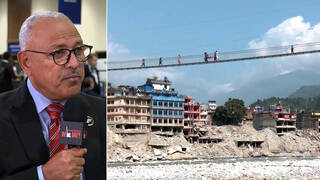
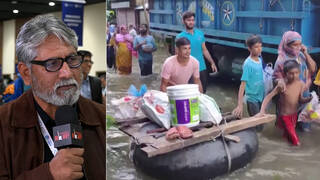
In August, catastrophic floods in mountainous Nepal washed away entire villages and left nearly 7,000 people dead or missing, triggered by the collapse of a Himalayan glacier. Nepal contributes less than 0.1% to global carbon emissions and is one of the poorest countries in the world. We speak to Arjun Karki, who served as Nepal’s ambassador to the United States from 2015 to 2021.
Related Story
 StoryNov 17, 2026Bangladesh Faces Mounting Climate Crisis While Wealthy, Polluting Nations Resist Calls to Pay Up
Transcript
AMY GOODMAN: This is Democracy Now!, democracynow.org, The War and Peace Report. I’m Amy Goodman. We’re broadcasting from the U.N. climate summit in Antalya, Turkey. It’s called COP31, for the conference of the parties, 31 years.
In August, catastrophic floods in mountainous Nepal washed away entire villages and left nearly 7,000 people dead or missing, triggered by the collapse of a Himalayan glacier. Nepal contributes less than 0.1% to global carbon emissions. It’s one of the poorest countries in the world. The U.N. Fund for Responding to Loss and Damage was created in 2022 to provide financial support to developing nations on the frontlines of the climate-fueled disasters, but the fund has fallen far short of what’s needed. So far, it has only pledged about $20 million to Nepal, far short of the nearly $5 billion the government estimates for reconstruction and recovery from the floods.
For more, we’re joined by Arjun Karki. He’s a lawmaker from Nepal and was Nepal’s ambassador to the United States from 2015 to 2021.
Thank you so much, Ambassador, for joining us. Now you’re an elected representative in Nepal’s Parliament. Where were you when the glacier broke off and killed — or, we don’t know how many thousands of people at this point?
ARJUN KARKI: I was very close to Makalu base camp. It’s a Himalaya, Makalu Mountain, that is next to — 19 kilometer away from the Mount Everest. I was in the Himalayan region.
AMY GOODMAN: And what did you see?
ARJUN KARKI: I didn’t see anything. I heard this news, and I took a helicopter to come back to Kathmandu. And immediately visited the disaster area, next day.
AMY GOODMAN: That is one glacier that melted. You have over a thousand glaciers in Nepal alone. How many are at risk of breaking off like this one did?
ARJUN KARKI: Let me correct you here. This was not a glacial lake. This was a permafrost. That’s why this was not really somebody expecting in and around that time. There was no rain, no flood, nothing. All of a sudden, it came. So, it is melting of permafrost, not glacial lake outburst.
But your question about glacial lake outburst, there are 47. What UNDP and ICIMOD, the Mountain Research Institute, says is there are 47 potentially dangerous glacial lakes. And out of 47 in India, China and Nepal — they have done a three-country study. Out of 47, 42 are in Nepal. And the 42 are in the province from where I got elected.
AMY GOODMAN: So, how are you beginning to cope and to prepare?
ARJUN KARKI: We are doing advocacy work now, lobbying our government, our policymakers to do early-warning systems to try to find out ways of draining those glacial lakes before it bursts. And also, we have learned a lot from Bhotekoshi flood, that the inhabitants in and around the river corridor need to be resettled somewhere in and around safe place. So, most of Nepal’s river basins are heavily inhabited area. So, if this glacial lakes outburst floods, melts down, it will put in risk to all those inhabitants who are inhabited for several years in the river basin corridor.
AMY GOODMAN: So, explain the climate fund, how little has been allocated to Nepal. And the only way you could describe the — use the word “little” with Nepal is how little you, the country Nepal, has contributed to climate change, but how vast the effects of climate change are right now.
ARJUN KARKI: We are least contributor, as you have said that. Our contribution to the greenhouse gas emission is 0.01%. But we borne the brunt of the climate crisis very badly. We are the worst sufferer, but least contributor, so that as far as climate finance is concerned, we think that this Global North has historical responsibility. So, those who contributed must need to finance the climate disaster.
AMY GOODMAN: So, you were Nepal’s ambassador to the United States for a number of years. You lived in Washington, D.C.
ARJUN KARKI: Yes.
AMY GOODMAN: The U.S. is historically the largest carbon gas emitter. Your prime minister was in New York in September for the U.N. General Assembly. There were many climate activists from Nepal and Bangladesh and other places, the most affected when it comes to climate change, urging world leaders to treat every new oil, gas and coal approval as an active violation of human rights and international law. Can you talk about that accusation?
ARJUN KARKI: As I have said earlier, we are the least contributor. There is a historical responsibility of the Global North. They have used fossil fuel to pollute the world. So, this climate change doesn’t recognize national borders. It doesn’t travel with passport and visa. It affects all countries equally. But there are countries who are responsible for temperature rise, and there are countries who suffer most, are the least contributor. That’s why we want reparation. We want the Global North, those who contributed most, to finance the climate crisis.
AMY GOODMAN: The World Bank unlocked $170 million in loan financing for Nepal, while the Loss and Damage Fund has allocated $20 million for Nepal. But even that, it’s not immediate. There’s a timeline. How much does Nepal actually need to deal with climate reparations for what has happened?
ARJUN KARKI: No, our initial estimate is $4.8 billion to address the Bhotekoshi crisis only.
AMY GOODMAN: $4.8 billion.
ARJUN KARKI: Billion dollar. The allocation from the Loss and Damage Fund is, as you have said, $20 million, which is very insignificant amount. So, this is not enough. But we are asking international development partner countries to contribute, to finance, to become more generous, so that countries like ours, which are defined as least-developed countries by United Nations, suffering from the climate crisis, for which we are not responsible, we should be compensated. It is — we see the climate finance as human rights issue. It is our right. It is not charity. It is issue of climate justice. That’s why we urge them to become generous and finance.
AMY GOODMAN: It’s interesting that you were just on a panel with a group of young, newly elected congressmembers from the United States. Talk about what you’re asking of them.
ARJUN KARKI: I was with them yesterday in one panel, and day before yesterday in another panel. Basically, they were newly elected Democrats, and they were very much empathetic to us. OK? They think that they have to really come back to COP, they have to really rejoin the various initiatives initiated by the United Nations. So, they were very sympathetic. I found at least in the panel, OK, they were talking about climate is really a crisis, and we need to really engage. We need to really contribute to address the climate crisis. This is what they were basically saying.
AMY GOODMAN: As we begin to wrap up now, there are, over this two weeks, something like 90,000 people here at COP31. It’s the largest U.N. climate summit. Of course, many of them are fossil fuel lobbyists and countries that push fossil fuels. What final message do you have for everyone here? What would you consider a successful U.N. climate summit?
ARJUN KARKI: My argument to those who are engaged and involved is: Climate crisis is real. It doesn’t recognize country borders. As I mentioned earlier, it doesn’t travel with passport and visa. It will create crisis everywhere, no matter from where it is initiated. In one way or other, all of us are going to be affected. So, we need to be very much sensitive. We need to work on addressing the challenges, and particularly early-warning system, and early recovery is very important for us. So, we need to really share knowledge, technology, and finance the crisis before it happens. Thank you.
AMY GOODMAN: Thank you very much.
ARJUN KARKI: Thank you very much for having me.
AMY GOODMAN: Arjun Karki is a member of Nepal’s House of Representatives. He’s a member of the Nepali Parliament. He served as Nepal’s ambassador to the United States from 2015 to 2021. This is Democracy Now! I’m Amy Goodman, here in Antalya, Turkey, at the U.N. climate summit, COP 31.




 Top
Media Options