





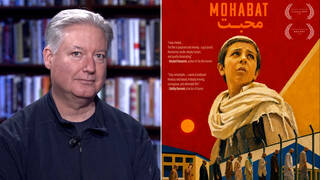





Oscar-nominated filmmaker James Longley talks about his new documentary Mohabat, named after a 12-year-old Afghan boy whose father was killed in a U.S. drone strike in 2019. Longley has filmed for years in Afghanistan both during the U.S. war and since the Taliban regained power. His previous films include Iraq in Fragments and Sari’s Mother, both of which received Academy Award nominations. His first feature-length documentary was Gaza Strip, released in 2002.
Related Story
 StoryJan 28, 2013Dirty Wars, Documentary on U.S. Covert Warfare Abroad, Wins Sundance Cinematography Award
Transcript
AMY GOODMAN: This is Democracy Now!, democracynow.org, The War and Peace Report. I’m Amy Goodman, with Anjali Kamat.
ANJALI KAMAT: We turn now to the Oscar-nominated filmmaker James Longley, who’s filmed for years in Afghanistan, both during the U.S. war and since the Taliban regained power. James Longley’s new film is Mohabat. It is named after a 12-year-old Afghan boy whose father was killed in a U.S. drone strike in 2019. This is a clip from the film featuring Mohabat.
MOHABAT: [translated] When the Americans came here, wherever they went, a drone was always with them. When the drone was flying, everyone was afraid. The sound of them was awful. Every person thought they would be the one targeted. I thought they would bomb me.
AMY GOODMAN: In this next clip from Mohabat, several young Afghan boys talk about how their fathers were killed during the U.S. occupation.
AFGHAN BOY 1: [translated] A night raid came. They killed my father and dragged him behind their Humvee.
AFGHAN BOY 2: [translated] My father was Taliban. I was young when he was killed.
AFGHAN BOY 3: [translated] The helicopter shot my father, and he fell out of a tree.
AFGHAN BOY 4: [translated] My father was killed by a drone strike on the second day of Eid.
AFGHAN BOY 5: [translated] My father and his friend went to fight in the war. The Americans ambushed and killed them.
AFGHAN BOY 6: [translated] It was night when they brought him home.
AFGHAN BOY 7: [translated] My father was talking on his mobile, crossing the Wardak mountains.
AFGHAN BOY 8: [translated] A drone fired at him.
AFGHAN BOY 9: [translated] They buried him with an excavator on a mountainside in Nerkh district.
AMY GOODMAN: That’s a clip from James Longley’s new documentary Mohabat. The film is having its North American premiere at the DOC NYC Film Festival here in New York this weekend. James Longley’s previous films include Iraq in Fragments and Sari’s Mother, both of which received Academy Award nominations. His first feature-length documentary was Gaza Strip, released in 2002.
And I remember interviewing you then, James. What an honor it is to have you back with this deeply moving documentary. It features one boy, but it’s about three sons of an Afghan man who was killed in a U.S. drone strike. Tell us the story and how you found them. You’ve lived in Afghanistan for years.
JAMES LONGLEY: Well, I had been in Afghanistan for three-and-a-half years during the war. And when the Taliban took over, for a few months, like a lot of other people, we were working to get my crew members from the previous film out of the country, because at that time people were quite afraid of the Taliban, and no one knew what was going to happen.
AMY GOODMAN: And yet, you say that you knew for years, interviewing people, that people were saying, when the U.S. pulled out, the Taliban would take over.
JAMES LONGLEY: Yes. In my previous film, Angels Are Made of Light, many people say that they’re worried that the Taliban is going to come, that the Americans will leave and the Taliban will come back. And I also thought that, because it seemed quite obvious that the United States wasn’t going to be in Afghanistan forever, and that when they left, the only real possibility was that the Taliban would take over. It would either be a civil war followed by the Taliban, or just an immediate takeover. And years in advance, Afghan people who I trusted were telling me that the situation would change very quickly, and that when the United States left, they probably wouldn’t even make it all the way out of the country before the government fell.
So, in the beginning of 2022, I was able to get a visa and go back to Afghanistan and, once in Afghanistan, extend all of my documents. And we wound up staying there for two years, 15 months on the ground filming this documentary. And we traveled all over Afghanistan, location scouting and sort of casting the film, looking for the right people to follow. So, it gave me an opportunity to see Afghanistan in a way that I hadn’t before.
During the war, most of the journalists were effectively trapped in the cities because of security, and that gave the news coverage of Afghanistan a particular kind of urban bias, because, really, the war in Afghanistan was taking place mostly in the countryside. And so, most of the journalists, unless they were embedded with the U.S. military, they never actually got close to the war.
But the way that people experienced those 20 years was quite different, whether they were in a place like Maidan Wardak in a mountain village or whether they were in Kabul. And in Kabul, people felt a bit under siege and, you know, worried that the Taliban was going to come back, worried about Taliban attacks, whereas in the countryside it was kind of the reverse situation, where people were living under U.S. occupation directly. There were fighter planes and A-10 attack planes and Apache helicopters and Black Hawk helicopters coming in night raids. And the Afghan National Army would have their bases above people’s villages. People were being killed in drone strikes left and right. And so, everyone’s life was interrupted for two decades by the war. They were — farmers complained they couldn’t water their crops because of the threat of foreign soldiers.
ANJALI KAMAT: James, let’s go to another clip from your film, Mohabat. In this clip, a local villager takes Mohabat to the spot where his father was killed in a U.S. drone strike.
VILLAGER: [translated] There was a cloud of black smoke. Your father, Razeq, was killed here. They hit him here, and he went down the hill to the apricot tree. I was lying over there. I asked him to come take a picture of the rabbit. He took out his mobile, and the drone fired at us. I was up by the reservoir.
MOHABAT: [translated] Who did they hit first?
VILLAGER: [translated] First they fired at me and Safi. They hit your father a few minutes later. Your father made it over here, drowning in snow. When he was here, the drone hit him. He got up from here, and then he died.
MOHABAT: [translated] Who took you down the hill?
VILLAGER: [translated] The people of Kunda came here. They carried me on their shoulders. I thought we’d be hit again. My legs wouldn’t carry me. They cut us to pieces. That’s what they did to us here.
ANJALI KAMAT: And that’s one of the survivors of the drone strike who takes Mohabat to the site?
JAMES LONGLEY: Yes, he survived the drone strike. He was injured. He was blind in one eye. And the local villagers carried him down the hill. One time, I came to the village, and a man accosted me, and he said, “You know, I was supposed to be in this group that was killed in the drone strike.” There were six people killed. And he was running up the hill following them to join the hunting party. And —
AMY GOODMAN: They were hunting rabbits?
JAMES LONGLEY: Yeah, rabbits and quail. And his son was with the group. And so, he was running up the hill, and he saw them in the distance, and he was making his way through the snow, when the drone strike happened. So he saw his son blown up in a drone strike. And he was so agitated and crying and angry. And he said, “You know, I wasn’t in the Taliban at all, but after this drone strike, I joined.” He said, “If it weren’t for the Taliban’s orders, I would kill you right now, as an American walking in my village.”
AMY GOODMAN: And did you ever figure out — this drone strike occurred during Trump’s first term. Who was in charge? Why did this drone strike happen?
JAMES LONGLEY: In an earlier interview with Variety, I incorrectly stated that Mike Pompeo was in charge of the drone program at that time, but this was on January 22nd of 2019, and Gina Haspel was in charge of the CIA, which did most of the drone strikes in Afghanistan. But the U.S. Air Force also operated armed drones, so it’s not really clear whether it was the CIA or the Air Force that conducted this particular drone strike.
AMY GOODMAN: And at the beginning of the film, with all of the kids talking about what happened to their family members, explain the U.S. response. How do they explain these drone strikes? Were you ever able to track down why they did the drone strike, at least their reason, January 22nd?
JAMES LONGLEY: I don’t think the United States ever commented on this particular strike. There was a spokesperson, an Afghan spokesperson, for the Afghan National Army locally in that province who claimed that these people were Taliban and they had been under surveillance for a long time. But nothing that I was able to discover confirmed that statement. That’s what was told to Reuters and to the Pajhwok Afghan News agency and to some others at the time who reported on the strike.
It actually — interestingly, it happened January 22nd, 2019. At that very moment, the Taliban and the United States were meeting in Doha to arrange the withdrawal of the United States from Afghanistan. People forget that the United States arranged for the Taliban to take over. That was an agreement that was made.
AMY GOODMAN: Explain
JAMES LONGLEY: Well, Trump had promised that we were going to get out of Afghanistan, and so he assigned his secretary of state, Mike Pompeo, who had just been the director of the CIA prior to that, to negotiate it. And they met with the Taliban in Doha without the — without the government, the Kabul government that was backed by the United States. They weren’t part of the meeting. They, I think, realized at the time that they were going to leave and that the only real possibility was that the Taliban would take over. And so, they wanted to agree with the Taliban that, you know, we’re going to leave, and what we want from you is not to attack U.S. soldiers during this period when we’re pulling out. And the Taliban agreed to that, and they stood by it.
AMY GOODMAN: When eventually Biden pulled out.
JAMES LONGLEY: Eventually Biden pulled out, but he followed the same timetable.
ANJALI KAMAT: And, James, this film is such a beautiful portrait of the traumatic impact of 20 years of U.S. war and occupation on one family. Can you say a little bit more about what happens to Mohabat and his brothers after their father is killed, and where they are in Afghanistan?
JAMES LONGLEY: So, Mohabat had two older brothers. The oldest one, who was 34, had gone mad when their father was killed. And so, in a small village, it was kind of untenable. He was cutting down people’s apple trees and getting into fights and beyond — sort of outside the pale of what’s permissible in Afghan society, especially in a small town. So, eventually, the family, at the behest of the village, they put him in a facility for drug rehabilitation, for heroin addicts, because they didn’t know what else to do with him. He had schizophrenia, and he wasn’t really addicted to any hard substances, but they thought, you know, “We can’t have him in the village. And this is a place where, you know, he’ll be fed and taken care of, at least.” And so, we wound up filming him in that facility five or six times. And strangely, we were able to get access to it.
And he has a middle brother who’s 18, Mawladdin, and Mawladdin became the head of the household by default when their father was killed, so he was responsible for everything. But he was only a teenager, and he had these teenage dreams of escape. And so, at the end of the film, well, you’ll see what happens. But yeah, the family is torn apart by the effect of the war. This drone strike that most Americans never heard about it, or it was at the end of some article in Reuters or something, completely destroyed this family.
AMY GOODMAN: And Mohabat, what happened to him, the little boy?
JAMES LONGLEY: Mohabat, the film, is a coming-of-age story. And he goes from being a barely 12-year-old child to being — also taking on a lot more responsibility than he should at that age.
AMY GOODMAN: But going into an orphanage.
JAMES LONGLEY: Yeah. In the beginning of the film, we find him in a Taliban orphanage. And we interviewed all the kids in the orphanage and eventually decided to follow him. We also filmed the stories of his friends, but those were cut for time.
ANJALI KAMAT: James, you’re one of the few American filmmakers or journalists to have spent time in Taliban-controlled Afghanistan and in rural areas. What was that like? Say a little bit more about your experience of living there and what you saw. I mean, there’s also — it’s quite striking that there’s no women or girls in your film.
JAMES LONGLEY: Right, we didn’t film any women especially. There are — you can see girls in the film at the school, for example, but they don’t have speaking parts. And the reason we made that decision is that it would have been too difficult for them in the village to have been part of a film, and then they would be subject to the social pressures involved in that. Even before the Taliban, these kinds of places are quite socially conservative. And even when I was filming during the war, during the United States’ occupation in Kabul, in that film, Angels Are Made of Light, we do have four narrating women protagonists, but we, for example, never filmed in anyone’s house. So, even in Kabul, even prior to the Taliban, Afghanistan was quite conservative. And it still is, of course.
ANJALI KAMAT: And what was it like? Like, what would you say was most remarkable about spending time in Afghanistan post-2021? Because you were there previously, as well.
JAMES LONGLEY: I think the important thing for Americans to realize is that when we left the country, the war ended. And suddenly there was peace and security. Well, we can call it peace. It’s a kind of a cold peace, of course. Many people are unhappy with the government. But there isn’t any fighting in Afghanistan. You can drive around Afghanistan without worrying that you’ll be pulled out of a bus and, you know, shot at the side of the road, as was happening during the war. There’s security under the Taliban, like them or not.
AMY GOODMAN: Was there any part of the film you had to do covertly?
JAMES LONGLEY: No, we did everything — we did everything with official written permissions from the ministries. At the same time, they didn’t really understand filmmaking that well. But they wanted to show their openness to Western journalists, and they wanted to show that they were a responsible government, so there was a willingness on their part to allow us to work. They didn’t really pay that much attention to us. We did receive some death threats in the villages. But in Kabul, in the ministries, we actually didn’t have any problems. Everything took a long time and a lot of conversations, but the Taliban have essentially taken over all the — you know, they’ve taken the government that was in charge, and they shadowed those people in their offices and find out what they did, to find out what — you know, how they were working, and then they simply took over. So, they did it very systematically.
AMY GOODMAN: Are you going to show this film in Afghanistan?
JAMES LONGLEY: We have told the families that we won’t try to sell the film or broadcast the film in Afghanistan, but I have to assume that everyone in Afghanistan will see it. And so, we made the film with that in mind, that if everyone in this boy’s village sees the film, that it wouldn’t be — that he would still be able to continue living in the village. It wouldn’t be something shameful for him.
ANJALI KAMAT: And what was most moving for you in the process of making this film? I mean, you’ve made so many films, many of them following young children, from Gaza to Iraq to now Afghanistan.
JAMES LONGLEY: Well, so many things. You know, we recorded so much material that we couldn’t use in the film, and so much of it is heartbreaking. And, you know, there are all these stories of war told to us by children who witnessed it themselves. And, you know, sadly, our film is under 90 minutes, and so we were just not able to include all of the stories that we have. But I hope that maybe in some way in the future all of that material can be part of some archive, because, really, during the war there were so few journalists who had the opportunity to really report on the war directly and from the point of view of Afghans. And I think now under the Taliban, the chance that people have is to be able to go there and actually see what was happening on the other side, see what was happening in the villages that were under — that were living under the war.
ANJALI KAMAT: And when you look at the psychological toll that this long war and occupation have had on people in Afghanistan, what kind of resources are there for families like Mohabat’s?
JAMES LONGLEY: Well, Afghanistan is quite poor, but, you know, it’s more usual to see people on the street here in the United States than it is in Afghanistan. People in Afghanistan have systems of collective support that they use. Extended families will support each other. And this is the way they’ve been able to survive for these decades and decades of war, civil war and the Soviet occupation and the Taliban part one and the 20-year war of the United States, and now under the Taliban again.
But I think it’s important for Americans to think about what our policy does to Afghanistan, how we affect Afghanistan. There’s a — you know, most of our media talks about, you know, how bad the Taliban are because they, for example, won’t allow higher education for women and these kinds of things. And we love to say, you know, they’re backwards, and they’re — you know, they’re anti-women and so on. But, you know, I think our strategy is a little bit backward. I think if we care about the Afghan people and what happens to them, we have to care about the economic situation there, and we have to think about what will happen if we continue to exclude Afghanistan, effectively, from international business, from international banking, and if we continue to isolate Afghanistan, how that will affect the economy and, in turn, how that will affect the population.
I know it’s quite popular to say that we shouldn’t engage with the Taliban because of their policies, and that if we just put enough pressure on the Taliban, that they will eventually fold and do what we want. But that’s not going to happen. After talking with a lot of Taliban people in the government and just fighters on the street, you know, there’s, A, no chance that the Taliban is going to go away. They’re very much in place, and there isn’t anything that would dislodge them, besides perhaps some internal rift, but even then. And so, I think —
AMY GOODMAN: And so —
JAMES LONGLEY: Yeah.
AMY GOODMAN: And when you talk about perhaps an internal rift, in your talking to Taliban, are there any who feel they’re taking a wrong approach when it comes to women? If only because — for example, because there can’t be, you know, male doctors for women? They can’t — then they’d need women doctors, but they can’t get educated to be women doctors.
JAMES LONGLEY: I mean, there’s — I think it’s quite likely that the majority of Taliban are against the policy toward women, because they all have their own wives and daughters and sisters. And if for no other reason than economics, they would prefer that they have the opportunity to be educated. I would say most — even most of the Taliban — feel that way.
But it’s politically untenable for the leadership to acquiesce, to give in to Western demands, because the way they see it, they fought for 20 years, they suffered a lot, and then they won the war against, as they say — as they see it, against all odds, against all of NATO, not only against the United States. So they see it as something miraculous, as something God-given to them. And so, they don’t tolerate the idea that now the losing side of the war is dictating to them what they have to do.
And if you know anything about the mentality of these people, you’ll know that they’ll never give in. In the same way that they never gave in during the war, they will never give in to Western pressure. So, the more pressure we put on them to change their policies, the less likely it is to happen. And I think, you know, paradoxically, the pragmatic thing to do is to engage with the Taliban. And I think it’s the only way forward, as distasteful as it may be for many people.
AMY GOODMAN: James Longley, we want to thank you so much for being with us, director of the new documentary Mohabat. He’s an award-winning filmmaker and MacArthur fellow, twice nominated for an Academy Award for his films Iraq in Fragments and Sari’s Mother, did the film Gaza Strip and Angels Are Made of Light, also about Afghanistan. This is Democracy Now! I’m Amy Goodman, with Anjali Kamat.





 Top
Media Options