







 Watch Full Show


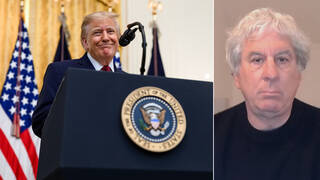
As Democrats prepare to take control of Congress in January, party leaders say they intend to hold Trump officials accountable with stepped-up hearings and investigations. The administration, however, has responded with threats to launch its own investigations into lawmakers for carrying out their oversight responsibilities.
“The oversight function of Congress is well established by the founders. It’s a normal part of government. The separation of powers requires oversight,” says Brad Adams, co-founder of The Rule of Law Project, which seeks to provide outside accountability due to what he describes as the administration’s refusal to investigate “obvious cases of corruption.”
Related Story
 StoryOct 22, 2026Mehdi Hasan on AIPAC’s Role in El-Sayed vs. Rogers Race in Michigan & Trump’s Targeting of Ilhan Omar
Transcript
AMY GOODMAN: This is Democracy Now!, democracynow.org. I’m Amy Goodman.
Democrats have made clear their intentions to increase oversight and investigations into President Trump and administration officials in the next Congress. After Democrats secured the incoming majority in the midterm elections, the top-ranking Democrat on the House Oversight and Government Reform Committee, Congressmember Robert Garcia, released a statement, saying only, “Lawyer up.”
On Monday, the top White House lawyer, Will Scharf, sent Garcia a letter warning Democrats’ language and plans for investigations and subpoenas, quote, “may cross the line into blatant criminality.” He also wrote, quote, “The Administration will not be extorted and will not be cowed by unlawful process motivated by animus, pettiness, hatred, or any other unlawful motive,” the White House lawyer said.
For more on this brewing legal battle, we’re joined by Brad Adams, co-founder of The Rule of Law Project, a new organization formed by former federal civil rights and corruption prosecutors and investigators.
Brad, thanks so much for being with us. Can you first respond to the White House saying that if congressmembers engage in oversight, they might cross the line into criminality?
BRAD ADAMS: Yeah, it’s a bit rich, isn’t it? The oversight function of Congress is well established by the founders. It’s a normal part of government. The separation of powers requires oversight.
And what is, you know, ironic, of course, is that the Republicans have tried to weaponize the oversight process for many years. Think back to Benghazi and, you know, other high-profile efforts to harass the Biden administration or the Obama administration or some members of the Cabinet, such as Hillary Clinton. And I’ll point out, I’m not sure that Will Scharf wants — realizes this, but the newly elected leader of the minority in the House, Jim Jordan, was the chair of the House Judiciary Committee, and in that role, he issued 91 subpoenas to Democratic administrations. And many of those were clearly just meant to be political grandstanding, to harass, to get in the newspaper.
The Supreme Court in 2020 issued a ruling on this, and they said there are limits on oversight. And they basically said one key point — made one key point, which is that there has to be a clear legislative purpose. And what Representative Garcia is suggesting has a clear legislative purpose: to ensure that corruption doesn’t go unchecked, to look into ICE violence, killings, beatings on the streets, custodial mistreatment in ICE detention facilities, etc.
So, I mean, this statement, basically, you know, makes a lawyer who went to Harvard — that’s Will Scharf, went to Harvard — appear that he never took constitutional law classes.
AMY GOODMAN: And can you also respond to Todd Blanche, the attorney general, responding to Garcia, who is talking about everyone, from Stephen Miller on, to lawyer up? And he said, “I’m Stephen Miller’s lawyer. He doesn’t need to hire one.” What does that mean? I thought the attorney general was the people’s attorney. He was even questioned about this at his confirmation hearing, and he said he wasn’t, for example, Trump’s lawyer — which he used to be, of course.
BRAD ADAMS: Yeah, well, you can say one thing during confirmation hearings and then act in another way later. I mean, you know, Todd Blanche answers Trump’s question, you know, “Who’s my Roy Cohn?” And it’s Todd Blanche. And he’s forgetting his responsibility is to defend the Constitution and to represent the United States government and the people of the United States, and not individuals.
He’s not Stephen Miller’s lawyer. If Stephen Miller is brought before a committee, needs a lawyer, he’s going to have to find outside counsel. The Department of Justice should have nothing to do with defending Stephen Miller as a person. They have an obligation and a right to defend government officials in the course of their official duties. But if there’s an allegation that Stephen Miller committed a crime, that’s not for the Department of Justice. That’s for a criminal defense lawyer.
AMY GOODMAN: So, we only have three minutes, but, Brad Adams, I want to ask you about this new Rule of Law Project and the official corruption you say you’re going to be investigating, as well as extrajudicial, state-sanctioned violence, like ICE, everything from ICE in the United States to the bombing of vessels in the Caribbean and the Pacific.
BRAD ADAMS: Well, we shouldn’t have to do this. I was the Asia director at Human Rights Watch. We did investigations in places like the Philippines. We participated in the investigation that put Rodrigo Duterte in The Hague. We worked on atrocities against Rohingya in Myanmar. But that’s because the state didn’t function in those countries. And we should be able to expect that the state will function here, but it’s not. The Department of Justice has made very clear that it is not going to investigate officials in the administration. It’s not going to investigate some of the more obvious cases of corruption that we see reported regularly, whether it’s crypto or quid pro quos or pardons or insider trading.
And, you know, as a former investigator of very serious violence at Human Rights Watch and, before that, at the U.N., you know, it kind of broke my heart to see thugs on the streets, masked, beating people up. And obviously, the Renee Good and Alex Pretti cases are the most well known, but there have been many other shootings. And also, we have, you know, many reports of mistreatment in custody. And this is quintessentially what the Department of Justice should be looking into, but they’ve made it very clear that they’re just not going to. So we created this organization where we’ve hired former federal prosecutors, former FBI agents to do the work that the government should be doing.
Now, people may ask, “What about the pardon power?” Pardons will not extend to crimes committed in state jurisdictions. And there are many states that are willing and able — and we’re starting to work with them — to investigate and hold people accountable there. And the Department of Justice, hopefully, when we get a new government after the 2028 election, will be reestablished and take its role seriously. But it will take some time for it to be functional. We’ll be providing prosecution-ready cases to state and local prosecutors before then, and to the DOJ after that.
AMY GOODMAN: And will you be working with Congress?
BRAD ADAMS: Yeah, I’m already talking to oversight committees, coincidentally and ironically, and they are getting ready. We’ve talked. We’ve talked to House Judiciary, for example, and they’re on a hiring spree, because the amount of illegality in this country right now is unprecedented, as we all see. And it contributed to the election results, of course. You know, people are fed up with blatant corruption and all the violence committed by ICE.
And the oversight committees have a very important function to play. We hope that they will play them responsibly. You know, it’s very important to be really careful with factual allegations, to be specific — you know, to use a soccer analogy, to play the ball, not to play the man. Don’t go after people on an ad hominem basis. But there is so much to investigate that we think that the oversight committees will play a key role, and we’ll work very closely with them.
AMY GOODMAN: Brad Adams, co-founder of The Rule of Law Project, speaking to us from California.
That does it for our show. Very happy birthday to Ishmael Daro! Oh, and the new film about Democracy Now!, the documentary Steal This Story, Please!, is now out on digital platforms, from Amazon Prime to Apple to Fandango to Google Play. You can go to StealThisStory.org to get the latest information. Also, we’ll be broadcasting from Turkey all next week from the U.N. climate summit, COP31. I’m Amy Goodman. Thanks so much for joining us for another edition of Democracy Now!





 Top
Media Options