



 Watch Full Show


Guests
- Sharif Jamilenvironmental activist, coordinator of Waterkeepers Bangladesh and board member of the Waterkeeper Alliance.
Bangladesh’s first riverkeeper, Sharif Jamil, shares how poor countries in the Global South are struggling to effectively adapt to climate change as rising sea levels, extreme weather patterns, pollution and more are creating an escalating “humanitarian catastrophe,” while the wealthy impede efforts to reallocate financial resources for adaptation and mitigation. “If you want to protect the planet, if you want to save the planet from global warming, you need climate finance to make all this transition,” says Jamil.
Related Story
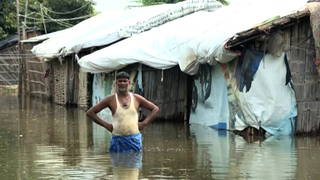
 StoryAug 29, 20171,200 Die as “Devastating” Climate Change-Linked Floods Submerge Parts of South Asia
Transcript
AMY GOODMAN: This is Democracy Now!, democracynow.org, The War and Peace Report. I’m Amy Goodman. We’re broadcasting from COP31, the U.N. climate summit, in Antalya, Turkey.
We turn now to how Global South countries at the frontlines of climate change-fueled disasters are demanding more funding and accountability from rich countries during the negotiations here at COP31.
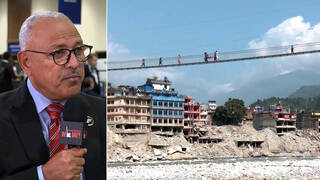
In August, catastrophic floods in mountainous Nepal washed away entire villages, left nearly 7,000 people dead or missing, triggered by the collapse of a Himalayan glacier. Meanwhile, in low-lying Bangladesh, rising sea levels pose an existential threat to tens of millions of Bangladeshis living along the coast. Bangladesh and Nepal are among the most vulnerable to climate change-related disasters, yet together they contribute less than half a percent of global carbon emissions. They’re also among the poorest countries in the world.
The U.N. Fund for Responding to Loss and Damage was created in 2022 to provide financial support to developing nations on the frontlines of climate-fueled disasters, but the fund has fallen far short of what’s needed. In total, the fund already has over 175 requests from developing countries for nearly $3 billion, but rich countries, the most responsible for climate change, have only pledged $820 million to the fund.
For more, we’re joined by Sharif Jamil, environmental activist, coordinator of Waterkeepers Bangladesh, board member of the Waterkeeper Alliance.
It’s great to have you with us.
SHARIF JAMIL: Thank you for having me.
AMY GOODMAN: Why don’t you pick that mic right up? Because it’s noisy here. There are 90,000 people registered over these two weeks of the climate summit, the biggest one yet. Yet, what is being accomplished? And what are you demanding? But I want you to start off by talking about your own country, Bangladesh, the real recipient of, unfortunately, as we can say, the effects of climate change, climate catastrophe.
SHARIF JAMIL: Yes, you are very right. Bangladesh is in the bottom of the Ganges and Brahmaputra River system, and it is the largest active delta in the world. And if you see the demography, it is highly and densely populated country. And as it is delta, so environmental pollution and climate catastrophe are actually creating humanitarian catastrophe there.
So, it’s not like one particular event. There are extreme weather patterns coming up very frequently and more intensely from the Indian Ocean towards the Bay of Bengal. Salinity intrusion are coming to the middle part of the country. Farmers are losing the crop from their farmlands. Fishers are not able to go to the seas or in the oceans to be fishing. So, it’s a lot of livelihood crisis, lot of migration crisis. There are erosions happening. And in the global platform, Bangladesh is also one of the mostly victimized countries in the world under climate catastrophe.
AMY GOODMAN: So, how can what people decide here — I should say, what countries decide here — affect Bangladesh?
SHARIF JAMIL: Well, it’s been discussed a long, long time. And in Paris Agreement, there are some legally binding commitments came up, that the Global North will be providing adequate climate finance. It was not adequate amount that was discussed by then, and still the amount you already told about the Loss and Damage Fund is like peanuts in terms of real need for the Global South. But still, these things are not operationalized since the Paris Agreement.
Even here in COP31, the cover decision came up. Of course, you can get a direction in which way the COP is going heading forward, and you see there is no Belém-Antalya mechanism discussed in the cover decision like that. And there is new things came up with the 1.5-degree threshold overshoot and what the consequences are coming for the countries like us.
AMY GOODMAN: Talk about climate finance. That is a jargon term, but it’s about the most — the countries that are most responsible for climate change paying for the most damaged, poorest countries. What does Bangladesh need? And if Sharif Jamil was in charge, if you were the head of the U.N. climate summit, of course, it would be a different world. But what would you be working for right now?
SHARIF JAMIL: I mean, the U.N. COP process is working to protect the planet, not only Bangladesh. But to protect the planet, you need to actually bring the global temperature threshold below 1.5 degree, or, in other term, you have to come out of fossil fuel, because they are the 80% responsible sector for the global warming.
So, to do the right thing to protect the planet, whatever you want to do, like, adaptation is something for us which you cannot avoid. Whenever there is a crisis, you have to face it. So, adaptation is something you right away need it. But in terms of mitigation, if we don’t do mitigation, if we don’t make the mitigation work program functional, then what will be happening in the future? And, of course, how the transition will be happening?
If you want to bring the fossil fuel transition away from fossil fuel, and if you want to scale up renewable energy, which is very much necessary to protect the planet, then even you need climate finance. So, climate finance is not something you just go and help some other Global South. If you want to protect the planet, if you want to save the planet from global warming, you need climate finance to make all this transition to be happening. Whatever the things are being discussed here, to make it operationalized, you need to institutionalize this thing, and you need proper allocation of finance to let it be happening.
AMY GOODMAN: Can you explain the electrification pledge? “Electrification” is a buzzword here at the U.N. climate summit.
SHARIF JAMIL: Yes.
AMY GOODMAN: What does it mean for Bangladesh?
SHARIF JAMIL: That is very interesting. It is not clear to everyone yet here in COP31 space. The COP presidency is pushing for it. It’s an action item. But from the cover decision, we can get it that it is probably coming to the cover discussion.
But 35-35 does not necessarily mean it will expedite the transitioning from fossil fuel, because the end users who can be electrified — as for example, my gas burner can be turned into electricity burner, but that also will increase the demand of electricity. So, the basic question is how you are fueling that electricity, whether you are getting this electricity from renewable sources or not. This is one thing.
Another thing, you can come out with electric vehicles, but in the Global South, how many people can buy, own electric vehicle? You have to focus on the mass traffic transit, how many electric train system you are coming up with, how much mass buses you are coming up with electricity. This is important. And when you are doing it, another thing is very important, which is: Are you considering the social justice, the ecological justice, environmental justice, gender justice and all these things integrated in the 35-35 plan?
AMY GOODMAN: Can I ask you, in this last minute — Bangladesh is now going through massive strikes, people who work in the clothing district shutting down factories, many of those clothes making their way to the United States. You talk about justice. The whole issue of human rights, workers’ rights and climate rights?
SHARIF JAMIL: That’s very much related to the climate rights also, because the climate migrants. We have a very old data that more than a million people are migrated every year from the coastal areas, under river erosion and other environmental crises. So, all these people are coming to the city, and they are working in the garment sector, because our industrialization also did not take place properly. So, these chaoses are also a cumulative impact of all these things. So you cannot put climate issue away from this crisis, as well.
AMY GOODMAN: Well, Sharif Jamil, I want to thank you so much for being with us, environmental activist, coordinator of Waterkeepers Bangladesh and board member of the Waterkeeper Alliance.
Special thanks to our team here in Turkey: Anjali Kamat, Nicole Salazar, Nermeen Shaikh, Tey-Marie Astudillo, Hany Massoud and Denis Moynihan.
Tomorrow on Democracy Now!, here at the U.N. climate summit in Antalya, Turkey, we’re going to be talking about human rights in Turkey. We’ll also be speaking with a climate scientist, as well as a delegate here at the climate summit.
Oh, and you can tune in, if you live in the United States and Canada, online on Apple, on Amazon Prime, to the Democracy Now! documentary Steal This Story, Please! It begins with a chase scene at the COP summit in Katowice, Poland, chasing a U.S. climate representative. You can check the website StealThisStory.org. I’m Amy Goodman. Thanks so much for joining us.



 Top
Media Options