










 Watch Full Show


Topics
Guests
- Irene Vélez-Torresformer director of Colombia’s National Environmental Agency and chair of the Santa Marta Conference.
Links
The U.N. climate summit comes seven months after a major climate meeting was held in Santa Marta, Colombia, where more than 50 countries gathered for a groundbreaking effort to push for phasing out fossil fuels to combat the climate crisis. The initiative was championed by Colombian President Gustavo Petro, whose term ended in August, but Colombia’s new right-wing President Abelardo de la Espriella has withdrawn Colombia from the Santa Marta coalition.
“Colombia has just reversed the protection of the Amazon,” says Irene Vélez-Torres, former Colombian environment minister under Petro. “What we are seeing is really an ecocide taking place in Colombia.”
Meanwhile, at COP31, “there are petro lobbyists, people here defending the interest of the corporations, and therefore the discussions cannot make any progress,” Vélez-Torres adds. “The agreements cannot even mention the word 'fossil fuels.'”
Related Story
 StoryNov 18, 2026Ecuador Pushes to Expand Amazon Oil Drilling While Land Defenders Face Threats
Transcript
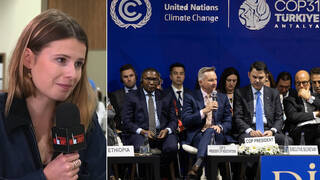
AMY GOODMAN: This is Democracy Now!, democracynow.org. I’m Amy Goodman. We’re broadcasting from the U.N. climate summit — that’s COP31, conference of parties, 31 years — here in Antalya, Turkey. Over 90,000 people have participated in this summit over the last week and a half. It’s considered the largest.
Negotiators have just a few more days to see if they can come to some final agreement. Despite all the many significant issues being debated here, from climate finance to electrification, what’s not discussed is also significant, and that’s the transition away from fossil fuels, the number one driver of global warming.
Well, seven months ago, a bloc of nations led by Colombia held a separate conference in Santa Marta, Colombia, with the explicit shared agenda to begin the transition away from fossil fuels. More than 50 countries participated. A group of countries have already released national roadmaps to do just that.
Colombia is a significant fossil fuel producer. The country is Latin America’s largest coal exporter, as well as a significant exporter of crude oil. Despite the importance of the fossil fuel industry for Colombia’s economy, the Santa Marta Conference was championed by then-Colombian President Gustavo Petro, whose term ended in August. Colombia’s new right-wing President Abelardo de la Espriella has since withdrawn Colombia from the Santa Marta coalition. But the larger process continues.
We’re joined now by Irene Vélez-Torres. As Colombia’s acting minister of environment and sustainable development under Petro, she served as co-chair for the Santa Monica Conference along with the Netherlands. She was also the former director of Colombia’s National Environmental Agency and the former minister of mines and energy.
We thank you so much for being with us. Those are a lot of titles that you don’t have right now because of the new government in Colombia. But you’re here to represent the Santa Marta coalition. First, the significance of your new president pulling out of the Santa Marta coalition? And explain what it is.
IRENE VÉLEZ-TORRES: The Santa Marta coalition unites 57 governments, but also civil society, subnational governments, parliamentarians, NGOs, who came together in Santa Marta with a very specific, clear message, which is it is needed and urgent to phase out fossil fuels. And because here in these COPS we have the limitation of consensus, then we needed a different —
AMY GOODMAN: Which it really isn’t. Consensus is not actually the rule. It’s just the custom. But to make clear to people around the world, fossil fuels are not mentioned when it comes to final documents at the COP summit, which might shock people.
IRENE VÉLEZ-TORRES: It is really strange for someone that is not part of this diplomatic world to actually know that 80% of the global emissions are connected to fossil fuels, and however, climate change being discussed in these COPs is not addressed from the production and consumption of fossil fuels. The production side of this problem has always been denied. And why is that? Because there are lobbyists, there are petro lobbyists, people here defending the interest of the corporations, and therefore the discussions cannot make any progress. The agreements cannot even mention the word “fossil fuels.”
AMY GOODMAN: So, talk about what’s come out of the Santa Marta coalition. You are releasing a report this week. We just heard, after yesterday’s broadcast of Democracy Now!, that countries like Spain are releasing a roadmap. What does that mean? A roadmap to what?
IRENE VÉLEZ-TORRES: One year ago, when we were in Belém in the COP30, we were very frustrated, because we couldn’t address the elimination of fossil fuels as part of the dialogues and as part of the official agenda. So, we decided, led by President Petro, that it was needed to create a parallel but connected space. And we decided to host that particular space, to create that particular space in Santa Marta, Colombia. We managed to gather 57 countries with one agreement in order to get there, that the elimination of fossil fuels was necessary and that we needed to do it in an orderly and urgent way. We invited not only governments, but also civil society and subnational governments.
And when we were there, we decided that the transition away from fossil fuels had three calls of action: one, to make roadmaps, which implies to plan; second, that the decarbonization of trade is needed, particularly for oil, coal and gas-producing countries like Colombia; and third, that the financial system has to be revised, because, otherwise, especially countries from the Global South won’t have the investment needed in order to make the diversification of economies that are necessary as part of the just transition. So, we have these three work streams already in progress, and we hope that towards the second conference, that is going to take place in Tuvalu in July 2027, we can show more action-oriented decisions by the governments.
AMY GOODMAN: When you say “climate finance,” another buzzword that most people don’t understand — loss and damage is within that — if you can explain what it is, what it means when you have the historically biggest carbon polluters in the world, from the United States to China, and those countries feeling the terrible effects then, though not causing it? What is a fair way to help these countries adapt, but also deal with catastrophes, like Nepal —
IRENE VÉLEZ-TORRES: Yes.
AMY GOODMAN: — with a glacier breaking off and killing thousands of people?
IRENE VÉLEZ-TORRES: Yes, 31 COPs have been trying to address the problem of financiating actions that could cope with climate change. What kind of actions? Most of them are focused on adaptation, which means to have the tools at the national level to cope with the changes that the increase in global temperatures are going to generate.
It was maybe three COPs ago that we also came with the concept of the Loss and Damage Fund, which will mean that all developed countries, the ones that have polluted the most, will put money in a bag, and every country that will feel damages generated by climate change will be able to address that fund. However, the fund is insufficient, and the mechanisms to address that money are super complicated, bureaucratic, very difficult for countries to actually get to those resources.
But there is another, blind coronary that I want to point here, which is that this finance is not meant for the diversification of economies, which means that there is no allocation of money for transitioning from producing gas, oil and coal to producing something different, which means that our economic dependency is not really overcome with the kind of finance that is offered in these COPs.
AMY GOODMAN: The Colombian government and the U.S. government have signed two new agreements around critical minerals and nuclear energy. What is the significance of this?
IRENE VÉLEZ-TORRES: It is a terrible news for Colombia and its sovereignty. Basically, what happened there is that the Colombian government resigned to sovereignty. And there are particularities about that agreement that should be clearly stated. One, the Colombian government has made explicit that it’s going to ask permission to the U.S. in order to allocate any mining project, which means that it’s like if we were the son that has to ask for permission in order to act, and not a proper government, not a proper state.
The second, all the knowledge generated by Colombia as a sovereign country will have to be shared with the U.S., meaning that we don’t have knowledge sovereignty and that everything that is our resources in the subsoil will be known by the U.S.
And the third one is that any investment that the U.S. would like to prioritize will have to be also prioritized by Colombia.
AMY GOODMAN: Final comments? We have 20 seconds. What people should know around the world about what you want to see come out of COP31?
IRENE VÉLEZ-TORRES: Let me also say that this government of Colombia has just reversed the protection of the Amazon. Gustavo Petro already had protected 42% of our territory, declaring it a fossil-free zone. And however, this government came and reversed that historical decision, not only for Colombia, but for all the South American countries that share this biome. This is making a huge risk in terms of water integrity, because the water that is generated by the forest of the Amazon also moves towards Bogotá. So, what we are seeing is really an ecocide taking place in Colombia.
AMY GOODMAN: Irene Vélez-Torres, former director of Colombia’s National Environmental Agency, also served as Colombia’s acting minister of the environment under President Gustavo Petro. She co-chaired the Santa Marta Conference earlier this year.
Coming up, Rachel Cleetus, climate program director at Union of Concerned Scientists. And then we’ll talk about what’s happening in Ecuador. We’re at the U.N. climate summit. Back in a minute.
[break]
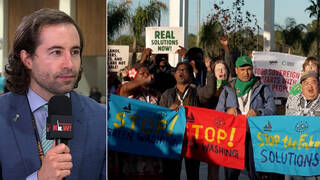
AMY GOODMAN: For our radio listeners, that music break was recorded at the — for our radio listeners, that musical break was recorded at the “Polluters Must Pay” protest here at COP31 in Antalya this morning. In the video, protesters dressed as giant peanuts. Yes, peanuts. They’re dancing while holding up giant pennies that spell out “Pay Up.” A recurring chant at the protest was “Billions, not peanuts,” “Trillions, not peanuts.” They were protesting the inadequate funding and contributions from rich, polluting countries to the countries that need adaptation and recovery funds the most.





 Top
Media Options