





 Watch Full Show


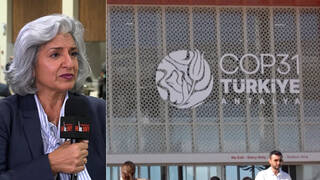
Democracy Now! is in Antalya, Turkey, where this year’s United Nations climate summit, COP31, is being held. For the second year in a row, the United States has not sent an official delegation to the international talks, in keeping with the Trump administration’s longstanding hostility to such efforts to address the climate crisis.
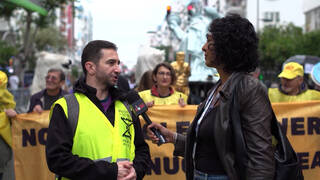
There are nearly 100,000 participants here at this year’s climate summit, including many civil society activists from Turkey and around the globe. Over the weekend, Democracy Now! was in the streets of Antalya to speak with some of the thousands of protesters who marched to demand urgent climate action, including many labor leaders.
“Trade unions care about a lot more than just protecting jobs. We have systemic demands,” said Lala Peñaranda, the Latin America coordinator for Trade Unions for Energy Democracy.
Related Story
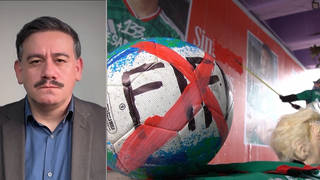
 StoryJun 11, 2026World Cup Kicks Off in Mexico Amid Protests Against Austerity and Forced Disappearances
Transcript
AMY GOODMAN: We are broadcasting from the U.N. climate summit, COP31, here in Antalya, Turkey. More than 190 countries are attending the summit, but for the second year in a row, the United States has not sent an official delegation. Shortly after returning to the White House, President Trump withdrew the U.S. from the landmark 2015 Paris Climate Agreement.
Here at COP31, climate activists have been demanding immediate action to confront the climate crisis. Earlier today, activists rallied against the plastics industry.
PROTESTERS: Less plastics! More life! Less plastics! More life! Less plastics! More life! Less plastics! More life! Less plastics! More life!
AMY GOODMAN: Over the weekend, Democracy Now! was in the streets of Antalya as thousands of protesters marched to demand urgent climate action. Democracy Now!’s Anjali Kamat filed this report.
PROTESTER: We are children of this planet! We have a right on this planet!
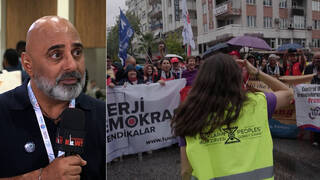
ANJALI KAMAT: Over 10,000 people came out in the streets of Antalya, Turkey, this Saturday to participate in the People’s Climate March.
PROTESTERS: The people, united, will never be defeated!
ANJALI KAMAT: Despite a light rain, the mood was festive and defiant, with people from across Turkey and around the world demanding stronger climate action. From Indigenous rights to making polluters pay to ending the genocide in Gaza and the war in Iran, the protesters connected the dots.
PROTESTERS: Free, free Palestine! Free, free Palestine! Worker power! Worker power!
KIVANÇ ELIAÇIK: This is Kıvanç Eliaçık, labor activist. I’m with People’s Climate Summit. I’m based in Istanbul normally. Fossil fuels are killing the planet. Of course, there are a long list of demands, but from a trade union perspective, we are asking for a just transition, which we mean we want exit from fossil fuels, but we want job security, income security or pension rights. So we are asking for just transition. We want to keep the planet, but we want to keep the jobs, as well.
ANJALI KAMAT: Just as the COP opened last week, Turkish President Recep Tayyip Erdoğan announced the discovery of two new oil fields in the southeast of the country. Kıvanç is one of the organizers of an alternative People’s Climate Summit that kicked off with Saturday’s march.
KIVANÇ ELIAÇIK: Turkey is co-hosting COP31 together with Australia. They are also destroying the nature to build new infrastructures to host this event. And while having the COP31 presidency, co-presidency here, Turkey has no plan for exit of fossil fuels. So, the meeting, the Turkish co-presidency focused on zero waste. It’s an important issue. Recycling, waste management is important issue. But we have no plans about fossil fuels. So we need a plan for fossil fuels.
PROTESTERS: Workers, united, will never be defeated!
ANJALI KAMAT: Labor groups made up a large portion of the march. Nearly 80 unions from over 40 countries met in Antalya last week to call for more public solutions to the climate crisis.
PROTESTERS: Worker power! Worker power! Worker power! Worker power!
LALA PEÑARANDA: My name is Lala Peñaranda. I’m the Latin America coordinator at Trade Unions for Energy Democracy. I’m based in Bogotá, Colombia. Trade unions care about a lot more than just protecting jobs. We have systemic demands. It’s really to reject the “privatize to decarbonize” agenda, to the fight for energy as a human right, not as a commodity.
ANJALI KAMAT: When you say “privatize to decarbonize,” what do you mean by that?
LALA PEÑARANDA: We saw a growing trend of both institutions, like the IMF and the World Bank, but also even some actors in the trade union movement, that were saying, “You know what? As long as we have a seat at the table, we’re fine. You can privatize energy, you can privatize public services, as long as we have a seat at the table and we have a job.” And we were saying, “No, no, the trade union tradition is to defend the working class — not the unions, not the union bureaucracy, the working class.” And that means that our public services, starting with energy, has to be public. It has to be in public hands, and it has to be for the people.
AKHATOR JOEL ODIGIE: Akhator Joel Odigie is my name, general secretary of the African Regional Organisation of the International Trade Union Confederation.
ANJALI KAMAT: And where are you coming from, sir?
AKHATOR JOEL ODIGIE: I am coming from Lomé, Togo. That’s where I am headquartered.
ANJALI KAMAT: And what is your main demand?
AKHATOR JOEL ODIGIE: Just transition for workers that is inclusive, that is financed. And more than ever before, the Belém plan of action, we need to begin implementation now. And we are not seeing that, unfortunately. The planet is heating up. We cannot continue to pretend that things are the same. They are not the same.
ANJALI KAMAT: And are people inside the COP31 meeting — are they addressing any of this?
AKHATOR JOEL ODIGIE: This is a challenge, we are saying. They are not listening as we would want. There is so much slowdown. To get to all of these, we need huge financing. Polluters must pay. Those that are polluting the climate should come forward with the resources.
SUNGHEE OH: OK, I’m SungHee Oh from South Korea, South Korean trade union.
ANJALI KAMAT: Are you feeling hopeful about anything coming out of this formal summit?
SUNGHEE OH: Not really, because, you know, the labor unions around the world, we have been demanding a just transition, you know, with guaranteed workers’ rights for many years. And they agreed to have a just transition mechanism in the COP30 — I mean, the COP governance, but they haven’t been able to include, you know, trade unions and workers in the negotiations. So, I don’t know. I’m not so sure. That’s why we gather here, and, you know, we try to put pressure on, you know, those government parties in the negotiation tables.
PROTESTERS: Polluters have to pay! Polluters have to pay! What do we want? Climate justice! What do we want? Climate justice!
ANJALI KAMAT: We also met a farmer from Pakistan who lost his harvest and livestock in the catastrophic floods of 2022 that displaced over 30 million people and inundated millions of acres of farmland.
ABDUL KHALIQUE LAGHARI: [translated] My name is Abdul Khalique Laghari. I’m from Dadu Province in Sindh, Pakistan.
ANJALI KAMAT: Laghari is part of a group of nearly 40 flood-affected farmers who are suing two of Germany’s most polluting companies for their emissions. They’re suing on the basis of a German court ruling last year that opened the door to companies being held liable for climate damages caused by their carbon emissions. Pakistan contributes less than 1% to global carbon emissions. Nasir Mansour from the National Trade Union Federation of Pakistan is supporting the lawsuit.
NASIR MANSOUR: We have made the polluters accountable. So, we are not only asking for a compensation, but we are all asking for the justice. So, it’s a symbolic kind of our venture. It will give a new boost and the hope to the other communities who suffer from the climatic displacement and the calamities.
ANJALI KAMAT: It wasn’t just groups from Turkey and the Global South at the march, but also activists from Europe still reeling from the heat waves this summer that killed over 50,000 people.
SORAYA FETTIH: My name is Soraya Fettih. I work for 350.org. I’m based in the southwest of France. Just last summer, I saw part of my region just burned to the ground because, yet once again, our politicians are doing almost nothing to fight the climate crisis that is happening. We lost people. We lost, like, our fields, some of our means of, like, livelihood. So, for me, coming here was a way to protest, fight for what’s needed.
ANJALI KAMAT: And, Soraya, are you going to be at the COP, or are you outside this whole week?
SORAYA FETTIH: I’m doing both. Like, I feel like we have to be everywhere and give it our all, because, again, like, the climate emergency, we can all feel it wherever we are right now. It used to be mostly the countries and the populations from the so-called Global South, those who did the least to, like, create this crisis, that would feel the most impact. But right now we are all feeling it, whether you are from the North or the South. And so, the urgency that we’re feeling, we need to translate it in proper action and hire the pressure, again, on our leaders and on our governments right now. They are just, like, not doing enough.
ANJALI KAMAT: As the march came to an end in Antalya’s Republic Square, the sun was out, and a group of Turkish activists unfurled rainbow flags and burst into song.
*PROTESTERS: [singing] O bella ciao, bella ciao, bella ciao, ciao, ciao…
ANJALI KAMAT: While climate justice was the focus of Saturday’s march, many of the participating Turkish groups raised concerns over domestic repression in other arenas. In September, Turkish authorities launched nationwide raids against the LGBTQ+ community, arresting over a hundred activists.
YAĞMUR ORHAN: We hide the flags on our backs, and then we open them. So we were able to use them today.
ANJALI KAMAT: This is Yağmur Orhan, a 21-year-old activist.
YAĞMUR ORHAN: We are starting a campaign called We Want Freedom. And we demand that our friends will be released immediately and stop this madness, honestly.
ANJALI KAMAT: Is there a sense of fear in the community, given the scale of the crackdown?
YAĞMUR ORHAN: It’s honestly a very scary environment. We feel that in our communities, in our homes, in our everyday lives, because we are being arrested, we are being accused of nonsense crimes, so that we can feel that very much. But we are sticking together. We are fighting against this together. So, we’re going to be OK. I’m sure about that.
ANJALI KAMAT: Do you feel like people are able to come out and say proudly that they are part of the LGBTQ community in Turkey?
YAĞMUR ORHAN: No, I don’t really think that. Trans people cannot transition because of this environment. People are scared of their families, the people, the government. So, not a very safe space right now.
ANJALI KAMAT: If people say, “How is this related to climate?” what would you say?
YAĞMUR ORHAN: We know today that the fascist government that is attacking the LGBTQ people today is the same one that attacks the nature, the animals, the people. So, we know that this is an intersectionality problem, so we are here today.
ANJALI KAMAT: As the gathering came to a close, we also ran into some veteran campaigners who have been advocating for climate justice for decades, both inside the COP and on the streets.
ASAD REHMAN: My name is Asad Rehman. I’m from Friends of the Earth in England, Wales, Northern Ireland. We are in the midst of a crisis, of a crisis of crisis. We could see that with the killer floods, droughts and famines impacting people everywhere. Our ecosystems are collapsing. The U.N. has warned we’re about to breach the critical 1.5-degree guardrail with devastating consequences on all of that happening, of course, on top of a global inequality crisis, where the rich and powerful are getting richer and richer, and more and more people are struggling to survive. So, we come to these climate talks with an urgent need for, one, governments to — especially the rich countries to do their fair share of action and to provide much-needed resources and finance, particularly for those on the frontlines, not just in the Global South now, but increasingly in the Global North, as well. Will rich countries provide real public finance? Now, let me tell you, just five oil companies in the last nine months have made profits five times the amount that the rich countries have handed over in public climate finance. There is abundant wealth, but it’s obviously in the hands of a very, very few people.
HARJEET SINGH: I’m Harjeet Singh. I’m with the Fossil Fuel Treaty Initiative and Fill the Fund campaign. We want finance in the form of grants. We don’t want money that is going to further exacerbate the debt crisis. Developing countries are already struggling. And the reality is that developed countries only want to see how they can make money from this process and not to help communities who are facing the climate crisis right now. Unless and until finance is provided by developed countries, nothing is going to move. That’s the reality. Or, if we don’t see action on phasing out fossil fuels, we are going to see this crisis only intensifying, and that’s what we are seeing. Look at how we have actually breached the 1.5 degree Celsius target, and disasters are everywhere, not just in developing countries. Even the developed world is suffering now.
KUMI NAIDOO: My name is Kumi Naidoo. I’m from South Africa. I’m the president of the Fossil Fuel Treaty Initiative. Today, the fossil fuel industry holds a roughly morally equivalent position of what the slave-owning class did. They occupy — because, you know, the slave owners, when we were — people were saying, “We need a phaseout. It’s inhumane, and it’s a violation of all our religions,” and so on, they would say, “Oh, if we stop doing slavery, the whole world will fall apart. Impossible!” All those arguments that they gave, you will hear it now from the fossil fuel industry. “Everything will fall down,” and so on. And let’s hope that the fossil fuel industry gets a message that their days are numbered. And, you know, people must just remember one thing: Nobody anticipated the Berlin Wall would come down as fast as it did. Everybody thought it was going to be forever. And it happened. I believe that the fall of the fossil fuel industry will happen in the same way. And this moment needs, calls for massive, peaceful civil disobedience against the fossil fuel companies wherever they are, wherever they continue to operate. And I’m seeing it happening, and I think it’s going to grow in leaps and bounds in the months to come.
ANJALI KAMAT: For Democracy Now!, this is Anjali Kamat, with Hany Massoud and Nicole Salazar.
AMY GOODMAN: And thanks so much to Anjali, Hany and Nicole for that report from the streets of Antalya, Turkey, for the People’s Climate March on the Global Day of Climate Action this past Saturday.
Coming up, Farhana Yamin, a climate negotiator who’s been to nearly every COP — that’s climate summit — over the last 30 years. She helped negotiate the 1.5 degree Celsius limit in the 2015 Paris Climate Agreement, that is now on track to be surpassed. What does this mean? We’ll get her reaction, and we’ll also speak to Asad Rehman from Friends of the Earth. Stay with us.
[break]
AMY GOODMAN: Casey Camp-Horinek of the Ponca Nation of Oklahoma, here at the People’s Climate Summit taking place in Antalya on Sunday.




 Top
Media Options