





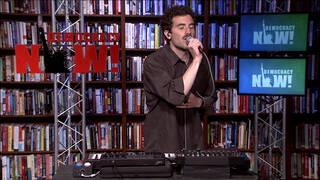






Celebrated Chilean American composer, musician and electronic music producer Nicolás Jaar recently stopped by the Democracy Now! studio to perform and talk about his work. He has released seven solo albums, including Piedras 1 and Piedras 2, both of which came out in 2025. He’s also known for his film scores, including for Dheepan by Jacques Audiard and Ema by Pablo Larraín.
Related Story
 Web ExclusiveSep 24, 2026Rhiannon Giddens: Full Interview & Performance of New Song, “Wish In Vain”
Transcript
AMY GOODMAN: This is Democracy Now!, democracynow.org, The War and Peace Report. I’m Amy Goodman.
We’re joined now by the celebrated Chilean American composer, musician, electronic music producer Nicolás Jaar. He’s released seven solo albums. His latest is Piedras 1 and 2, Stones 1 and 2, out early last year. He’s also known for his film scores, including for Dheepan, by the director Jacques Audiard, and Ema, by Pablo Larraín.
Nicolás Jaar’s father’s family has roots in Bethlehem, Palestine. His father, Alfredo Jaar, is a renowned Chilean conceptual artist and architect. He actually has an exhibit at a gallery here in Chelsea, in New York City. His mother, Evelyne Meynard, is a French Chilean former dancer. She’s a writer.
At a set in Coachella last year, Nicolás Jaar talked about ICE and Palestine. He said, quote, “There’s more people locked up in California than at Coachella right now, and this country keeps on arming and funding, also with tech and Silicon Valley, the genocide of the Palestinian people and arming and funding Israel’s system of apartheid and ethnic cleansing.”
He’s joining us in studio now. It’s great to have you with us. Nicolás, welcome to Democracy Now!
NICOLÁS JAAR: Thank you so much for having me.
AMY GOODMAN: You’re here in New York right after the 25th anniversary of the terror attacks on 9/11. When they happened, we were the closest national broadcast to ground zero. The second plane hit the second tower in the midst of the broadcast. We were doing a special that day on the connection between terror and September 11th, 1973, when Salvador Allende died in the palace in Chile, and the Pinochet forces, the U.S.-backed, Kissinger-backed, Nixon-backed Pinochet forces, rose to power. That September 11th, the other 9/11, doesn’t get as much attention in this country. But can you talk about the significance of it, especially because even in your own country now, in Chile, I think it’s the first time since the coup that it wasn’t nationally celebrated officially — not celebrated, but observed?
NICOLÁS JAAR: Yeah. I mean, I think the American government have been professional terrorists for a very long time. And in Chile in '73 is just one small aspect of the longer widespread campaign. And yeah, these days, as we have seen, the kind of “Donroe” or Monroe Doctrine, kind of the U.S. trying to exert its hegemony, its influence, in a very violent, extremely violent way all throughout the entire continent. And Kast is also — the current president of Chile — is one aspect of this. And we're seeing intense militarization of Wallmapu, the Indigenous Mapuche area in the south of Chile. And we’re seeing just horrendous ecological — basically, them taking back years of ecological — progress in regards to ecological laws that had been taken, and all of this very much in line with the U.S.’s imperial ambitions.
AMY GOODMAN: I’m wondering also if you can comment on something else that has happened in the last few weeks: the axing of a musician, Macklemore, from the British pop star Ed Sheeran’s national tour. Macklemore had said, “Free Palestine.” He sang a song, “Hind’s Hall,” for Rajab Hind. And Ed Sheeran and the promoter dropped Macklemore under pressure from Robert Kraft, the billionaire owner of the New England Patriots and Boston’s Gillette Stadium, who rallied other stadium owners and said there would be a boycott of Sheeran’s tour if he continued with Macklemore. So, Macklemore out, and then one musician after another who was part of the tour dropped out, including Sheeran’s backup band. If you can talk about the significance of this?
NICOLÁS JAAR: Yeah. Well, in certain ways, not in this program, but the news cycle has largely, in a way, forgotten that there is an ongoing genocide, to this day, in Palestine. And in a sense, these moments of musicians speaking out can, hopefully, bring a little — shed a little bit of light on this continuing horror and catastrophe that is happening and still happening, all thanks to and with the financial help of this country, of the American country.
And as far as the silencing of artists, it does make me wonder for how many years Palestinian artists were silenced. And it was not visible — right? — when they were silenced, so there was a silencing and an invisibility in regards to the silencing itself, which now, I guess, Macklemore using his — the privileged position he has, it does shed a light on something very important. But I think it’s always very important to continue and center the invisibilization of the genocide and of Palestinian people at this time, yeah.
AMY GOODMAN: You’re from Chile, which has the largest Palestinian community outside the Arab world. Can you talk about your father’s family, Bethlehem and your own connections to the West Bank?
NICOLÁS JAAR: Yeah. So, when I was growing up in Chile, I grew up going to my grandmother’s house and eating various Palestinian foods, etc. But it was a very diasporic experience. I had never been to Palestine until I was actually invited to play music there. So, it is really music that brought me to Palestine in the first place. It was in 2017. I decided to go a couple months earlier to be there before I would play. And, of course, I think the diasporic mind, or at least the Chilean Palestinian diasporic mind, sets up certain kind of myths around what it means, and then you go there, and you have a very different reality. But what has struck with me and stuck with me since then is that everything that I had read, everything that I had heard from the family, was just — it paled in comparison to what I saw there and what you are witness to if you go to Palestine. The system of apartheid is not just a word; it’s something you see in every corner.
AMY GOODMAN: You said at Coachella, “There’s more people locked up in California than at Coachella right now, and this country keeps on arming and funding, also with tech and Silicon Valley, the genocide of the Palestinian people and arming and funding Israel’s system of apartheid and ethnic cleansing.” So, you’re talking about ICE. You’re talking about Israel’s support, the U.S. support for Israel. Talk more about why this matters to you so much and you feel that you need to speak up as an artist.
NICOLÁS JAAR: Yeah, I think what matters to me in regards to making those connections is that the carceral system is also the border system. It is hard to — really, it is impossible to separate them. And once we look into the ways in which the police system works in this country, the connection it has with Israeli tech, Israeli intelligence, as well, you end up seeing that all of these different things are intimately connected. And you even see it in Chile. Some of the drones that are used to surveil and to — and are violently used against Mapuche communities are also Israeli drones. They’re made by different Israeli companies. And so, these questions around — none of these questions are happening in a vacuum. And I think, for me, that has been in the past few years the thing that I am trying to, I guess, come across — like, for it to come across, is this thing of of everything is intimately connected.
AMY GOODMAN: Can you tell us about the song you just performed here in Democracy Now!’s studio?
NICOLÁS JAAR: Yeah. So, it’s a song that I would listen to. It just would come up everywhere in Chile when I was growing up. And my mother is a big fan of Mercedes Sosa. And —
AMY GOODMAN: And talk about who Mercedes Sosa is.
NICOLÁS JAAR: Yeah, Mercedes Sosa, incredible, incredible personality, singer and musician who influenced so many, so many of us, with the political nature of her work and also with, I think, all the other ways in which music speaks, right? Through emotion, through the heart. It’s hard not to really, you know, get emotional — for me, at least — listening to Mercedes Sosa’s work.
And when I thought — when I was invited — and I’m so grateful to be here — I thought I wanted to do something different, not play my own music. And this is a song that was actually written by Gieco, an Argentinian songwriter, I think, in ’70 — in the ’70s, and it was banned by the dictatorship at the time. And Mercedes Sosa kind of popularized the song, I would say. And those are the — those are the versions that I heard, at least when I was a child. And this is the song I started humming to myself when thinking about: What am I going to do at Democracy Now!? All of the lyrics — some of the lyrics of the song, I felt I wanted to maybe change them a little bit to make them speak to our current moment, and so most of the lyrics are changed, actually. But the main refrain of “Sólo le Pido a Dios” I decided to keep.
NICOLÁS JAAR: [performing “Sólo le Pido a Dios”]
Solo le pido a Dios
Que el engaño no me sea indiferente
Si un traidor puede más que unos cuantos
Que esos cuantos no lo olviden fácilmente
Solo le pido a Dios
Que la memoria no me sea indiferente
Dignas son las que han tenido que marchar
A vivir una cultura diferente
Y solo le pido a Dios
Solo le pido a Dios
Que el futuro no me sea indiferente
Nobles son las que han tenido que luchar
Resistiendo el blanqueamiento de la mente
Y solo le pido a Dios
Solo le pido a Dios
Que el frio no me sea indiferente
Que nunca se me olviden esos ojos
Que el hielo ha secuestrado brutalmente
Y solo le pido a Dios
Solo le pido a Dios
Que los muros no me sean indiferente
Bajo ese viejo arbol en arizona
que nos susurra “no hay barreras en la mente”
Y solo le pido a Dios
Solo le pido a Dios
Que el frio no me sea indiferente
Que nunca se me olviden esos ojos
Que el hielo ha secuestrado brutalmente
Y solo le pido a Dios
Que el dolor no me sea indiferente
Que la reseca muerte no me encuentre
Vacío y solo sin haber hecho lo suficiente
Y solo te pido a vos
AMY GOODMAN: And can you talk about the importance of art and resistance?
NICOLÁS JAAR: Yeah. I guess I’ll speak about it from a musical perspective. One thing that kind of blows my mind to this day about songs — for example, this song, “Sólo le Pido a Dios” — is that it’s a melody that is recognizable, that speaks to a certain feeling, and it can be used in order to tell a message. It can be used to bring people together. And it’s a technology, in a sense, not in the tech way that we talk about, but it is a technology. And I feel like it is a technology of resistance, of course, and it must be. It’s not the only one, and it’s not enough, I would say. But I do think that music speaks through so many layers. And I’m invested in all of those layers, not only the musical layer or the harmonic layer, but also in all the other ways that music can create a small change or just hold someone’s hand, which is enough sometimes.
AMY GOODMAN: I want to thank you so much for taking this time and stopping by Democracy Now!’s studios. Nicolás Jaar is performing Friday in New York at 314 Scholes with his friend Patrick Higgins. Can you talk about that performance?
NICOLÁS JAAR: Yeah, it’s an electroacoustic performance, quite experimental in nature. We’re also working with an incredible drummer and cellist. And it will be, I think, broad in scope. It will be instrumental. And it will be the first time that we actually play this music live, and so we’re very excited about it.
AMY GOODMAN: Nicolás Jaar, celebrated Chilean American composer, musician, electronic music producer. Thank you so much.
NICOLÁS JAAR: Thank you so much. Honored to be here.




 Top
Top
Media Options