






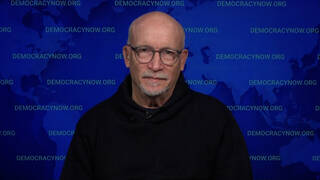






Part 2 of our conversation with Academy Award-winning director Alex Gibney about his new documentary Musk, an expansive, nearly four-hour examination of the world’s first trillionaire.
Transcript
AMY GOODMAN: This is Democracy Now!, democracynow.org, The War and Peace Report. I’m Amy Goodman, as we bring you Part 2 of our conversation with Alex Gibney, Academy Award-winning director. His new film is Musk.
Last week, Defense Secretary Pete Hegseth announced a new Pentagon project on the future of warfare. Elon Musk will lead the task force along with former Republican House Speaker Newt Gingrich and Trump donor and weapons entrepreneur Palmer Luckey. This comes as The New York Times reports Musk has spent $366 million to help Republicans in the midterms. Now, according to NPR, SpaceX, Musk’s company, has secured over $8 billion in U.S. military contracts in this year alone. So, if he can keep the Republicans in power, $366 million is a small price to pay for that.
Can you comment on the power of Elon Musk?
ALEX GIBNEY: I mean, in a way, in the film, Musk texts to his then-girlfriend Ashley St. Clair he’s found an anomaly in the matrix. That refers to something else. But the anomaly in the matrix that Musk has found in the American political system is money. This is our great weakness. And now with an utterly transactional president and an administration that’s completely transactional, you get what you pay for. You put hundreds of millions of dollars into getting either Trump or Republicans elected, and you get paid back with enormous government contracts.
And SpaceX now, we must remember, is not only the ability to launch rockets; it’s also xAI, which is maybe the most flawed and most reckless frontier AI company that there is. But because Musk is a political contributor, he’s given a vast kind of subsidy for that flawed AI system. And indeed, you know, that system, we don’t know exactly how it’s being deployed, but it could be, as far as we know, being deployed for autonomous weapons, which is a really scary thought, since, you know, as we profile in the film, this is the — this is the AI that birthed a character online called “MechaHitler” and also, you know, introduced a product that was designed to undress young children for the amusement of pedophiles. So, this really — it’s a terrifying prospect, the idea that Elon Musk is being put in charge of the future of war. It’s a little bit like putting the Joker in charge of the Manhattan Project.
AMY GOODMAN: Actually, tell us about that incident where Grok adopted this Hitler persona. In fact, the Pentagon is using Grok.
ALEX GIBNEY: Indeed. So, I mean, you know, one of the things we all need to understand, or perhaps all of us know at this point, is that LLMs, like Grok or Claude or ChatGPT, you know, they sample a huge amount of data, and based on those samples, then they are able to feed back or to predict, you know, what you may or may not want to hear. But how they react and how they respond depends tremendously on the data that they sample. And so, you know, Musk was upset that his Grok was too woke, so suddenly he was feeding it more non-woke data, presumably stuff about Nazis, because if you feed it Nazi data, that’s what you get back in terms of a kind of a chatbot. And one day, you know, Grok, they sort of overtweaked the algorithm, and Grok was suddenly responding to everybody in a voice that was called MechaHitler.
AMY GOODMAN: So, AI, Elon Musk’s attitude toward artificial intelligence, if you can document it through time, and then what exactly xAI is doing and why it is so flawed?
ALEX GIBNEY: Well, it’s fair to say that Elon Musk was one of the first people to sort of warn the public at large about the existential threat of AI. He said it was “summoning the demon.” Now, even as he was warning that and starting a nonprofit called OpenAI, which was originally started as a nonprofit to explore AI in an ethical way, he was already pivoting at Tesla in terms of using AI in the Autopilot system of his cars, which, you know, we talked about earlier. It was flawed there, and over time, it’s become flawed even as he’s expanded his AI ambitions. And there was some thought that — early on, that Musk may have been warning about the dangers of AI because his AI companies were behind. In other words, then this would give him an opportunity to catch up.
Be that as it may, flash-forward a number of years, and suddenly, you know, Musk has a company called xAI, which he folds into SpaceX just before the IPO. And I think what’s interesting about xAI is, we know that by the number of people who rather publicly left the company, very high-ranking executives who were deeply concerned about the lack of safety at xAI, that it’s a very reckless product, far more reckless even than something like OpenAI. So, you know, it’s of enormous concern that that reckless AI program would be so fully integrated into our Department of Defense.
AMY GOODMAN: I wanted to read to you from Time magazine, Alex. They said, “In December 2025, Elon Musk returned to the Oval Office for a clandestine meeting. Trump spent hours asking Grok, Musk’s AI chatbot, questions about his presidency and legacy, according to an official present. … Trump … asked Grok how Venezuelans would react if the U.S. captured” — you know, then-Venzuelan President Nicolás — “Maduro. According to the official present, the chatbot responded that Maduro was a repressive and deeply unpopular dictator and that many Venezuelans would likely celebrate his downfall. After Trump ordered the mission to seize Maduro, the following month, celebrations broke out in the streets. Trump, according to officials, came away thinking Grok was ingenious.”
ALEX GIBNEY: Well, yeah, I think that illustrates the flaw or the confusion that we’re all suffering now between what AI is telling us and also what human beings do with AI, either the people who are in charge of it or the people who fall under its sway. So, I think the flaw in the system there is President Trump.
AMY GOODMAN: Well, I wanted to go back, and in Part 1, you talked about reasons that Elon Musk might be investigated — in fact, investigations that were dropped into a number of his companies, in fact, criminal investigations of Elon Musk, and what’s at stake right now when we see this massive amount of money he’s poured into the midterms, like more than $360 million. Talk about what happened over the years and what he’s so afraid of.
ALEX GIBNEY: Well, we just know that there were ongoing — I’m not going to remember the exact number now, but it was double figures in terms of federal investigations into his companies. And these related to NLRB investigations. I believe there are EPA investigations relating to explosions of SpaceX rockets, a tremendous number of civil investigations into malfeasance by his companies. But there was at the heart — there was, in addition, a criminal investigation into fraud relating to Autopilot in likely — we don’t know precisely the parameters of the investigation. We know it was criminal. It was actually disclosed by Tesla, and Reuters wrote a number of pieces about it. So, he jokes with Tucker Carlson, in fact, just before the election, “Oh my god, if I don’t win, I wonder how long my prison sentence is going to be, haha haha,” which is a classic Elon trope, where everything is both deadly serious and a joke at the same time. But I think it’s fair to say that his companies were at risk, and he himself was at risk of going to prison, potentially. So, that investment in Trump’s election in 2024 was hugely motivated by self-preservation.
Now, flash-forward, and you see this pattern repeating itself with this now even larger amount of money flowing to the Republican Party prior to the midterm elections. And by the way, the stated number could be much smaller than the larger number, because it doesn’t even account for dark money groups that he may have, you know, thrown money to. But I think it’s — I think it’s fair to say that he anticipates that if the Democrats win the House and the Senate, that there are going to be a lot of investigations into Musk’s activity, including his activity at DOGE, not only in terms of the lives that were lost because of the sudden shutdown of something like USAID, but also, you know, what about that data? Did he access that data? Did he take it to SpaceX? What has he done with it, if he did? So, you know, he knows those investigations are coming, so he’s kind of desperate to make sure that Republicans win this time so he’s not held to account.
AMY GOODMAN: And desperate to colonize Mars, maybe another place to go in case he’s in trouble.
ALEX GIBNEY: Well, good luck with that. I mean, I think, you know, intellectually, he may feel that he can colonize Mars. That’s not happening. Anybody who realistically looks at the likelihood that he’s going to be able to, you know, have a million people on Mars, as he’s said is likely in the next few years, is high on their own supply.
AMY GOODMAN: What about your avatar, this very creative device you use? Because Elon Musk refused to talk to you, right?
ALEX GIBNEY: Elon Musk refused to talk to me, so we needed a workaround. And, of course, we could have just used archival clips, but I felt that, for all sorts of thematic reasons, it might be interesting and fun to go in a different direction. We assembled a massive database of everything that he had ever said — audio, video, outtakes from documentaries, all sorts of stuff. And then, one of the things that came up in that database was that he perseverated over and over and over again about this idea that we might be living in — or, we were likely living in a simulation, a simulation run by either an advanced AI or an alien civilization in the future, which had harvested all knowledge from planet Earth and was now running kind of an existential video game. So, he believes strongly that that is likely. So, given that, I thought, “OK, let’s play an Elon’s sandbox,” and we created an Elon Musk avatar to visually mouth his own words that we had collected and to substitute for an interview.
And we purposely designed it so that he, like I am doing now, is looking right into the barrel of the lens, looking, therefore, at the audience, and speaking things that he did in fact say. And we try to, you know, in terms of what he said, try to use statements that were forceful and also directly related to the subject at hand in the narrative. I thought it was important to do that not only because of this simulation idea, but when it comes to Musk, there is a constant blurring of what is real and what is unreal, and that this avatar would really reach into that idea. And going back to AI, I think that we’re all facing now this discomfiting notion that AIs learn to sort of guess what we’re thinking or imagining, and invest in trying to please us. And so, this kind of transference that takes place with a machine is also something that I thought might be interesting to explore by housing what Elon Musk says in an avatar. And by the way, I think you know, our avatar makes Elon look pretty good. I mean, he’s buff, a lot more buff than he’s looking right now. And it just seemed a kind of playful way to get at some of these issues that relate to Elon Musk’s troubled relationship with the truth.
AMY GOODMAN: What about with drugs? There is one reference to it, but according to The New York Times, Musk engaged in extensive drug consumption when one of Donald Trump’s closest advisers, taking ketamine so frequently it caused bladder problems, traveling with a daily supply of something like 20 pills. What did you find?
ALEX GIBNEY: Well, we didn’t go too deep into that, except to, you know, remind people of The Wall Street Journal's reporting, which has not been undermined by anything that Elon Musk has said or done, which indicates that not only is he using ketamine, but he's also — there’s also a toxic mix of cocaine, LSD and a number of other drugs. So, this goes to the question of whether or not, you know, he’s stable. And if he’s self-medicating, is he self-medicating in a reckless way that is making his actions extremely erratic, chaotic? Add to that, you know, his obsession and addiction, I would say, with tweeting, sometimes tweeting as much as 150 times a day, on a platform which he himself has tweaked to become a kind of rage-inducing environment, and you have a very toxic stew. I think that’s the important thing to remember here.
AMY GOODMAN: You interview Elon Musk’s father, Errol Musk. You don’t talk as much about Elon Musk’s background, growing up in South Africa, and his relationship with apartheid South Africa. Can you talk about that now?
ALEX GIBNEY: I mean, it’s a fact that he grew up in apartheid South Africa. I didn’t lean too deeply on it, except to say it’s part of this overall mix. You didn’t see so much of that surface during the Barack Obama administration, but you’re certainly seeing a lot of racist tweets from Elon Musk now. So, I think whether it’s because he has a newfound affinity for MAGA and is sort of embracing its worst values, or is it a hangover from his days in apartheid South Africa, it’s hard to be certain, except that we know the direction he’s going. And it’s not only a direction, you know, an increasingly racist direction, but also he’s investing in very violent, seemingly anti-immigrant political parties overseas — Tommy Robinson in the U.K., AfD in Germany — and also authoritarian regimes overseas. So, there is a kind of political project for him, but I think it does center around this notion that he wants to be able to favor the kind of people that he likes, and also he wants governments that are increasingly transactional.
AMY GOODMAN: In fact, he went to Russia early on, you point out, when it came to SpaceX, wondering why the U.S. program and the rockets cost so much money, and so much less money in Russia. But I’d like to ask you about Russia and also Ukraine and Starlink. If you can talk about its significance and how he’s used his power with Starlink against Ukraine?
ALEX GIBNEY: Well, it’s interesting, because Starlink, I think you could fairly say, also greatly advantaged Ukraine. In fact, there are a number of Ukrainian military who talk about how Musk’s Starlink was hugely helpful to them on the battlefield. And yet we also know at critical moments that he was talking directly to Putin, and also shut down Starlink or refused to turn it on in the Crimea when — in Crimea, when, you know, Ukraine was about to launch an attack, and also in the Donbas at critical moments. I think the more — the most troubling thing about this whole episode is you have an individual, untethered from any government control, who’s personally deciding when and how the war should be fought in Ukraine. He’s a one-person foreign policy when it comes to Ukraine because of his control of this technology. To me, that’s the most troubling thing.
AMY GOODMAN: And can you explain what Starlink is, and also Starlink at the White House?
ALEX GIBNEY: So, Starlink is, effectively, a satellite internet system. In other words, instead of connecting to a coaxial cable somewhere or fiber lines, you literally have a dish that connects you with a satellite up above. And I should say that for airlines and for remote rural areas or for the battlefield in Ukraine, it’s an extremely effective technology. It’s not, in an urban environment, nearly as good as fiber, but Elon Musk is pushing it as if it is. And indeed, he’s got the State Department to sort of muscle governments overseas to buy Starlink, even though it’s not necessarily that effective in urban environments.
There’s a couple of interesting things about Starlink, though, that I think we should focus on. First of all, unlike the internet, where it’s end-to-end transmission, if you’re in, say — I don’t know — Omaha, and you’re sending an email to somebody in New York, your signal goes up to a satellite, goes to SpaceX, and then, from SpaceX, goes up to a satellite near New York, and then is beamed down. That’s very interesting, because it means all that data is flowing through SpaceX. And, of course, you know, as AI becomes better and better at foiling encryption, that could become increasingly problematic.
And that’s one of the things I thought that was problematic about the fact that during the Trump administration, suddenly there was a SpaceX technician — not a government technician, but a SpaceX technician — installing Starlink in the White House system. And I posit in the film: Was that so — you know, did that mean that now Elon Musk is listening to what the White House has to say? You know, because it wasn’t necessary for that to happen for the White House to have secure communication. In fact, it made the White House communication less secure.
ALEX GIBNEY: In fact, you have Ashley St. Clair raising the same kinds of questions when she talked about Elon Musk leaving early on election night, and when she said, “Do you know? It looks like he’s going to win,” and he said, “Yes, I know,” and referred to 10,000 lasers.
ALEX GIBNEY: In space, yeah, and that was referring to Starlink. I mean, that’s when he sent her a number of text messages saying, “I found an” — you know, when she was wondering how he could know for certain that Trump was going to win, well before, you know, it was announced by anybody, he said, “Well, I found an anomaly in the matrix. And after all, I have 10,000 lasers in space,” presumably referring to Starlink. Ashley said in text at the time, “I would ask more, but I don’t want to be deposed.” And Elon Musk responded back, “Wise.”
Now, we don’t know exactly what that meant, to be honest with you. And I extremely doubt that — and it’s been debunked, that Starlink could actually change votes. But it’s clear, or it seems clear, that he had unusual advance notice of who was going to win, in ways that should be concerning to us in the future.
AMY GOODMAN: You interview Ashley St. Clair, the mother of one of his many children. He’s, as you call him, a pronatalist, at least 14 children that we know of. You also interview Justine Musk, who is the mother of Vivian Wilson, who is Elon Musk’s oldest and trans daughter, who he thoroughly rejected. Can you talk about that relationship and the belief that that may have led to his political transformation and his vicious attacks on what he calls anything woke?
ALEX GIBNEY: Well, I think you could say that the personal is political, and that the transition of his daughter, Vivian Jenna Wilson, may have taken him down that political path. But I think it’s too simple to sort of blame his political transformation on that. He’s — it became a kind of — once he had started to go right, and I think he started to go right during the pandemic, you know, his anger over his child doing something that he didn’t like becomes part of his stated political project, and he starts launching anti-trans ads, and so forth and so on.
It’s very moving in the film to hear Justine Musk, Vivian Jenna Wilson’s mother, talk about how, you know, this is a child, you know, because Musk had famously said, “My son Xavier is dead,” using the deadname for Vivian. And Justine Musk in the film talks very movingly about how, you know, that was hard for her to hear, because they themselves had gone through the death of a child, one of — their first kid died of SIDS, and that this is not the death of a child. Vivian Jenna Wilson is a dynamic young woman who’s a very, you know, interesting character. This is a child growing up. And inevitably, when children grow up, they move away from their parents, and that’s part of the growing up process. So, Musk’s — you know, he is obsessed with maintaining control over his personal relationships, and also that kind of personal obsession with control is something that you see spill out into his professional enterprises, as well.
AMY GOODMAN: As we begin to wrap up, talk about Musk’s fury when you call X “Twitter.” Right? He took — he bought Twitter and renamed it X. You show him throwing out — his people throwing out the bird, and his rage when he tweeted something that President Biden also tweeted about, but Biden got more views than Musk did, and that’s what ignited his fury.
ALEX GIBNEY: It’s so interesting, the purchase of Twitter, because I think, in some ways, he made an offer for Twitter almost as a kind of a joke. You know, his — Talulah Riley, his wife or his girlfriend at the time — I can’t remember exactly the timing — said, you know, “What they’re doing there is not free speech. You should take it over.” So he launches a bid, way overpriced, but because he was so reckless with his bid, he was forced to live up to the bid that he made. He buys it, almost destroys it by firing 80% of the workforce, but then discovers that he has this propaganda platform, and he begins to tweak it.
And one of those key moments when he starts to tweak it to become increasingly a propaganda platform is he and Biden are both tweeting over the Super Bowl, because they were both interested in the Philadelphia Eagles. But Biden is getting much more engagement online than he is. So, he immediately flies into a rage. He flies his private jet back to San Francisco, and he gets the engineers to work through the night to tweak the algorithms at Twitter, or X. And so, the next morning, everybody woke up and looked on their phones, and all they could see were Elon Musk tweets, you know, because he had overdone it, just the way he overdid it with MechaHitler.
But you can see how these social media platforms work. You know, you can tweak them to get what you want. And suddenly he realized, “Oh my gosh, this is the opportunity to remake Twitter into a — into X, which is now going to become my personal propaganda platform, that I will also, you know, put at the service of various foreign dictators.”
AMY GOODMAN: Alex Gibney, what most shocked you in this investigation you have done, in this documentary you have made about Elon Musk?
ALEX GIBNEY: Perhaps the thing that shocked me the most is an interview, an archival interview, that we included toward the end of the film. There is an interviewer who’s asking Elon Musk, when he’s talking about the sort of the fully integrated power that he now commands with Starlink and SpaceX and xAI and X, you know, why that globe-encircling power is so important to him. And Musk stumbles. I mean, you know, over a minute, a minute and a half, he literally can’t answer the question. It reminded me of when, long ago, somebody asked Ted Kennedy, “Why are you running for president?” He couldn’t answer. But here you have a man with maybe, arguably, except for Donald Trump, more power than anybody on the planet, and he can’t answer the fundamental question of why. So, that’s power not only without accountability, but without reason. And that, to me, was the most chilling thing that I discovered.
AMY GOODMAN: Alex Gibney, I want to thank you for being with us, Academy Award-winning director, and congratulate you on your new documentary. It’s called Musk. Alex Gibney’s previous films include the Academy-nominated Enron: The Smartest Guys in the Room, Going Clear: Scientology and the Prison of Belief and the Oscar-winning documentary Taxi to the Dark Side. To see Part 1 of our conversation, go to democracynow.org. I’m Amy Goodman. Thanks so much for joining us.




 Top
Top
Media Options