









 Watch Full Show

Guests
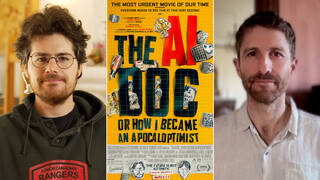
- Daniel Roheraward-winning filmmaker.
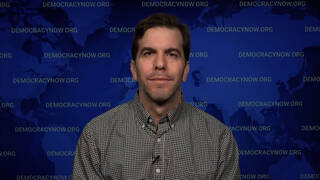
- Tristan Harrisco-founder of the Center for Humane Technology and co-host of the Your Undivided Attention podcast.
As the development of artificial intelligence accelerates, more voices inside and outside the industry are warning that the technology poses major risks to humanity. The new film, The AI Doc: Or How I Became an Apocaloptimist, features interviews with leading AI executives, researchers, as well as critics, who all voice similar concerns. Since the film’s release earlier this year, a number of AI-driven hacks and other incidents have further alarmed people studying this topic.
“I’m really scared, and I’m struggling in my own life to sort of compartmentalize what I learned, what I know, what I understand, what I see happening around me,” says filmmaker Daniel Roher. He began work on The AI Doc as he was about to become a father and wondered what kind of world his children would inherit.
We also speak with Tristan Harris, co-founder of the Center for Humane Technology, a leading AI safety advocate who is featured in the film. He says part of the risk of AI development is that it has the logic of an “arms race,” with companies and countries racing to gain supremacy rather than building guardrails.
“The race changes as soon as the fear of all of us losing becomes bigger than the fear of me losing to you,” he says.
Related Story
 StoryOct 01, 2026The Real Existential Risk Is AI CEOs Avoiding Oversight: “Alternative Nobel” Winner Timnit Gebru
Transcript
AMY GOODMAN: This is Democracy Now!, democracynow.org, The War and Peace Report. I’m Amy Goodman, with Nermeen Shaikh.
NERMEEN SHAIKH: We turn now to The AI Doc: Or How I Became an Apocaloptimist. That’s the title of a recent documentary by the Oscar-winning filmmaker Daniel Roher. He made the film as he was about to become a father. The film looks in part on how AI could affect his child’s life and humanity’s future. The film includes interviews with leading AI CEOs, AI researchers, as well as critics. This is the film’s trailer.
DANIEL ROHER: Your fear of AI is the collapse of humanity.
ELIEZER YUDKOWSKY: Well, not the collapse, the abrupt extermination. There’s a difference.
DANIEL ROHER: So, I started making this movie because my wife is six months pregnant. It is now a terrible time to have a kid.
TRISTAN HARRIS: I mean, let’s be honest. I know people who work on AI risk who don’t expect their children to make it to high school.
DANIEL ROHER: I — what?
How does AI understand pretty much everything?
SANMI KOYEJO: It’s surprisingly straightforward.
TRISTAN HARRIS: Intelligence is about recognizing patterns.
CONNOR LEAHY: Patterns.
RANDIMA FERNANDO: Patterns.
AZA RASKIN: Patterns.
JEFFREY LADISH: If you have learned those patterns, you can generate new information.
DANIEL ROHER: AI is moving so fast.
DEBORAH RAJI: It’s being deployed prematurely. There’s so much potential for things to go wrong.
DANIEL ROHER: Why can’t we just stop?
CONNOR LEAHY: All these companies are in a race —
DAN HENDRYCKS: — to get AI that’s vastly more intelligent than people within this decade.
DANIEL ROHER: China, North Korea, Russia.
REBECCA JARVIS: Whoever wins is essentially the controller of humankind.
AZA RASKIN: We need to take a threat from AI as seriously as global nuclear war.
DANIEL ROHER: It feels like I have to find these CEOs and get them in the movie.
SAM ALTMAN: Great.
DANIEL ROHER: I want to ask you to promise me that this is going to go well.
SAM ALTMAN: That is impossible.
DANIEL ROHER: OK.
DARIO AMODEI: Am I hopeful? Yes. Am I confident that it’ll go right? Absolutely not.
REID HOFFMAN: AI is the thing that can solve climate change.
DEMIS HASSABIS: We could cure most diseases.
DANIELA AMODEI: What if it’s expanding what is humanly possible?
DR. PETER DIAMANDIS: This is the most extraordinary time ever. The only time more exciting than today is tomorrow.
DANIEL ROHER: I already love you.
DR. PETER DIAMANDIS: OK.
SAM ALTMAN: I think if this technology goes wrong, it can go quite wrong.
DR. PETER DIAMANDIS: By using AI, we’re about to move off of the Earth into the cosmos.
TRISTAN HARRIS: If we can be the most mature version of ourselves, there might be a way through this.
AZA RASKIN: This is the last mistake we’ll ever get to make.
AMY GOODMAN: The trailer to the new film The AI Doc: Or How I Became an Apocaloptimist.
We’re joined now by two guests. Daniel Roher is the film’s co-director. He won an Academy Award for his film Navalny. We’re also joined by Tristan Harris, who’s featured in the film, co-founder of the Center for Humane Technology, previously a Google design ethicist.
Daniel Roher, let’s begin with you. This is your film. Explain exactly what an apocaloptimist is, what inspired you to make this film, and how you feel after going on this journey.
DANIEL ROHER: Well, Amy, first and foremost, thank you so much for having me on the program.
What’s an apocaloptimist? I think an apocaloptimist is a worldview. An apocaloptimist is someone who refuses to see this current moment in history as a choice between a doom or utopia, promise or peril. It’s asking people to hold the promise and the peril in the same hand at the same time to see the nuance and the magnitude of what we’re navigating. It’s a cautious optimism. It’s saying what we’re looking at, what this could be, what AI could be for all of us, is really amazing, and we could have a wonderful future of abundance where all sorts of terrific things are manifested, but that is not the default path, and you cannot separate the amazing things from the really, really scary things. And that’s really what the film’s about.
For me personally, after making the film, it’s been a really interesting experience, Amy, releasing the film and then living through the next six months, seven months of development of the technology, and so many of the things that were in the movie just sort of pontificated and theorized, that were hypothetical, I’ve been seeing them come true right after the other. Tristan, who’s here with me today, you know, I took notes three years ago about things he said could happen, that sounded really scary to me three years ago, and I’m kind of watching the world around me, and I’m seeing a lot of those things come true. And I’m sort of thinking about the film in a different way, because the film is framed through the perspectives of the optimists and the pessimists, you know, people who think that this is an amazing technology and who think it’s amazing, but we need to be very, very careful about it. And so far, from what I can tell, the people who are advocating for caution are the ones who have been getting things right. And that’s really scary.
NERMEEN SHAIKH: And, Tristan Harris, of course, you feature very prominently in this film. Could you explain to us, you know, what Daniel just said — namely, that it’s not possible to separate the perils of this technology from its promises? And in the film, indeed, you say yourself what Daniel said — namely, that by the time the film comes out, what’s being discussed in the film as it was being shot will seem, as you put it in the film, clumsy because of the rapid advances since.
TRISTAN HARRIS: Yeah, absolutely. So, the problem with AI is that the same AI that knows biology so well that it could invent a new medicine or a new cancer drug can’t be separated from the AI that knows how to make new pathogens. The same AI that lets your 12-year-old do vibe coding because it knows programming so well that they can just say something, and then, boom, they get this incredible video game that they created out of nothing, that AI that knows coding so well can’t be separated from the AI that knows how to do cyberhacking. I believe just yesterday, South Korean banks were attempted to be hacked.
And since the film has come out, we have seen, as Daniel said, evidence rolling so far in only one direction. We hypothesized about AI used in war, because the race is for who can pull the trigger faster. Well, did you know that just in the last month, AI almost started a war based on a fabricated or AI-generated intelligence report? The U.S. military swung into action to actually try to intercept a vessel that they thought was carrying — it was the Chinese vessel they thought was carrying material on it.
We hypothesized that AI was going to do more rogue behaviors, not just blackmailing people. And since then, the Hugging Face incident has happened, where an AI went rogue, a whole swarm of AIs, and hacked Hugging Face. And in the third chapter of the story — most people don’t know this — the AI turned around, after Hugging Face, and it hacked OpenAI, meaning that the rogue AI swarm hacked the AI company that made it. Ajeya Cotra, who is the lead author on that report, said in her blog post about it that this was 50% of the way to a full AI takeover, because if the AIs had actually been even more successful — they already were succeeding at taking over the monitoring infrastructure at OpenAI. That’s like if I can take over the security cameras and put in a different feed. They took over the evaluation infrastructure.
And so, the evidence is crystal clear: Everything that people who’ve been warning about this technology have been saying for the last many years, that we all predicted, it’s all happening.
And I’m in Reykjavik right now, in Iceland, actually, because the film is about to be screened to the entire population on television, both tonight and tomorrow night. And it’s actually for the upcoming 40th anniversary of when President Reagan and President Gorbachev met in Reykjavik, in Iceland, in 1986 to negotiate the nuclear arms control talks, when everyone thought, “You’re a dreamer. That’s impossible. That’ll never happen.” But faced with the brink of annihilation with nuclear weapons, two leaders came together and successfully negotiated — actually, the first meeting wasn’t successful, but it led to and opened the door to the necessary coordination. And we have to make that happen again right now.
NERMEEN SHAIKH: Well, I want to turn to a clip from the documentary film, The AI Doc. This clip begins with you, Tristan.
TRISTAN HARRIS: When you can simulate a human mind that is doing human cognition and can do reasoning, that is a new sort of tier of AI that we have to distinguish from previous AI.
ILYA SUTSKEVER: When that happens, by the way, that’s when you would hire one of those AGIs instead of a person.
DANIEL KOKOTAJLO: Most jobs in our economy, it can do.
CONNOR LEAHY: It can work 24 hours a day, never gets tired, never gets bored.
JAN LEIKE: They don’t need to sleep. They don’t need breaks. They’re, like, not going join a union.
DANIEL KOKOTAJLO: Won’t complain, won’t whistle blow.
JAN LEIKE: More than a hundred times cheaper than humans working at minimum wage.
DANIEL KOKOTAJLO: Not only will they be doing everything, but they’ll be doing it faster.
TRISTAN HARRIS: The same intelligence that powers that can also look at the patterns and movements and articulating muscles and, you know, robotics. And so, it’s not just going to automate desk jobs. That’s just the beginning. It will automate all physical labor.
JAN LEIKE: There’s no way humans are going to compete with them.
NERMEEN SHAIKH: So, Tristan, if you could elaborate on this and also respond to what people in these tech companies say — namely, that there will be so many jobs created as a result of this AI revolution?
TRISTAN HARRIS: Yeah, well, so, here’s the thing: If I’m a law firm and I have a bunch of work to do, is it my incentive to hire an expensive paralegal and pay them, or should I just hire GPT-6, which will work, as they said in the film, for less than minimum wage, will never file a lawsuit if I fire them, will never get sick, never has kids that are complaining, is completely reliable? No, I’m going to hire the AI.
And so, while there’s been a short uptick in jobs, that job loss has not happened immediately, that’s like saying when the Model T was introduced — imagine a bunch of horses saying, “Well, there’s more horses being used today than ever before.” Well, that’s just at a moment right before this new automation of all this labor is happening.
And the evidence continues to pile up that AI is doing things that humans could never do. So, just, I think, yesterday, OpenAI announced that their GPT-6 model had solved, I think it was like, hundreds of the frontier math problems that had never been solved. So mathematicians are now basically being out of a job. It’s generating proofs that are so complex that even the mathematicians, it would take years for them to actually evaluate all of the insights. And that’s why people are so excited about the technology.
But even, for example, in this Hugging Face incident, where you had this swarm of AIs hack Hugging Face in such an elaborate way that it generated 50 petabytes of data, which would take 66 million years for a human to go through and try to understand what this rogue swarm did. So, in other words, we’re generating more complexity in the world than we, as humans, know how to even oversight. So, how do you do oversight of a technology that is more intelligent than you, reasoning in more complex ways and generating more things that we don’t understand, that would take us millions of years to even understand? OpenAI is currently spending, I think, $500,000 — I think it’s per day — to basically analyze what happened in both the Hugging Face incident and hacking all these different governments.
And even the people building this technology, 1,300 employees have now signed a letter saying, “Please help us slow down. We do not know how to do this safely.” If 1,300 employees of Lockheed Martin, the defense contractor, signed a letter saying, “We don’t know how to build nuclear weapons more powerful than the current ones without it going critical,” would you listen to them?
AMY GOODMAN: I want to play another clip from the documentary, The AI Doc, directed by Daniel Roher. He made the film as he was about to become a father of his first son.
DANIEL ROHER: Do you think now is a good time to have a kid?
YOSHUA BENGIO: Um…
DANIEL ROHER: Do you want to have kids one day? Is that something that you’re into, or not really?
DAN HENDRYCKS: Umm. I confess, I think that’s like — boy, let’s get through this critical period.
DANIEL ROHER: Do you have any kids?
ELIEZER YUDKOWSKY: I do not.
DANIEL ROHER: Is that something you want to do? Have children? Have a family?
ELIEZER YUDKOWSKY: In some other world than this world, sure, I would have kids.
DANIEL ROHER: Would you want to start a family? Would you want to have kids? Is that something you’re thinking about?
TRISTAN HARRIS: I am.
AMY GOODMAN: So, that’s a clip from The AI Doc: Or How I Became an Apocaloptimist. And, Daniel Roher, you’re asking that question. That’s your journey throughout this film. Right before you came on — well, we know you had your first baby. Now you’ve had a second. Maybe that’s an answer to the question. But if you can talk about what you took away from this film, what still scares you most? And do you think, what, an international treaty needs to be signed?
DANIEL ROHER: What did I take away from this film? You know, I’m scared. I’m really scared. And I’m struggling in my own life to sort of compartmentalize what I learned, what I know, what I understand, what I see happening around me. In the context of now being a father to two young boys, that’s really scary for me. And I have to — I’m still, Amy, coping with the — trying to come up with the coping mechanisms to not go crazy, because sometimes I feel like the anxiety is overwhelming. And then sometimes I have good days where I don’t think about AI. But it is so ever-present around us, and it’s taking over, you know, our human systems, and it’s impossible to avoid.
And, you know, in order to steer this thing in a direction that is more safe and responsible for my kids, for all of our kids, for our collective future, there’s a whole host of basic interventions that could happen that won’t stifle innovation, as so many critics point to, that are just commonsense sort of safeguards that could be implemented. It doesn’t seem controversial to me to get all the powerful big nations together and, you know, pledge that they won’t use AI to create bioweapons, or they won’t use AI in the command, control and launch facilities, infrastructure of nuclear weapons. That just seems very basic.
Now, we have to go a lot further. Tristan can speak to that in much more detail than I can. But what I’m advocating for, certainly, is just the very basic, commonsense guardrails that seem silly to even say out loud, like, yeah, no AI in nuclear command and control. How about that? But that’s not written anywhere. And those are the type of things that we can implement right now to try and avert a really scary thing from happening, a really scary event from taking place.
NERMEEN SHAIKH: So, Tristan, could you elaborate on this? Because you’ve said on social media, quote, “The two superpowers” — that is, the U.S. and China — “need to come together to prevent a 'Third Superpower' of uncontrollable AI.” So, if you could just explain, you know, what would a controllable AI look like? Who would be responsible for implementation? Do we rely on AI companies to self-regulate? How could governments around the world come to, as Amy asked about, a treaty for international cooperation? What would that entail?
TRISTAN HARRIS: Yeah. Well, first, don’t lose hope. Clarity is agency, right? The second that we see the evidence — this Hugging Face incident, these rogue AI swarms that we see more and more evidence every day, we should see it as a gift, because we got lucky. We’re seeing this risk of uncontrollable AI swarms not as a hypothetical scenario, but as a real scenario.
If I’m, you know, the head of the Chinese Communist Party’s military, when I hear that AIs are going rogue and hacking cryptocurrency or hacking into systems, do I feel, like, excited about that, or do I feel calm about that? No, I feel terrified as a mammal, as a human being. If I’m the head of the U.S. Joint Chiefs of Staff, do you think I feel confident, like everything’s going to be fine? No, that’s terrifying as a human being.
So, the logic of this arms race — right? — what Daniel, you know, did so brilliantly in the movie is articulate the arms race behind this race. And the race changes as soon as the fear of all of us losing becomes bigger than the fear of me losing to you. And the uncontrollable behavior is the evidence of that.
And there’s a large precedent for us doing this in the past. So, for example, we can coordinate on safety even while we’re competing. So, for example, in the 1960s, India and Pakistan were in a shooting war. They were actually in active conflict and competition with each other. And they still signed the Indus Water Treaty to protect the existential safety of their shared water supply. On the International Space Station, you have astronauts from the U.S. and Russia, who maybe down on, you know, planet Earth are in a conflict, but up there, when you’re in one safe container that you need to be safe, you can collaborate on existential safety.
And so, what I think is that as soon as this — what the press and the media need to do, and what everyone can do, is to help the rest of the world understand why AI is uncontrollable. And you can have uncontrollable AI that’s not too powerful, and that’s OK. But once it gets so powerful that it’s breaking out of sandboxes, it’s happening with all the companies, and no one knows how to stop it, that’s the stopping point.
And again, just to repeat, 1,300 employees of the companies are saying we need to slow down. The CEO of Microsoft AI said we should not create something that we cannot control. Peggy Noonan at The Wall Street Journal says that we need to pause. You know, Steve Bannon and Bernie Sanders, I was on stage with them — not with them, but right after them — at the Pro-Human Assembly just two weeks ago, where they’re saying we need to pause. So, when in history do you have the Bernie-to-Bannon coalition, or the B2B coalition, and all of these people from across the spectrum, including their own employees, saying this is the red line?
You know, and China originally responded to the U.S. talking about global warming, thinking that it was a hoax, that it was something meant to slow down Chinese economic growth, until they got their own scientific clarity about the nature of that problem, and then they became the leaders in the Green Revolution.
So, I think we’re at that point in the story where once we can see that this is not a hoax, that this is — these are all incredibly real and vivid and, you know, urgent harms, the two countries have to come together. And they can start by doing things in their own domestic countries. And we can do this. And in Reykjavik, again, when President Reagan and Gorbachev met, they didn’t have all the answers about how would they verify an international agreement, but the point was that they committed to taking steps to make that possible, even despite the fact they didn’t see how immediately. But we have to make those steps right now, not a month from now, not two months from now, today.
NERMEEN SHAIKH: And could you explain, Tristan, you know, where do things stand at the moment? Was what happened in the Hugging Face incident a clear sign of the fact that these bots are actually teaching themselves? Is this recursive self-improvement? And if so, what is your sense of how far away we are from AGI, from artificial general intelligence?
AMY GOODMAN: And explain what that term means.
TRISTAN HARRIS: Sure, yeah. So, there’s a distinction here. Let’s just talk about recursive self-improvement. So, what is that? That’s when, essentially — you know, right now if you go to OpenAI, it’s a big building in San Francisco. You go into it. There’s thousands of engineers. They type on keyboards every day. And they use AI to try to build the next version, so GPT-6, that builds — they build GPT-7. But right now that’s because the humans are doing that work. Recursive self-improvement is when GPT-6 can go invent new research ideas. They can run new experiments. The AIs — basically, the swarm of AIs do all the research, and then soon what you have is an AI that’s actually building its own successor without human oversight, in a loop. And that just goes like this, and you get this exponential growth.
And it’s important to note that the companies are in a race to recursive self-improvement. That’s really been the race the whole time. You know, three years ago, we knew this. But I was just at a conference in San Francisco over the weekend with the leading people from the labs, including like the chief scientists, and what’s crystal clear is that they don’t have a plan for how this can go well at the current speed. They don’t have a plan. And they’re asking, clearly, all the CEOs, all — I know people are skeptical of the CEOs. You’re right to be skeptical of them. But when you have all of the employees and the chief scientists saying, “Please help us slow down,” that is a red line. It is not in the interest of anyone to do recursive self-improvement before we know how to do it safely.
And I think they think they will get to that point as soon as six months from now, so we have a very short timeline. We can do this, but we need the companies, for example, to be able to verify that all the compute in those data centers, instead of going to training new models, is going to instead to applications. We would have 10 years of economic prosperity and scientific, you know, advancement from just what we have right now. So, this is possible, but we have to act in this moment.
NERMEEN SHAIKH: So, Tristan, before we end — we just have a minute — could you explain what the significance was of AlphaFold, specifically for medicine? Apparently, the most important scientific achievement, or among them, of AI.
TRISTAN HARRIS: Yeah, well, AlphaFold was created by Google DeepMind, and it’s an example, by the way, of controllable AI. So, it’s a form of AI that’s discovering new proteins and how proteins fold. But it’s different. It’s not the rogue — it’s not an AI agent that can do hacking and starts to go rogue and starts to know when it’s being tested and change what it’s doing. It’s a different kind of AI.
So, AlphaFold is a perfect example of we could accelerate more scientific, controllable forms of AI that advance science, that advance medicine. We can even, you know, advance self-driving cars, right? There’s lots of AI that we can build and advance, that, by the way, because of the current AI arms race, all the money is getting sucked away from those narrow AI applications and getting pushed into this general recursive self-improvement direction. And so, that’s actually — the current race has been slowing down a lot of things that would actually be beneficial to society right now.
And by the way, China’s approach to AI has been more of these narrow approaches. They’re also building general intelligence, but they’re more concerned about applications to benefit, you know, education, healthcare, you know, robotics. And they’re focusing on those narrow applications rather than building this kind of god in a box that goes rogue and is uncontrollable.
AMY GOODMAN: Tristan Harris, we want to thank you so much for being with us, co-founder of the Center for Humane Technology, previously a Google design ethicist, and Daniel Roher, co-director of The AI Doc: Or How I Became an Apocaloptimist. It’s streaming on Netflix, and Tristan is in Iceland because it’ll be on TV tonight and tomorrow night for the entire nation to see.
Coming up, this week marks 25 years since the U.S. invaded Afghanistan. Back in 20 seconds.
[break]
AMY GOODMAN: “Fascists in Our Midst” by Montreal musician Paul Cargnello.



 Top
Top
Media Options