






 Watch Full Show


Black voters in Georgia on Tuesday said, “Not today, Satan,” according to professor Carol Anderson, professor of African American studies at Emory University. Despite the Trump administration’s efforts to disenfranchise Black voters in the South this election cycle and the Supreme Court’s gutting of the Voting Rights Act, she says there was “massive turnout” that propelled Democrats to victory. Former Atlanta Mayor Keisha Lance Bottoms defeated billionaire Republican healthcare executive Rick Jackson, becoming the first Black woman ever elected governor in the United States. Incumbent Democratic Senator Jon Ossoff also handily won his bid for reelection.
Related Story
 StoryNov 10, 2022Democrats May Lose U.S. House Because New York Dem. Leaders Were Too Focused on Defeating the Left
Transcript
AMY GOODMAN: This is Democracy Now!, democracynow.org. I’m Amy Goodman, with Anjali Kamat.
ANJALI KAMAT: We turn now to Georgia, where former Atlanta Mayor Keisha Lance Bottoms has defeated billionaire Republican healthcare executive Rick Jackson to become the state’s next governor. Jackson spent more than $200 million in his losing bid. Bottoms becomes the first Black woman ever elected governor in the United States. This is Keisha Lance Bottoms in her victory speech Tuesday night.
GOV.-ELECT KEISHA LANCE BOTTOMS: This win is for the caregiver who can’t afford healthcare and needs Georgia to finally expand Medicaid. It is for the entrepreneur who is seeking to grow her small business. This win is for the farmer who is trying to hold on to his family land. It is for the teacher who’s working two jobs so that they can educate our children. And this win is for the child who deserves every opportunity to succeed. Georgia, this win is for all of us.
AMY GOODMAN: Keisha Lance Bottoms in her victory address last night. Again, she becomes the first Black woman governor in U.S. history. Also in Georgia, Senator Jon Ossoff cruised to reelection early Tuesday night. Many people wonder if this is now just ushering in his run for president in 2028.
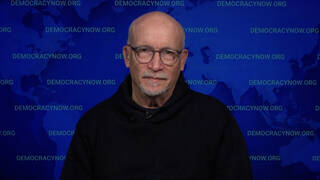
For more, we’re joined by Carol Anderson, professor of African American studies at Emory University, the author of many books, including One Person, No Vote: How Voter Suppression Is Destroying Our Democracy.
Professor Anderson, thanks again for joining us today. As we talked to you last night in our midterm special, you had just finished driving people to the polls. The significance of the voter turnout, the Black woman voter turnout? The significance of this history that has been made, not only with Keisha Lance Bottoms, but with the attorney general of Georgia and the secretary of state, all three Black women?
CAROL ANDERSON: Yes, I mean, this is monumental. And I think what we’re really seeing here is this is basically the result of over a decade of organizing, of being in the community. So, when you’re looking at Governor-elect Bottoms, Lance Bottoms’ vote, you’ll see that it went all the way from Augusta through Macon and through to Columbus, so you get this belt of voters in those counties that we don’t often think of as — and so, this, again, is — like I said, this is part of the work that Stacey Abrams has done over a decade ago in terms of being in those counties, doing that kind of relationship, doing that kind of organizing, building the kind of capacity that can get that massive voter turnout.
And it’s about framing this election for all of us. It’s recognizing that in a state that has systematically refused to expand Medicaid, even when there was money on the table in order to do that, instead being willing to have rural hospitals shut down, instead being willing to have some counties that have no OB-GYN, so that somebody who is pregnant will have to go over like a hundred miles in order to get to a doctor — it is recognizing the absolute inhumanity of that. And that’s what we’re seeing in this vote. We’re seeing in this vote this quest for humanity, this quest for dignity, this quest in order to live our lives fully.
ANJALI KAMAT: And, Professor Anderson, I mean, you’ve talked about the long history of organizing in Georgia, but this is also coming at a time when the Trump administration was trying to redistrict, to gerrymander so many districts across the South, and to disenfranchise Black voters. Can you talk about how that pushed more people to the polls?
CAROL ANDERSON: Oh my gosh! It was like — and so you see this massive push, where it’s like, “Oh, you want to take away my voting rights? Not today, Satan. Not today.” And so you see this kind of — the anger. So, when Governor Kemp made the decision to have a special session to basically redraw the boundaries, the way that Abbott did in Texas, there was this massive organizing that happened throughout the community, where you began to see people just fill up the state House as the Legislature is beginning this special session. And when they saw all of those people in the state House, they backed off. They said, “Oh, we’re not going to do this right now. We know this will not be a good thing.” And so, this is where that organizing comes in. This is where that kind of sense of “You’re trying to steal my ability to have my citizenship rights. You’re trying to steal one of the key components of being an American. You’re trying to steal that from me. I’m not going to let you take it.”
AMY GOODMAN: We’re talking about the Deep South. Whether we’re talking about Georgia or we’re talking about South Carolina, where Dr. Annie Andrews has just flipped a Senate seat, we are seeing in the South a massive change, why the Republicans poured millions into the reddest of red states. If you can talk about the significance, going beyond Georgia, of what has taken place, with what some are calling not just a blue wave, a blue tsunami, a “bluenami,” that has taken place?
CAROL ANDERSON: I mean, so, you see it, for instance, in Louisiana, where you had this massive Black voter turnout in terms of early voting. You see it in South Carolina, where you had this massive Black voter turnout. You’re seeing it here in Georgia. And what that is talking really — what that’s really signaling is this sense of what Callais did. So, the Supreme Court’s Callais decision was really about diluting the power of the Black vote. It really was about saying, “OK, so, we can just gerrymander you and put you into districts where you can vote, but you will not have any kind of power to choose your representatives.” And that is so Jim Crow. That is so — Georgia used to have a thing called the county unit system, which was about minimizing the power of the Black vote in the urban areas and increasing the power of the white conservative vote in the rural areas. And so, you see this hearkening back to those good old days of Jim Crow. And you had the Black community saying, “We’re not having it,” and that kind of turnout in South Carolina, in Louisiana, in Mississippi.
Think about this. In Mississippi, where you’ve got — the race is really close between Cindy Hyde-Smith and Colom, right? It’s really close. And it’s that close because of the power of that Black vote. And remember, in Mississippi, where you had the Legislature basically carve out a district, a policing — a judicial district in Jackson, so that Black folks in Jackson would have no kind of power, no kind of authority in that area, in their own city. And so, this is what we’re looking at. We’re looking at Black folks just standing up and saying, “Not today. You will not take away my rights. We will have representation. We will vote,” and again, that massive voter turnout. So, it was almost twice as many African Americans voted early in 2026 than they did in 2018, almost doubled. This is what we’re seeing here.
AMY GOODMAN: Do you think it’s also a wake-up call, Professor Anderson, for the Democratic Party? I mean, many people felt the lack of resources that were poured into the Democratic candidates in the South, not believing that there would be this blue wave, right through to Florida, where it looks — I mean, Angie Nixon, where she had so little support from the Democratic Party, the DSA Senate candidate. Yes, she was defeated, but it was such a close race against Ashley Moody. And then you’re talking about Scott Colom. That is still too close to call, African American in Mississippi taking on Cindy Hyde-Smith. We’ll see what happens with the votes still to be counted. If you can end up talking about what is the message to the Democratic Party right now?
CAROL ANDERSON: The message to the Democratic Party is believe us when we talk about we have the power. We just need the resources in order to be able to exercise that power. It is actually asking them to be very strategic and listen to the people and listen to the kinds of candidates that really resonate with the people. And that’s where the resources should go. It’s not going, “OK, who is electable?” “Who is electable” becomes a really kind of standard to just get the same old same old. And that same old same old will not work. We know that. And it is like — it is saying to basically have the resources to be able to lead, have the resources to be able to support these incredible candidates.
So, what happened in Florida, she deserved better than that. That was a fierce, fierce warrior. And when she said, “I am an organizer, not a politician,” and so that means that she’s going to get up and continue to work. And because that is a two-year term that they’re looking at here, it means that the Democratic leadership needs to begin to invest in these folks that can really speak to the people.
AMY GOODMAN: And isn’t this also a message about class? I mean, Rick Jackson, who Keisha Lance Bottoms defeated, poured over $200 million of his own personal fortune into his campaign, one of the largest self-funded candidates in Georgia politics. We have five seconds.
CAROL ANDERSON: Yes, it is. It is about that. It is about data centers. It is about really listening to the people and not having billionaires basically trying to buy this democracy.
AMY GOODMAN: Carol Anderson, professor of African American studies at Emory University, author of many books, including One Person, No Vote: How Voter Suppression Is Destroying Our Democracy.
That does it for our show. Visit democracynow.org and our YouTube channel to watch our four-hour election night special last night.
Oh, and Steal This Story, Please!, the documentary about Democracy Now!, is now available on many streaming platforms, from Amazon Prime to YouTube to Apple TV. Go to StealThisStory.org to see where you can watch it.
Democracy Now! produced by an amazing group: Mike Burke, Deena Guzder, Anjali Kamat, Messiah Rhodes, Nicole Salazar, Nermeen Shaikh, María Taracena, John Hamilton, Sara Nasser, Charina Nadura, Sam Alcoff, Tey-Marie Astudillo, Robby Karran, Hany Massoud. Special thanks to Julie Crosby, Denis Moynihan. I’m Amy Goodman, with Anjali Kamat.



 Top
Media Options