











 Watch Full Show

Guests
- Keith LaMarrecently issued a death penalty reprieve in Ohio.
- Keegan Stephancivil rights lawyer representing Keith LaMar.
- Amy GordiejewJustice for Keith LaMar campaign manager.
Links
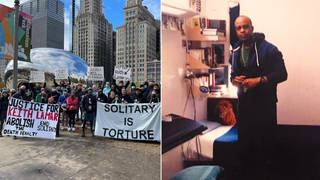
We speak with Keith LaMar, an artist, teacher and writer on death row in Ohio. LaMar, who has spent three decades in solitary confinement, was sentenced to death for the murder of five fellow prisoners during a 1993 prison uprising. He has always maintained his innocence. His trial was held in a remote Ohio community before an all-white jury. LaMar is one of three men on death row for whom Ohio Governor Mike DeWine issued reprieves, pushing back their execution dates to 2030.
“The reprieve, while good in a legal sense in giving us more time, it also increases the pressure, the harassment that I’m undergoing,” says Keith LaMar. “I’ve been undergoing consistent torture since the last reprieve,” explains LaMar, who received a previous reprieve three years ago.
LaMar’s lawyer Keegan Stephan says there is “incredible new evidence” of his client’s innocence, and Amy Gordiejew, campaign manager of Justice for Keith LaMar, says he “was framed.”
Related Story
 StoryMay 26, 2025“I’m Innocent”: Keith LaMar Speaks Live from Death Row About His Case, Conditions & Pending Execution
Transcript
AMY GOODMAN: “Tell ’Em the Truth,” spoken words by Keith LaMar, music by Albert Marquès. This is Democracy Now!, democracynow.org, The War and Peace Report. I’m Amy Goodman in Edinburgh, Scotland, with Nermeen Shaikh in New York.
NERMEEN SHAIKH: On Friday, Ohio Governor Mike DeWine issued reprieves for three men on death row, citing the difficulty of procuring lethal injection drugs from pharmaceutical suppliers. The execution dates of the three men were pushed back to 2030. This comes after Governor DeWine, who is a Republican, announced in June that he no longer believes in the efficacy of the death penalty as a deterrent.
GOV. MIKE DEWINE: It is today impossible to make the case that the death penalty is a deterrent. I no longer believe the death penalty is a deterrent to murder. The moral justification I had for voting for the death penalty simply no longer exists. For the state to take a human life, there must — in my opinion, there must be evidence that in doing so, it will help protect the public that the threat of that action will deter someone from committing murder. For the reasons stated above, I do not believe that argument today can be successfully made, nor do I believe that there’s any chance in the future the facts that I have cited to support that belief will change. Therefore, I believe Ohio should abolish the death penalty.
AMY GOODMAN: One of the men on Ohio’s death row who received the reprieve from Governor DeWine is Keith LaMar. The new day gives LaMar, his attorneys and supporters more time to fight for his freedom.
LaMar was sentenced to death for the murder of five fellow prisoners during the 1993 Lucasville prison uprising. He and his attorneys say he’s innocent and was wrongfully convicted. His trial was held in a remote Ohio community before an all-white jury. He’s now spent over 30 years in solitary confinement.
NERMEEN SHAIKH: This is an excerpt from the animated short film The Injustice of Justice narrated by Keith LaMar and illustrated by Molly Crabapple, which won the Grand Prize for the Best Animated Short Film at the 2025 Golden State Film Festival.
KEITH LAMAR: I was on the recreation yard when it all began. A guard came running out of the building with blood streaming down his face, followed by a masked prisoner who was carrying a weapon and yelling, “We taking over!” Against my better judgment, I went inside to check on my personal belongings. A fatal mistake. It was complete chaos. When I made it to my assigned location, I discovered that it was being used as a holding area for hostages, both guards and prisoners. I was thereafter approached by a masked prisoner, who gave me the option to either participate or leave. I chose to leave. Hundreds of us gathered on the yard, waiting as the National Guard and Highway Patrol took up watch outside the perimeter fence. …
Because I had gone into the hostage area without wearing a mask, my name would be mentioned among the vast array of potential subjects. Even though the state concedes that I was never affiliated with any of the gangs said to have presided over the riot, the fact that I was already serving time for murder would play big part in their decision to indict me. Ultimately, I was charged with nine counts of aggravated murder. I couldn’t believe it.
AMY GOODMAN: That was an excerpt from the animated documentary The Justice of Injustice, narrated by Keith LaMar, illustrated by Molly Crabapple.
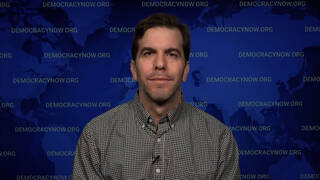
For more on the news of the reprieve and the latest on Keith LaMar’s case, we’re joined by three guests. Keegan Stephan is a civil rights lawyer with Beldock Lavine & Hoffman. He’s representing Keith LaMar, joining us in New York. Amy Gordiejew is campaign manager for Justice for Keith LaMar. She’s with us from Cleveland, Ohio. And on the phone from Ohio’s death row is Keith LaMar.
Keith, we’re going to begin with you. I don’t know whether to say congratulations or recognizing that this means you still have an execution on the horizon. But the significance of the Republican Ohio Governor Mike DeWine putting off, giving you a reprieve on this execution for three years? Can you talk about your response and how you learned that you would not be killed by the state next year?
KEITH LAMAR: Well, first of all, I think — well, thanks so much, Amy, for the opportunity, obviously, to elevate the profile of my case.
I think congratulations is in order, because aside from me receiving a reprieve, which I was very relieved. Though we anticipated that he would do — stick to his pattern, I’m still relieved that I don’t have that hanging over my head.
But in the meantime, you know, I’ve been undergoing consistent torture since the last reprieve. Guards have been spraying chemicals in and around my cell. I haven’t been able to eat breakfast or lunch over three years because of the chemicals that’s being spread in my food. I’m being harassed constantly. And so, you know, not the death penalty — you know, the execution is one thing to worry about, but I’ve also, you know, been caught up in this thing called the push-off, where guards try to push you off the planet, try to get you to kill yourself. And one of my friends two months ago committed suicide because of the same treatment that I’ve been undergoing for the past three years.
But yeah, getting to my legal case, you know, I’ve been working very hard with a formidable team of attorneys, who are right now uncovering evidence that has been withheld for the past, you know, three decades. And so, it’s been really, really, you know, difficult over the past several months, because, you know, with the execution looming, we didn’t — we would have a concern about filing under that, under the impression that we were trying to execute some kind of ploy. And, you know, with that now being removed, we don’t — we’re not operating under that type of pressure and that suspicion. So, you know, hopefully, the courts will take the motion that we’re about to file more seriously because of the reprieve. But I’m thankful, grateful for the time that I’ve been given, because that gives my attorneys more time to develop my claims, yeah.
NERMEEN SHAIKH: So, Keith, you know, we’re very, very sorry to hear about this absolutely atrocious treatment that you have been receiving. I mean —
KEITH LAMAR: Yeah.
NERMEEN SHAIKH: — if you could talk a little bit more about, you know, is there any recourse? What kind of response do you get when you point out what’s happening?
KEITH LAMAR: Well, about four or five years ago, they passed a rule that all guards have to wear cameras, body cameras, similar to police officers on the street. And ironically, the result of them having cameras has allowed them to do more mistreatment, more harassment, because if it’s not on the camera, it didn’t exist, it didn’t happen. So, I filed over 50 complaints with the administration here, and they checked the camera. They don’t see anything. They claim not to see anything. And because they didn’t see anything, it doesn’t exist.
Meanwhile, you know, my health has — you know, has depreciated. I’m in constant jeopardy, like I said. I’m losing weight. You know, I’m right now sitting in a plume of fumes as I’m speaking to you on the phone, but I have to sit at the front of the cell because that’s where the signal is strongest. But I’m right now in a cloud, you know, of a bewilderment as I’m trying to communicate to people, you know, the specific details of my case.
And this is what I’ve been operating on under for the past three years, since the first reprieve. So, while the reprieve is, you know, particularly important, it also means more suffering, you know. And, you know, I’m trying to be available for these interviews, for these opportunities to speak out my truth, but, you know, they’re making it — they’re not making it easy, you know.
And I suspect that the harassment is being done with the approval or at the behest of the administration, because it’s blatant. They’re doing it with impunity, you know what I mean? With no concern or risk of losing their jobs, you know. And I’m pretty much laughed at on a routine basis whenever I bring it to the administration. And it’s to the point now it doesn’t even make sense to file complaints, you know, because all of my complaints have fallen on deaf ears.
AMY GOODMAN: Keith —
KEITH LAMAR: Right now as I’m speaking to you, my lips are stinging. Yeah, I’m sorry. Go ahead.
AMY GOODMAN: Keith LaMar, Mike DeWine, the Republican governor, has come out against the death penalty. Can you explain why, then —
KEITH LAMAR: Yes.
AMY GOODMAN: — he has granted a reprieve, as opposed to commuting your sentence? Your supporters, you are calling for your freedom. But if you can explain how this works? He just says he can’t get the execution drugs to kill you. What are you calling for right now?
KEITH LAMAR: Yeah. Well, Mike DeWine, at the end of the day, is a politician. As he himself stated, he was one of the architects who put in place the execution policy here in Ohio. You know, he’s about to retire. I think he’s well into his eighties now, and so he’s thinking about his legacy, you know. But he, at the end of the day, is a politician, and he’s doing the political thing and passing the buck, basically, for the next person who comes in line, which, if it’s a Republican, you know, you can expect the death penalty to be — the deaths to resume here in Ohio.
You know, Mike DeWine asked the voters to vote to abolish the death penalty, but you’re asking poor white people, the same people who voted for Trump overwhelmingly here in Ohio, to do something that they have some type of psychic need for. You know, it’s like, you know, I’m in here, and they want to see you suffer. You know what I mean? And that’s the whole thing. And so, they also heard the news that I got a reprieve. It spread around the prison immediately. And even on that day, you know, it’s just the attacks are immediate. You know, I know I sound a little hysterical, but I’m, you know, making this call under duress. I’m living under extreme strain. And the reprieve, while good in a legal sense in giving us more time, it also increases the pressure, the harassment that I’m undergoing.
NERMEEN SHAIKH: Keith LaMar, again, we’re so sorry to hear about this distressing treatment and the conditions under which you’re living there. I wanted to ask you about comments you’ve made about the disproportionate number of convictions and executions in Hamilton County and whether you think those have changed at all in the duration in which you’ve been imprisoned, and what the reasons are that you’ve said, of all-white juries, jailhouse informants, etc. If you could just —
KEITH LAMAR: Yeah.
NERMEEN SHAIKH: — elaborate?
KEITH LAMAR: Yeah, when the riot happened, they were looking for prosecutors to prosecute the crimes. And they picked Hamilton County because of Hamilton County’s dubious distinction of receiving these death penalty cases. I think they were only second to Texas at the time.
And Mark Piepmeier, from early 1990s up until now, used the same MO of using jailhouse informants, withholding exculpatory evidence. I mean, this is their MO. This is the DNA, the culture of this particular — this particular prosecuting office. And here in the early 2020s, a lot of those cases that was prosecuted 10, 20 years ago are coming back, you know, because of the misconduct, are being overturned. And the same thing he did in all these multiple cases that are now being overturned, he did to me. He withheld exculpatory evidence. He coached witnesses. I’ve only seen, based on the estimation of my attorneys, 30% of the evidence that was collected. And they’re talking about killing me.
And so, you know, this prosecutor’s office was handpicked. My case was, you know, shoved into this all-white county, Ironton, Ohio, where an all-white jury was all but certain. And they convicted me with no — absolutely no evidence at all.
NERMEEN SHAIKH: Well, Keith, I’d like to —
KEITH LAMAR: That wasn’t a coincidence. Yeah.
NERMEEN SHAIKH: I’d like to bring in your attorney, Keegan Stephan, who’s here with us in the New York studio. Keegan, if you could talk about what this reprieve means and how it came about now? What does it actually mean for what might happen to Keith?
KEEGAN STEPHAN: Sure. I mean, the most important thing by far is that this reprieve means that Keith LaMar, who is one of the most brilliant and loving humans I’ve ever met, in prison or outside, will not be executed for another three years. That is so meaningful to him and so many people who he loves and takes care of and educates on a day-to-day basis.
For his legal case, that means that we have another three years to litigate his innocence, which is absolutely critical. As Keith said, we were coming up to a deadline when we would have needed to file to make sure that this case wouldn’t have just been tossed at some juncture as being a last-ditch effort. And it’s not a last-ditch effort. We’ve been investigating now for over three years. We’ve uncovered incredible new evidence, very powerful evidence of his innocence. I’ve spoken to eyewitnesses, uncovered additional materials in the record, that have me believing that he is absolutely innocent. There is no question in my mind.
So, we are now in the process of putting all of that into a motion for leave and a motion to vacate his conviction, and we’ll be filing very soon. We will then have all of this time to litigate it, to get courts to decide on it. And hopefully, by the time three years rolls around, he will be exonerated and a free man.
AMY GOODMAN: And finally, Amy Gordiejew, what are — you’re leader, campaign manager for Justice for Keith LaMar. What are you and the supporters of Keith calling for now? How are you organizing?
AMY GORDIEJEW: Well, we are facing the departure of our governor, Governor Mike DeWine, in January, and right now we’re in an unusual moment of his political history, where he has the power to do something extraordinary, and that is to pardon Keith. We’re asking and calling on as many of your viewers and anyone they can share it with to sign the petition to Governor DeWine, asking him to look into this case and do the right thing, do the moral thing. He spoke of his morality and his beliefs, and we want him to take it one step further. And that petition can be found at KeithLaMar.org/petition.
We ask people to follow us on our social media. It’s all one word, @justiceforkeithlamar. And we really need to make our choir sing loudly now and show the government what the collective cry is of people who are feeling and caring and who’ve come to this conclusion with us. And as Keegan just mentioned, that evidence will soon be made public and available, and it’s unquestionable at that point. Anybody with — who’s a thinker will see right away that Keith was framed. And it’s not just his word; it’s all right there for anyone to see. So, we just ask everyone who can help us spread the word, because that, in our current society, seems to be — you know, the squeaky wheel gets a grease, as they say. And the more support we have, I think, the more compelling our cry will be when we take our petition to him in November.
AMY GOODMAN: I want to give Keith the last word. Keith, from Ohio’s death row, your final comment to the world right now?
KEITH LAMAR: I mean, you know, one of the things that — I mean, I was listening to the run-up to my segment about what’s going on in Israel, what’s going on all over the world. And it’s — you know, I’m emboldened always watching your show, Amy, that people are speaking up, standing out. And Audre Lorde once said that your silence will not protect you. And, you know, that’s the thing that I want to send out to anybody who might be listening to this, who might be going through any, you know, oppression or any type of evil or whatever it might be, that speak out who you are, and you will find or discover that you are not alone. And that’s been one of the, you know, big blessings in my life, you know. And I’m fortunate.
You know, I would, you know, want to thank all the people who supported me, but it’s too many people to thank, you know. But here we live in a capitalistic country, and Frederick Douglass said you might not always get what you pay for, but you’re going to pay for what you get. And so, all the people who have been, you know, funding my campaign, funding my legal fund, you know, I mean, I really, really want to thank you. It has made all the difference, you know, all the difference in the world. And I just want to thank you and your team, Amy, for once again helping me highlight my case. I mean, it really, really is invaluable, what you all are doing for me, and I’m really, really grateful. Really, really grateful. Thanks so much.
AMY GOODMAN: Well, Keith, we are going to — Keith, we’re going to continue to cover your case. Keith LaMar has been granted a reprieve by the Ohio Governor Mike DeWine for three years, a reprieve from execution. His supporters, like our guests, Amy Gordiejew, campaign manager for Justice for Keith LaMar, and attorney Keegan Stephan, are now organizing to call for the stopping of his execution.
Coming up — we are broadcasting from Edinburgh, Scotland — we’ll be joined by the world-renowned violinist Nicola Benedetti, the first Scot and first female to head the Edinburgh International Festival. We’ll then be joined by Wagner Moura. Stay with us.
[break]
AMY GOODMAN: World-renowned violinist Nicola Benedetti performing here at the Edinburgh International Festival.






 Top
Top
Media Options