





 Watch Full Show

Composer and playwright César Alvarez joins Democracy Now! to discuss their new musical, The Potluck. It tells the story of the 1979 Greensboro Massacre, when Klansmen and American Nazis opened fire on an antiracist demonstration in Greensboro, North Carolina, killing five members of the Communist Workers’ Party. In 2020, the Greensboro City Council passed a resolution apologizing for the attack and the police department’s complicity in the killings.
Alvarez tells Democracy Now! the musical is an attempt to grapple with “what it has meant to grow up in the aftermath of this state-sanctioned murder,” as well their personal connection to the massacre. Alvarez’s parents were part of the Communist Workers’ Party, and Alvarez is named in honor of two of their slain comrades.
Related Story
 StoryJul 02, 2026“The American Revolution Was Hardly an Anti-Colonial Movement”: UCLA Historian Robin D. G. Kelley
Transcript
AMY GOODMAN: This is Democracy Now!, democracynow.org. I’m Amy Goodman, with Juan González.
We turn now to The Potluck. It’s a musical about the 1979 Greensboro Massacre, in which five protesters in North Carolina at an anti-Klan rally there were gunned down by the Ku Klux Klan and the American Nazi Party. Those killed were members of the Communist Workers’ Party. Ten other activists were injured. No one was convicted, but a jury did find the Greensboro police liable for cooperating with the KKK in a wrongful death. In 2020, Greensboro’s City Council passed a resolution apologizing for the attack and the police department’s complicity in the killings.
Composer and playwright César James Alvarez was born in Greensboro a year after the murders. Their parents were among the survivors of the massacre. In a tribute to their parents’ murdered friends, César is named for two of those who were killed: César Cauce, a Cuban immigrant and union organizer, and James Waller, a pediatrician and president of the local textile workers’ union. This legacy and the weight of telling the story today form the backbone of César Alvarez’s new musical, The Potluck, presented by Soho Rep and INTAR, currently playing at the Peter Jay Sharp Theatre in New York through this Sunday, August 9th.
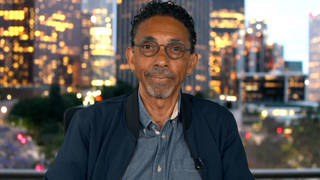
For more, we’re joined by composer and playwright César Alvarez.
César, I met you a few nights ago seeing this astounding play. Talk about, I mean, what you did with this play — it’s so odd to say a “massacre musical,” but so many people don’t even know what happened in 1979 — and then your family’s, your own close connection to the victims.
CÉSAR ALVAREZ: Yeah, it was a real puzzle to figure out, when I was kind of invited and asked by this commission to try to tell this story, because part of me wanted to just tell the story and tell the story, which is a story that’s been so distorted over the years by the narratives around it, and also deal with the real fact of what it has meant to grow up in the aftermath of this state-sanctioned murder and to carry the name of these fallen comrades and to feel called to duty to somehow answer, answer the work that they were doing.
So, the piece itself doesn’t abandon the puzzle. It actually becomes a showing of that dilemma, which so many of us carry, of how do we — how do we heal from these traumas that have happened to our families and to our ancestries, and how do we answer the call in a way that’s authentic and that actually is going to make a difference. And the piece then becomes this kind of attempt, this ritual, to unveil what teachings we can gain from this history.
JUAN GONZÁLEZ: And, César, I’m wondering if you could share what your parents told you as you were growing up about the massacre. And also, your musical is based on an annual survivors’ meeting in North Carolina, where they have a potluck paella. Why this tradition? And how has this been part of the healing and reflection for survivors?
CÉSAR ALVAREZ: Yeah, I don’t ever remember not knowing about the Greensboro Massacre. I only remember a slow accumulation of new information. As I got older, I started to get more facts and more images, and at a certain point, I actually saw the footage. And so, it’s this strange experience of it’s always been in the background of my life. It’s always been known to me that this is who I was named after and why I am even here. And so, in a way, the piece became this untangling.
And the potluck is this — yeah, it’s an event that for the last 47 years our community has come together and utilized this kind of technology of the potluck as a healing ritual. But the piece itself actually brings forth that architecture. And the architecture of the potluck is one that’s so elemental, in that it is a request that everyone come together and everyone bring what they have, and we’re all going to meet each other at a shared goal, which is that we need to nourish one another and be together. And there’s something that happens in a potluck, which is a clash, which is like a macaroni salad next to hand-rolled sushi, and it’s not necessarily the ideal pairing. However, what is what ends up happening in the event is an acknowledgment of our difference and an acknowledgement of our shared goals.
So, the piece itself actually invokes the dissonance of what it means to be in solidarity and to be working together across difference for something that we all need. And I just find that that idea and that practice, which was given to me as a gift by my community, is one that is absolutely essential, if we’re going to imagine a way forward in this moment of overlapping cataclysms.
AMY GOODMAN: César —
CÉSAR ALVAREZ: How do we get together across difference?
AMY GOODMAN: César —
CÉSAR ALVAREZ: How do we meet one another?
AMY GOODMAN: César, if you can explain the police complicity? How did this massacre take place?
CÉSAR ALVAREZ: Well, this is a moment in the South when the Klan was really on the resurgence. And my parents were organizing textile mills and working together to kind of get the communities, the working-class communities in Greensboro, organized around class consciousness and around improving their workforce, their work conditions. And they identified that the Klan was actually kind of operating as the fascist arm of the government in that way, and actually the government was in direct collusion with the Klan. They had paid informants in the Klan. And the Greensboro police handed the permit of the protest to the Klan and to the paid informants, and they vacated the premises when they knew the Klan was actually going to come in. And so, the minute it happened, everyone knew in our community that they had been set up. And over years and years and years and years, including a Truth and Reconciliation Commission in Greensboro, this was all established as fact.
But the reality is, the government was utilizing this fascistic faction in order to do its bidding, which was to repress really, really radical thought around working-class solidarity. And what ended up happening is these five heroes and, really, leaders were assassinated and targeted directly by the government and by this group. And the reverberations of this were massive through many, many, many communities and movement spaces. And the loss of these incredible leaders is still felt. And really, with the piece, I’m trying to actually feel the loss, and also to ask them, as martyrs in the spirit world: What do we have to learn, and how can we alchemize this into something that can do good for this moment?
JUAN GONZÁLEZ: And, César, the decision to show graphic footage from the documentary, because there was film footage of it, and to give your audience members the option to step out if they don’t want to watch it, can you talk about that?
CÉSAR ALVAREZ: Yeah. We tried to do the piece where we just showed the footage, because it felt really important for people to really actually confront what happened. And it’s — a lot of people aren’t necessarily in the space to be able to just see that in the context of a theater piece. And we tried it without the footage, and it was a huge loss, because I think a lot of people couldn’t access what had really gone down. And we created this, the solution, which I’m really in love with, which is that in the piece we ask people to decide whether they want to see the footage, that’s a seven-minute clip that’s in my mother’s documentary, Red November, Black November, or if they want to step outside and honor the five in a different way.
And so, what we end up doing is simultaneous events, which one is a ritual, and one is a real encounter with the video footage and the truth of what happened. And then we come back together, which again is a moment of solidarity and is acknowledgment that in movement spaces and in organizing, we can’t all access the same things, but we have to be able to figure out how to create multiplicity, multiple ways through, because we have a shared goal, which is to alchemize this tragedy, to learn from it and get to move forward better than we were before.
And so, in the piece, we ask you to decide. And we ask you also not to judge people’s decisions, let people figure out how they’re going to navigate their own way. But the reality is, you can’t experience the whole piece unless you come twice, because there are actually two different paths through the story.
AMY GOODMAN: César, you’re named after two of the five victims. Your father in the play is played by Rubén Flores. He has the most powerful song, talking to his best friend César, who you’re named for, who was killed, about what he’s missed in life. I wanted to play once again a bit of that song. Do you want to introduce it for everyone?
CÉSAR ALVAREZ: Yeah. I think that, you know, my whole life, growing up, I always thought about these five as kind of saints. And I think — I didn’t know them. I only got to hear about them, hear how wonderful they were, hear how brilliant they were, hear how committed they were to imagining a world that would work better for all of us.
And the gift of this piece was that I actually got to think, in an imaginative space and in a spiritual space, “What would I say to them? What would I — what could I say to them? And what might they say back?” And then, in going through that process, I actually got to ask my dad that very question, which opened up this whole heart journey for him about, “Oh my god, there’s so many things I would want to tell my friend about what’s gone wrong, and what’s gone right, and how amazing it is that something like Mandela could be elected president,” which at the time, in the '70s, would have seemed like science fiction to them. And so, it kind of creates this moment of: You really don't know what’s going to happen in history. You really don’t know what can be possible in movement spaces. And this moment of my dad wanting to share that with his friend becomes a really, really important touchstone in the piece.
AMY GOODMAN: And while your name is César Alvarez, they called him “Caesar,” right? His real name was César Cauce?
CÉSAR ALVAREZ: Yeah, they did.
AMY GOODMAN: And you even joke about that in the film. But just let’s hear a little from that film — sorry, let’s hear a little of that song. Again, it is performed by Rubén Flores.
JOE ALVAREZ: [played by Rubén Flores] We were really following liberation movements all over, especially in Latin America and South Africa.
CÉSAR ALVAREZ: Could you just, like talk to him, as though he’s here?
JOE ALVAREZ: Hmm. [singing] You’d never believe it. They ended apartheid in South Africa and elected Mandela president. The Berlin Wall came down, and the Soviet Union broke up. There is this deadly disease that was killing mostly gay men, so the government acted like it didn’t exist. But it did and still does. Terrorists attacked New York and D.C., and the World Trade Center collapsed. So we went to war again. There is this giant conversation happening on computers between nearly everyone on Earth. It is a mess, and it’s incredible. America had its first Black president. A bunch of people took over a park near Wall Street for weeks, which forced everyone to start talking about income inequality on the national news. You would have thought it was great. Also, the economy nearly collapsed in 2008. There is this thing called a meme, which is a self-replicating idea. So things spread fast now in ways that are both good and bad, I suppose. Cars can drive themselves, if you can afford one of those. Phones and cameras and computers are all one thing and about the thickness of a few dimes. And we communicate with hieroglyphs instead of words sometimes. The Earth is warming up because of pollution, and humans can’t agree about what to do.
AMY GOODMAN: Rubén Flores singing “Mandela” from César Alvarez’s play — or, musical called The Potluck. It’s being presented by Soho Rep and INTAR at the Peter Jay Sharp Theatre in New York City until Sunday, August 9th. We want to thank César Alvarez for joining us.



 Top
Top
Media Options