







 Watch Full Show


Topics
Guests
- Mahmood Mamdanidirector of the Dakar-based Council for Development of Social Research in Africa and director of the Institute for African Studies at Columbia University.
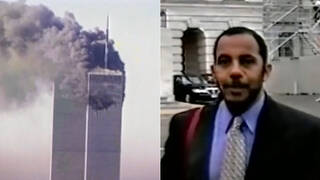
Last week, Riverside Church held a major teach-in on “9/11: Responses to Tragedy and Moving Forward.” Among the speakers was Mahmood Mamdani, director of the Dakar-based Council for Development of Social Research in Africa.
Related Story
 StorySep 14, 2026Trove of Evidence Sheds New Light on How Saudi Intelligence Asset Helped 9/11 Hijackers Before Attack
Transcript
AMY GOODMAN: “Fragile” by Sting, here on Democracy Now! in Exile’s War and Peace Report, as we return to the African perspective on the bombing of Afghanistan, one African perspective: Mahmood Mamdani, who is professor of government at Columbia University, director of the Institute of African Studies. He spoke last week at a panel on the bombing of Afghanistan.
MAHMOOD MAMDANI: We are now told to give serious attention to culture, because it is said culture is a matter of life and death. Is it really true that people’s public behavior, specifically their political behavior, can be read from their religion, so that a person who takes his or her religion literally is a potential terrorist, but someone who thinks of the text as not literal, but metaphorical or figurative, is likely to be tolerant of diverse views? How, one may ask, does the literal reading of religious texts translate into hijacking, murder and terrorism?
Now, some of you may think that I am presenting a caricature of what I have read in the press. After all, these days, there’s less and less talk of the clash of civilizations, more and more talk of a clash inside civilizations. After all, we are told to distinguish between good Muslims and bad Muslims — mind you, not between good and bad persons, criminals and civic citizens who both happen to be Muslims, but between good Muslims and bad Muslims. We are told that there’s a fault line running through Islam, between moderate Islam — said to be genuine Islam — and extremist Islam, political Islam. And we are told that the terrorists of September 11 did not just hijack planes; it is said that they also hijacked Islam, meaning genuine Islam.
Here’s one version of the argument that the clash is inside and not between civilizations. It’s an enlightened version, as I say “enlightened” because it doesn’t just speak of the other; it also speaks of self. It’s not really ethnocentric. It’s my construction. This is how the version goes, put together by things I’ve read over the last week.
Islam and Christianity have one thing in common. Both share a deep messianism. Both seem to have a conviction that each possesses the truth, a sense of mission to civilize the world. Both have a tendency to look at the world beyond as a sea of ignorance, one that should be redeemed, as in the Arabic word al-Jahiliyyah, the domain of ignorance. This conviction seems so deep-seated that it is even found in its secular version, as in the notion of a civilizing mission, or in its more racialized version, the white man’s burden, or simply manifest destiny.
In both cultures, these notions have been the subject of prolonged debates. Even if you should claim to know what is good for humanity, what do you do with that claim? How do you proceed? Do you proceed to persuade others of the claim, or do you proceed to impose it on them? The first type gives you evangelism, the second type crusades.
Take the example of Islam, the notion of jihad. A student of mine gave me a series of articles by Eqbal Ahmad, written in the Karachi-based Dawn. And in one of the articles, Eqbal Ahmad distinguishes between two broad traditions of jihad in Islam. The first, called “little jihad,” thinks of jihad as a struggle against external enemies of Islam, a sort of an Islamic version of the Christian just war. The second, called “big jihad,” thinks of jihad as more of a spiritual struggle, a struggle against self in a contaminated world.
Now, all of this is true, but I still don’t think it explains terrorism. I remain deeply skeptical that we can read people’s behavior from their religion or from their culture. Not so long ago, some used to claim that the behavior of others could be read from their genes. Could it be true that an Orthodox Muslim is a potential terrorist, or that an Orthodox Jew is a potential terrorist, and only a Reformed Jew is capable of tolerance? I am aware that this does not exhaust the question of culture and politics. How do we make sense of politics that consciously wears a religious mantle? After all, Osama bin Laden and al-Qaeda claim they are waging a jihad, a just war against the enemies of Islam. How do we make sense of this?
I want to suggest that we turn the cultural theory of politics on its head. Rather than see this politics as the outcome of an archaic culture, we see neither the culture nor the politics as archaic, but both as very contemporary outcomes of equally contemporary conditions, relations and conflicts. Instead of dismissing history and politics as does culture talk, we need to place cultural debates inside historical and political contexts, for terrorism is not a traditional cultural residue in modern politics. Terrorism is a modern construction. Even if it harnesses one or another aspect of tradition and culture, it puts this at the service of a modern project.
I want to take the rest of my time to give you a sense of what I think this modern project is and what it looks like from where I come from, which is from East Africa. I remember in 1985, in Uganda, seeing on television the image of Ronald Reagan. Reagan had just met a group of bearded Afghani men, and he brought them out to the White House lawn and introduced them to the media. And he said to the media, and I quote, “These gentlemen are the moral equivalents of America’s Founding Fathers.” That’s Reagan’s statement about the mujahideen. It was the moment when America tried to harness one version of Islam in a struggle against the Soviet Union.
Now, before exploring the politics of it, I want to explain this moment a little more from the point of view of somebody in East Africa. My point of departure is 1975, the year the U.S. was defeated in Indochina. 1975 was also the year the Portuguese Empire collapsed. It’s also the year the center of gravity of the Cold War shifted from Southeast Asia to southern Africa. And there was a shift in U.S. strategy. In Vietnam, Nixon had a doctrine which said, “Let Asian boys fight Asian wars,” but it was too late to put the doctrine into practice in Vietnam. It was going to be put in southern Africa. A strategic decision was made by the U.S. to harness, or even to cultivate, terrorist movements in the struggle against radical regimes.
A partnership was forged with apartheid South Africa, with the government that the U.N. said was perpetrating a crime against humanity. Reagan called this partnership “constructive engagement.” South Africa became both conduit and partner for the U.S. against the Soviet Union, conduit and partner in cultivating terrorist movements. The movement in Angola was called UNITA, and the movement in Mozambique was called RENAMO.
This was a new kind of terrorism never before seen, because it was not simply something that was willing to tolerate more civilian casualties in the pursuit of a military objective. This was a terrorism which targeted civilians specifically, to kill and maim them, but not to kill and maim all, because some must remain behind to tell the story, to spread the fear. Its object was to spread fear and paralyze governments.
In the next decade, the center of gravity of the Cold War shifted to Central America, to Nicaragua and El Salvador. And the project of cultivating terrorism, the American — official American project of cultivating terrorism also shifted to Nicaragua and El Salvador, and the beneficiaries were the Contras. The U.S. not only hosted terrorists, but directly helped and joined them, as when it mined harbors.
The shifting center of gravity of the Cold War was the major context in which Afghanistan policy was framed, but it was not the only context. The minor context was the Iranian Revolution of 1979, when Khomeini anointed official America the “Great Satan” and official Islam “American Islam.” Instead of also addressing the issues, the source of resentment against official America, the Reagan administration decided to create a pro-American Islamic jihad. It was drooling at two prospects: first, the prospect of uniting a billion Muslims around a holy war, a crusade against the evil empire. I should say “crusade” because it better explains the frame of mind of official America than does the word “jihad.” And it also drooled at the prospect of turning a religious schism inside Islam between minority Shia and majority Sunni into a political schism, thereby containing the Iranian Revolution, or hoping to contain it as a minority Shia affair. This is the context in which an American-Saudi-Pakistani alliance was forged, and religious madrasas were turned into political schools for cadre training.
The Islamic world had not seen an armed jihad for centuries, for millennia — sorry, for centuries. But now the CIA was determined to create one, to put the tradition in the service of politics. The CIA looked for a Saudi prince who could lead this crusade. It couldn’t find a prince, but the next best thing was the son of an illustrious family. This was not a backwater family steeped in premodernity, but a cosmopolitan family. The bin Laden family is a patron of scholarship. It endows programs at universities like Harvard and Yale. The CIA created bin Laden and the mujahideen as an alternative to secular nationalism, just as the Israeli intelligence created Hamas as an alternative to Arafat and the secular PLO.
Fundamentalism is a modern, not a traditional, project. When the Soviet Union was defeated, this terror consumed Afghanistan in the name of liberation. Different factions fought one another over who would have power. The Northern Alliance came to power until ’96, and then the Taliban took over. And in their civil war, they shelled their own cities with artillery and destroyed them.
I want to close by addressing the question of responsibility. Let me take us back to the end of the Second World War and the beginning of the Cold War. World War II was fought in Europe, not in the U.S. Civil life was devastated in Europe. And the question was: Whose responsibility was this? The question was urgent, given the beginning of the Cold War, given developments in Yugoslavia, Albania and particularly Greece. And the U.S. accepted responsibility for restoring conditions for decent life. This initiative was called the Marshall Plan.
The Cold War was not fought in the U.S. or even in Europe. It was fought in Southeast Asia, in southern Africa, in Central America. Should we, ordinary humanity, hold official America responsible for its actions during Cold War? Does official America have responsibility for napalm bombing and spraying Agent Orange in Vietnam, for cultivating terrorist movements in southern Africa and Central America? Official America has a habit of not taking responsibility for its own actions, instead looking for a high moral ground as a pretext for inaction.
Perhaps no other society paid a higher price for the defeat of the Soviet Union than did Afghanistan. Out of a population of roughly 15 million people, 1 million died. A million and a half were maimed. Five million were refugees. All that’s before this war began. It was a brutalized society.
After the Cold War, the U.S. and Britain compelled African countries, right up to the 10th of September, to reconcile with terrorist movements, to share power with them in the name of reconciliation. In country after country — Mozambique, Angola, Sierra Leone, Liberia — governments and peoples were told, “You must stop fighting and reconcile with terrorist movements.” Well, if terrorism was an official American Cold War brew, it was turned into a local Afghani or Sierra Leonean or Angolan or Mozambican brew after the Cold War. Is the local brew not a derivative product? Whose responsibility is it? Like Afghanistan, are these countries hosting terrorism, or are they also hostage to terrorism? I think both.
I was in Durban at the World Congress Against Racism, at the NGO conference, when the U.S. walked out. The Durban conference was about major crimes of the past, about racism and xenophobia and related crimes. I returned from Durban to New York to listen to Condoleezza Rice talk about the need to forget slavery, that civilized life requires that we must forget. It is true that unless we forget, life will turn into revenge seeking. Each of us will have nothing but a catalog of wrongs done to a long line of ancestors. But civilization cannot just be built on forgetting. We must also memorialize, particularly monumental crimes. America was built on two monumental crimes: the genocide of the Native American and the enslavement of African Americans. The tendency of official America is to memorialize other people’s crimes and to forget its own, to seek a high moral ground, as it did in Durban, as a pretext to ignore real issues.
Let me close. It’s a human tendency to look for others in times of adversity. We seek friends and allies in times of danger. But in times of prosperity, some tend to walk away. The contemporary history of Central America and southern Africa and Afghanistan testifies to this tendency. Modernity in politics, I think, is about moving away from exclusion to inclusion, from repression to incorporation. By including those previously excluded, you give those previously alienated a stake in things.
By doing so, you broaden the bounds of lived community and lived humanity. That, perhaps, is the real challenge today. It is the recognition that the good life cannot be lived in isolation. I think of civilization as a constant creation, whereby we gradually expand the boundaries of community, of who we think we share the world with — why it is so grotesque to see bombs and food parcels coming from the same source. Thank you.
AMY GOODMAN: Mahmood Mamdani, director of the Council for Development of Social Research in Africa, based in Dakar, Senegal. He was speaking last week at Riverside Church in New York. He’s also director of the Institute for African Studies at Columbia University.
And for a video cassette copy of his speech or the speeches of Howard Zinn, Noam Chomsky or the conversation I had last week with Farid Esack, Muslim liberation theologian, you can call 1-800-926-3921. That’s 1-800-926-3921. You can also get these videotapes online at freespeech.org. That’s www.freespeech.org.
And that does it for today’s program. Democracy Now! in Exile is produced by Kris Abrams, Brad Simpson, Miranda Kennedy, with help from Janice K. Bryant. Anthony Sloan is our music maestro and engineer. Errol Maitland is at wbix.org, where you can hear Democracy Now! You can also hear us at webactive.com. This is an unprecedented public media collaboration between Manhattan Neighborhood Network. We’re broadcasting on channel 34 in the morning, as well as WFMU in New York, broadcasting at 7:00 at 91.1 FM, and public access TV stations around the country, as well as community radio stations, Pacific affiliates around the country. We thank all of you. We are Pacifica. Special thanks to KPFA and KFCF. Also thanks to Downtown Community Television, Jon Alpert and Keiko Tsuno, where we’re broadcasting from this firehouse, and to Free Speech TV, Dish Network channel 9415. You can check us out on the satellite. We’re also on CUNY Television. In exile from the embattled studios of WBAI, from the studios of the banned and the fired, from the studios of our listeners, I’m Amy Goodman. Thanks for listening.



 Top
Media Options