








Guests
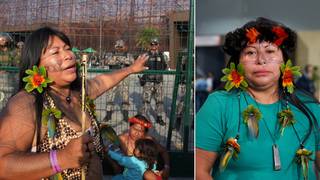
- Alessandra Korap Mundurukuenvironmental activist, member of the Munduruku Indigenous group of Sawré Muybu in Brazil.
Full interview with Alessandra Korap Munduruku, who led an Indigenous protest outside the U.N. climate summit in Belém, Brazil. In 2023, she was awarded the prestigious Goldman Environmental Prize for her leadership in organizing, forcing British mining giant Anglo American to withdraw from Indigenous lands, including those of her people.
Related Story
 StoryNov 21, 2025“We Need to Be Heard”: Indigenous Amazon Defender Alessandra Korap Munduruku on COP30 Protest
Transcript
AMY GOODMAN: If you could start by saying your full name? And what did you do on Friday, shutting down the U.N. climate summit for hours?
ALESSANDRA KORAP MUNDURUKU: [translated] My name is Alessandra Korap Munduruku. I am a leader from the Tapajós River, which is here in the state of Pará. And to come here, my delegation of the Munduruku people, we took two days by bus plus three days by boat. It was a long trip. We came with women. We came with children. We came with our shamans. So I’m not here alone. In Pará, there are over 17,000 Munduruku.
So, when we arrived here at COP30, we were abandoned. We didn’t have access to water. We had a hard time finding meals. It was very difficult for our people, who had traveled for so long to get here. And the people wanted to be heard. We came in a large delegation, and we wanted to speak, and we wanted to be heard. But we were blocked. I have credentials to enter COP, but many of the Munduruku who are here do not. And so, we decided that we needed to stop this COP. We needed people to stop and to listen to us.
They needed to listen to us, because we are the ones that are saying what the forest is demanding. We are the ones that are saying what the river is asking for. We are going through a lot of violence in our territories. The rivers, the Tapajós River, the Madeira River, they are being privatized for the creation of hydro waste, for the transportation of soy for agribusiness. This will expand the production of soy in Brazil. It will lead to more deforestation. It will lead to more Indigenous rights violations. So we blocked entry to COP because we need to be heard.
So, we live in the Amazon forest. We know what the river is going through. We need the river. We live with the river. Today, the river, the Tapajós River, is dry. There are days in which the river disappears. There are so many forest fires. So, why is it that we cannot have the power to decide here at COP? Why is it that they only speak about us, but that we cannot decide? And now President Lula has said that he’s going to consult the people about Federal Decree No. 12,600, which privatizes the rivers in the Amazon. But who is he going to consult? Is he going to consult the Indigenous groups? Is he going to consult the jaguars, the fish, the animals? How is this consultation going to be? Who needs to be heard?
And there’s another project that Lula and the government are trying to implement in the Tapajós region, in the Munduruku territory, which is called the Ferrogrão, the soy railway. The soy railway, it serves to cheapen the export of soy commodities from Brazil to the global market. It will lead to the expansion of soy production. Soy does not grow under trees. Soy leads to deforestation. Soy leads to the contamination of rivers by agrotoxics, the invasion of Indigenous territories.
We need to demarcate Indigenous lands in Brazil, because large-scale commodity production is killing Indigenous peoples. Yesterday, we had a Guarani-Kaiowá Indigenous person who was killed in the state of Mato Grosso do Sul with a bullet to his head. So, large-scale monoculture does not only kill with the pen by decision-making, by evicting Indigenous groups from their territory, but it also kills with the gun.
So, we’re here to urgently ask the international community to support the demarcation of Indigenous lands and to support that President Lula revoke Presidential Decree 12,600, which privatizes rivers in Brazil.
AMY GOODMAN: So, you led a flotilla down the river, and you shut down the U.N. climate summit. There’s this iconic image of the U.N. climate summit, the COP30 president — he is the climate ambassador for Brazil, André Corrêa do Lago — holding a Munduruku child. Can you explain what that is? You forced him to come out to negotiate with you.
ALESSANDRA KORAP MUNDURUKU: [translated] So, we were there blocking the entry to the COP, and we arrived very early. We arrived at 5 a.m. Everyone was hungry. We hadn’t eaten breakfast. The children started crying. And the children are the strongest ones, and they were already hungry. And the sun was coming out. And we wanted to speak to an authority, either the president of Brazil or the president of COP.
And at some point, the president of COP said that we had to open up entry to COP. And we said, “We are not leaving. You have to come out here and talk to us.” And so he came out. And we got the meeting with Minister Sônia Guajajara, Minister Marina Silva, because we knew that we had to be listened to.
And that child, that baby that André Corrêa holds in his arms, that is a very important symbol, because in holding that baby, that child represents the future of the Munduruku people, and Andre, if he carries out these projects, if the government of Brazil decides to implement these projects without consulting, without listening to the Munduruku nation, he is destroying the future of that child that he held in his own arms. So he’s assuming the responsibility for that life and for the life of all Munduruku children and babies.
AMY GOODMAN: Your protests have made an enormous difference. Brazil has now created 10 new Indigenous territories as you were protesting this week, territories for Indigenous people, which mean your culture and environment are protected under Brazilian law. That happened this past week. What exactly does that mean?
ALESSANDRA KORAP MUNDURUKU: [translated] So, to start, you know, we were here much before, thousands of years before colonization began, so all of this territory is ours. But today, to demarcate an Indigenous land, it’s very difficult. It’s a very long bureaucratic and political process, where we have to prove many things. So, we have to prove that that land is ours, even though it has always been ours.
And if government does not demarcate the land, it means that we will be expelled, evicted from our territories, and we will be killed. Demarcation is something that needs to happen, because nondemarcation means our deaths. There are so many companies that are — that have an eye on our land. So, hydropower plants, mining, soy producers, land grabbers, illegal loggers, legal loggers, there’s so many people that want our territory. And there’s so much land that still has to be demarcated.
So, let’s talk about the Munduruku lands in the mid-Tapajós region. My land, Sawré Ba’pim, was declared yesterday. Declaration is the third step in the long process of demarcation of an Indigenous land. So this is one more step in ensuring the full rights to our territory. But there’s another territory, called Sawré Muybu, which has already been declared, but now the illegal occupants need to be removed from this land. That’s the next step, the physical demarcation.
There are so many invaders in these lands, soy producers, farmers. It’s so easy for non-Indigenous peoples to have access to land in Brazil. All they need to do is go there, deforest, take down the forest, and they say that the land is theirs. That’s how land grabbing works. It’s so easy for them, but it’s so difficult for us. And now there’s this Marco Temporal, the temporal cutoff limit, that says that we only have rights to lands where we were physically present in 1988. But we were always on these lands. It doesn’t make any sense.
So, what I want to say is that we’re very happy that our lands advanced in the demarcation process, but there are so many lands that still need to be recognized and demarcated in Brazil.
AMY GOODMAN: In 2023, you won the Goldman Environmental Prize for fighting the British mining company Anglo American. Can you explain what they were trying to do and what you won?
ALESSANDRA KORAP MUNDURUKU: [translated] So, in 2019, after President Bolsonaro was elected, we started living a reign of terror in our territories. So, there was a lot of invasion by illegal gold diggers and illegal wildcat miners, garimpeiros. They came into the territory. They brought with them illegal criminal groups. They brought with them prostitution, violence, contamination of rivers, contamination of fish. It was a real order of terror.
And at that same time, between 2021 and 2022, we found out that the British mining company Anglo American had filed a request to prospect minerals within our land. Anglo American declared that our territory was not an Indigenous land because it was not yet formally demarcated. But everyone knew that we live there. Everyone knows that it’s our territory. For us, it’s our territory. And so, we were forced to fight at the same time against the garimpo, the illegal gold mining, and the big mining corporation Anglo American.
So we decided to speak out. We wrote a letter explaining everything that was happening, explaining what we demanded, that we demanded that Anglo American leave our territory immediately. Amazon Watch, which is a partner, sent this letter to the corporation. And they were obliged to step back, and they were obliged to remove their mining interests, to give up their mining interests within our territory, because of our struggle.
So, for us, that is an Indigenous land. That is a sacred land. It’s where our fish are, our fruits. It’s where we have authorization from the forest to step in. And so, we will continue fighting. We have so many victories that the world needs to learn more about. We kept a hydropower plant from being implemented in our territory, and we will continue fighting.
AMY GOODMAN: Alessandra, I want to ask what keeps you going. I mean, Indigenous land protectors, environmentalists, especially the Indigenous, are — face such violence. Talk about that threat that so many face, and why you keep going.
ALESSANDRA KORAP MUNDURUKU: [translated] So, what keeps me going are my people. My people keep me going, and my people keep me alive. The children, the territory, my family, it’s a collective struggle, and this is what keeps me alive. I’ve already suffered two attacks. Twice, people have entered my house, have invaded my house to try to keep me from fighting, threatening me. But I will not give up. I want the entire world to know who the Munduruku people are, who the Indigenous peoples of Brazil are and what we represent.
I know who I’m facing in my struggle. I know who I’m up against. I’m not up against just anyone. It’s against big corporations, against government, against these people that we commonly say that have power. But we have power. My people have power, because we have a people, we have culture, we have the forest. We have the things that really matter. So we know that we are powerful, and not them. I am not afraid, and I will not be silenced, and I will keep fighting.
AMY GOODMAN: I’m wondering if you could compare your struggles against the current government, the Lula government, to the Bolsonaro government.
ALESSANDRA KORAP MUNDURUKU: [translated] So, they were very different struggles in these two political contexts. So, former President Bolsonaro, he would foster violence against Indigenous peoples openly. There were no human rights. There was no protection. He was incentivizing the invasion of all territories. He was against the poor. He was against the Black population. He was against the Indigenous groups. He was against Brazilian society. He was only in favor of corporations. And his speech was that Indigenous peoples should become white people, that they should simply integrate Brazilian society and no longer be Indigenous. He would say this openly.
And the Munduruku people very openly confronted Bolsonaro. We very openly confronted the garimpo. There was a lot of violence against the Munduruku women. Maria Leusa, a Munduruku leader from the High Tapajós region, she was attacked. Her house was burned. There was a lot of direct confrontation.
Under Lula, things are very different. Lula speaks openly about the protection of the Amazon. He speaks about demarcation. He sits down with us. There is dialogue. He is demarcating Indigenous lands. But he still has a lot to learn. If he had learned what he should have learned by now, he would not have passed this decree which privatizes the rivers and turns them over to companies and concessions. He would be demarcating a lot more lands. So, it’s a lot better now, but there’s still so much to be done.
AMY GOODMAN: And what does it mean to you that Lula appointed the first Indigenous minister, Sônia Guajajara?
ALESSANDRA KORAP MUNDURUKU: [translated] So, in his campaign, Lula had already promised that he would create a Ministry for the Indigenous Peoples, of the Indigenous Peoples. And we already expected that it would be a woman, and a woman that the ministry — would be led by a woman that was involved in the struggles. And this is Sônia. Sônia is a woman who has a long history of leading Indigenous struggles in Brazil.
The problem is that when the right and when Congress saw that Sônia Guajajara would be the minister of Indigenous peoples, they tried to destroy the ministry. And they did this by reforming the ministry and by removing the attribution to declare Indigenous lands from the Ministry of Indigenous Peoples.
So, Sônia faced a decision, a difficult choice, either to leave the ministry, in which case it could be handed over to someone else, who we don’t know who that would be, or to stay in the ministry and use it as a device to represent Indigenous rights and Indigenous demands within government, and within a government that’s very unfavorable to Indigenous groups, within a very complex coalition government that’s very anti-Indigenous in its majority. So, Sônia Guajajara has been doing an extremely challenging job. Her work is very fundamental so that Indigenous rights are represented within the federal government.
But President Lula, unfortunately, has still not fully understood what the territories represent, what the sacred is, that it is the Indigenous territories and traditional territories that keep the forest standing, that keep the people standing, that keep the water running. He has still not learned this.
But Sônia’s work has been crucial for the Indigenous fight. They want the ministry to keep on going, and they are very fearful that if a right-wing government takes over in next year’s election, the ministry might be dissolved. They are very concerned about this, because the ministry must keep going.
AMY GOODMAN: Alessandra Munduruku, I asked you about Lula. I asked you about Bolsonaro. What about you and your plans? Do you think you might run for president of Brazil some day?
ALESSANDRA KORAP MUNDURUKU: [translated] So, I have been asked many times if I would run for elected offices. I am from the land, from the river. I travel. I can go. I can travel far away. I can go places to represent my people. And maybe the time has come to take my fight somewhere else.
I am thinking about whether next year, it’s the time, the time has arrived for me to run as federal congresswoman. I don’t know if that would be easy, probably not. I don’t have funds, but I have a lot of strength. And this is a big debate within the Indigenous movement, because we fight so much outside of the institutions, and we think that it’s time for us to occupy these institutions, to occupy Congress, to occupy the mayorships, even the presidency. Why not? We want to take our bodies into these spaces and to take the confrontation and the fight into these institutions, as well.
AMY GOODMAN: Finally, you represent so many Munduruku, not to mention Indigenous people and their allies. But I wanted to ask you about your representation of nature, even just by what you wear. If you can tell us about the feathers in your hair, the flowers that are earrings, and the straw skirt that you wear, what it all represents, each one?
ALESSANDRA KORAP MUNDURUKU: [translated] The forest, it gives us everything that we need. It gives us our food. It gives us our medicine. It gives us our culture. It gives us our clothing.
Why do I use these feathers? Why do I use these these coconuts? Everything that we use, our food, but not only literally in the terms of eating, but everything that constitutes us, is in our gardens, is in our backyard. So, the coconut, for instance, the small little coconuts, they’re eaten by the birds, and we also use them. We use them to make our jewelry. We use them to make the things that make us beautiful. We wear them. We look at nature in terms of what it shares with us, of what it gives us, of the parts of itself that it shares with us.
These paintings that I have on my face, they’re the paintings of the Korap. The Korap are the — it’s my clan, the white half of the Munduruku, the Korap clan. So, these paintings, they represent the Korap, these fish. In Munduruku, the women came from the fish. So, Karusakaibu, the great Munduruku god, he took the fish out of the water and transformed them into women. And in transforming them into women, he made us into women warriors, and this is why we struggle.
AMY GOODMAN: And finally, if you can look right into that camera and share your message to the world?
ALESSANDRA KORAP MUNDURUKU: [translated] So, my message, as Alessandra Korap Munduruku, to you, who’s watching this now, is: What are you doing to the environment? What is your country doing to the environment? What is your corporation, what are your companies, what are your representatives doing to the environment and to Indigenous rights? Do you know what they are doing? Are they respecting the rights of Indigenous peoples and of the environment? Are you monitoring where investments are going? Are you monitoring how corporate activities are taking place on the ground?
You need to know, because we, here, we do not eat soy. We do not eat gold. We do not eat iron ore. We eat the fish, and we eat the fruits from the forest. And we need our forest standing. So, I ask you, please, monitor your corporation. Monitor your company. Monitor your governments. Watch your representatives. Be aware of what they’re doing. We need you to do this for us here in the forest. This is my message to you, from Alessandra Korap Munduruku.
AMY GOODMAN: Alessandra Korap Munduruku, thank you so much for joining us.




 Top
Top
Media Options