








Geeta Gandbhir has made history as the first woman to receive Academy Award nominations for both Best Documentary Feature (for The Perfect Neighbor) and Best Documentary Short (The Devil Is Busy) in the same year. The Perfect Neighbor looks at the case of a 35-year-old Black mother of four who was fatally shot in 2023 by her white neighbor. The Devil Is Busy chronicles a day on the frontlines in the battle for reproductive rights at a women’s healthcare clinic in Atlanta, Georgia.
Related Story
 StoryOct 08, 2026“The AI Doc: Or How I Became an Apocaloptimist”: Daniel Roher, Tristan Harris Discuss New Film
Transcript
AMY GOODMAN: This is Democracy Now!, democracynow.org. I’m Amy Goodman.
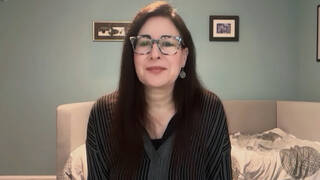
We’re joined now by Geeta Gandbhir, Emmy-winning, acclaimed Indian American documentary filmmaker, director, producer and editor. She recently made history as the first woman to be nominated in two categories of documentary for the Academy Awards — one, Best Documentary Feature, and the other, Best Documentary Short — in the same year.
The short documentary is called The Devil Is Busy. It chronicles a day on the frontlines in the battle for reproductive rights at a women’s health clinic in Atlanta, Georgia. It’s streaming on HBO Max.
And then there’s her feature documentary, The Perfect Neighbor, nominated for Best Documentary Feature. The film looks at the case of a 35-year-old Black mother of four named Ajike Owens, who was fatally shot in 2023 by her white neighbor, Susan Lorincz, raising further scrutiny about Florida’s racist enforcement of its so-called Stand Your Ground law. Lorincz is presently serving 25 years in prison after a jury convicted her of manslaughter in 2024. The film is streaming on Netflix.
Geeta, thanks so much for being with us. Congratulations! You have made history. Talk about what it meant to put out a short and feature documentary in one year on two very different subjects.
GEETA GANDBHIR: So, thank you so much for having me, first of all.
Oftentimes we filmmakers do work on multiple projects at the same time, and it is not unusual for them to come out, you know, in tandem or sometimes back to back. But I think the — again, for them both to be nominated was incredibly mind-blowing for both teams. And there’s some overlap between the teams, so — which is our — we have executive producers on The Devil Is Busy who are also executive producers on The Perfect Neighbor, and that’s Soledad O’Brien and Rose Arce. So I’m not alone in having two films this year. My EPs are also part of that. And we are thrilled. We’re thrilled. It’s an honor.
AMY GOODMAN: I want to start with the film that came out second. It’s the feature, and it’s called The Perfect Neighbor. Let’s go to the trailer.
911 DISPATCHER: 911. What’s the address of the emergency?
SUSAN LORINCZ: I’m having problems with the neighbor’s children.
OFFICER 1: Hello. Sheriff’s Office. Were any of you guys over here messing with this lady?
CHILD 1: No, no. We were playing football.
OFFICER 2: Sheriff’s Office.
SUSAN LORINCZ: I called because the kids from across the street, they shouldn’t be screaming and running around.
OFFICER 2: OK.
AJIKE OWENS: All the kids like to play. She moves in. They can’t walk or even throw their football over there.
911 DISPATCHER: 911. What is the address of the emergency?
SUSAN LORINCZ: There are several kids out there right now screaming and yelling.
NEIGHBOR 1: Nine times out of 10, that lady over there probably called.
OFFICER 3: Oh, I know.
NEIGHBOR 1: It’s like, they’re kids.
CHILD 2: She thinks we’re trying to steal her truck.
OFFICER 3: You even know how to drive?
CHILD 3: We’re 11!
SUSAN LORINCZ: It clearly says “no trespassing,” and they’re always walking their dog.
OFFICER 4: There doesn’t need to be a call for service every time there are kids playing in the yard.
NEIGHBOR 2: She’s always messing with people’s kids.
OFFICER 5: Sheriff’s Office!
SUSAN LORINCZ: One minute!
911 DISPATCHER: 911. What is the address of the emergency?
NEIGHBOR 3: My neighbor has been screaming outside.
NEIGHBOR 4: She started banging on her door.
NEIGHBOR 5: Pounding on it. “Let me in.” And then… Bang!
NEIGHBOR 6: Over here! Right here! Right here! Right here!
SUSAN LORINCZ: I’m peaceful. I’m quiet. I don’t bug anybody.
OFFICER 6: Come outside with your hands up!
SUSAN LORINCZ: You barely ever see me. I’m like the perfect neighbor.
AMY GOODMAN: Trailer for The Perfect Neighbor. Geeta Gandbhir, it is an amazing film. Talk about how you put this together and your use of the Ring or the doorbell footage, how you came to this project.
GEETA GANDBHIR: Sure. So, this is a project that myself and my team at Message Pictures, we didn’t go looking for it. It came to us. And the reason that it did was because Ajike Owens was a friend of my family. She was very close to some family that I have living in Florida.
And so, on the night that she was murdered, we got a distress call from my family, and we immediately sprung into action. And when I say “we,” I mean myself, my husband, and who’s also a producer on the film, Nikon Kwantu, and Message Pictures, my team, Alisa Payne and Sam Pollard. And we were immediately on the ground trying to support the family. And we became media liaisons for them, trying to get media — trying to get news coverage of the case, because we know without news coverage, unfortunately, gun violence is so common that cases like Ajike’s can get swept under the rug. So, that’s how we got involved.
AMY GOODMAN: Now, before Susan Lorincz kills Ajike, also known as “A.J.,” I want to go to several clips from the film of witnesses describing an incident with her. This is an incident with Susan Lorincz, the white woman who killed A.J., in which Susan waves a gun at the children in the neighborhood.
CHILD 1: Another thing that happened that my friend told — my friend me that lady over there showed the kids that she had a gun.
CHILD 2: We were just playing over there, and then she was waving her gun. And Isaac and all them were, like, “Run!” And we were hiding behind this car right here.
CHILD 3: And every time the basketball would go up there, I would be on my Ps and Qs, like, because I ain’t trying to get shot just for going up on her driveway.
CHILD 1: Maybe like two days before that.
OFFICER: About two days before —
CHILD 1: Yeah.
OFFICER: — she showed this gun?
CHILD 1: Yes.
AMY GOODMAN: Witnesses repeatedly describe Susan Lorincz’s racist and aggressive behavior toward the predominantly Black children living in the neighborhood, including referring to them as “slaves.” This is another clip from The Perfect Neighbor.
NEIGHBOR 1: Susan, she would come out and scream. And the language around these little kids.
OFFICER 1: That Susan would use?
NEIGHBOR 1: Yeah. Oh.
OFFICER 2: Describe to me what she was saying.
CHILD 1: The F-word, the B-word.
OFFICER 2: B-word and the F-word.
NEIGHBOR 2: She called them slaves. She told them that the field that they were on wasn’t the Underground Railroad.
OFFICER 3: You guys chasing a dog around here?
CHILD 2: Chasing a dog? What color is it?
OFFICER 3: I don’t know.
CHILD 2: What color is it?
OFFICER 3: You guys chasing a dog or trying to put a dog into a car or something?
CHILD 3: No. The Karen called.
CHILD 4: The Karen called.
CHILD 5: Yeah, she’s saying —
CHILD 3: I don’t know why she keeps trying to waste her time.
CHILD 2: She gets on — she just — we’re — the kids are just playing around here, right?
CHILD 6: Excuse me. He wants to talk to you.
CHILD 2: She came out and started talking smack.
CHILD 4: And she flipped me off.
CHILD 7: She flipped him off because this is public space right there.
OFFICER 3: OK. I’m going to go talk to her.
CHILD 8: Is she going to yell at us?
CHILD 3: She had — she asks — because every time I walk past, she thinks we’re trying to steal her truck, or by her truck.
CHILD 8: We’re not even —
OFFICER 3: How old are you?
CHILD 8: We’re 11!
OFFICER 3: OK, yeah.
AMY GOODMAN: OK. So, that’s another clip from The Perfect Neighbor. And these are kids who are being talked to by police officers. Geeta, if you could explain the footage that you used?
GEETA GANDBHIR: Sure. So, essentially, about two months after Ajike was murdered, we received the body-camera footage, which you see in these clips. The film is about 95% police evidence. We received it from the family lawyers, Benjamin Crump and Anthony Thomas. And they asked us to go through it to see if there was anything we could use for the media. And I used to be an editor. I strung it out. And we saw it was about 30 hours of material.
And what was so astonishing about it was that it went back two years, prior to the crime, and you never see this. In this footage, we got to see this beautiful, multiracial, intergenerational community as they were before, before this terrible crime occurred. And we get to see them living together, loving each other, raising kids together, kind of the best of us, the best of our society, a bit of the American dream, and how Susan, who was one outlier with a gun, used manufactured fear, weaponized racism and had access to guns. Again, the gun laws in Florida allow you to buy a weapon like a toaster oven or a microwave. And then also we see how Stand Your Ground laws came into play, and the intersection of all those things led to this terrible crime.
AMY GOODMAN: And the date of the killing?
GEETA GANDBHIR: It was June, June 2nd, 2023.
AMY GOODMAN: So, let’s go to another clip of The Perfect Neighbor, where we hear a portion of the 911 call after Susan Lorincz shoots A.J. Owens.
911 DISPATCHER: 911. What is the address of the emergency?
NEIGHBOR 1: Somebody got shot! Boys, come here. Y’all boys come here! Come here! Stay over here! You sure she got shot?
CHILD: Yes!
NEIGHBOR 2: Oh my god! Why did she do this?
NEIGHBOR 3: Hey, wake up! Hey, wake up! Wake up!
911 DISPATCHER: OK, they’re going as fast as they can. Where is it?
NEIGHBOR 1: Right here! Right here!
OFFICER 1: We need medical aid right there.
NEIGHBOR 1: She’s on the ground!
OFFICER 2: Hold on.
NEIGHBOR 2: Oh my god!
OFFICER 3: I’m in front. I’m in front. Sheriff’s Office! Come outside with your hands up! It’s the Marion County Sheriff’s Office! Come outside with your hands up!
AMY GOODMAN: I mean, I can’t imagine the guilt of her son, whose iPad is taken, and he goes to get his mom, because that’s what he’s instructed to do.
GEETA GANDBHIR: Because that’s what he’s supposed to do as a 9-year-old child. So he got her. Ajike went over. And she was irritated, and she knocked on the door about, I think, six times, perhaps, and that was it. And Susan shot her through the door. Susan was on the other side inside of her house, a locked metal door. And she just shot her. And her children were with her. So, it could have been a child that was struck. It was Ajike, who then managed to make it part way down the lawn before collapsing. And you see in the film that her oldest son ran to the neighbor’s house to get help. And then the entire community came out and surrounded her and tried to revive her and called 911, at great danger to their own lives, because Susan was still in the house with a gun. They didn’t know if she was going to come out. They didn’t know if she was going to shoot somebody else. But that beautiful community really did everything they could to try to protect the children and Ajike.
AMY GOODMAN: Now, since the police had been called so many times before, they knew that she had a gun.
GEETA GANDBHIR: They knew, yes. So, the police, I think — one of the things we see in the film is sort of the systemic failure of the police department in managing this case. They were called to the scene repeatedly, but they never saw Susan as a threat, and they never saw the community as needing protection from her, even though she was using hate speech against children, she was threatening them, she was filming them, she was constantly harassing them. But I think Susan was able to weaponize her privilege, and she tried to weaponize the police. She was not successful. Ultimately, they dismissed her as a nuisance. But that led her to then take matters into her own hands. And Susan’s behavior at times was very erratic, and they did not flag her as the problem. And I think that is where the police brought their own biases to the scene, unfortunately, and then the worst outcome happened on their watch for both parties, Susan — for both Susan and Ajike. I believe Susan was failed, too. They should have — she should have never had access to a gun.
AMY GOODMAN: So, let’s go to this clip from The Perfect Neighbor, where Susan Lorincz is interrogated by police after killing Ajike Owens.
RYAN STITH: At some point, you may have seen some of the news —
SUSAN LORINCZ: Yes.
RYAN STITH: — dealing with this case —
SUSAN LORINCZ: Yes.
RYAN STITH: — and this story.
SUSAN LORINCZ: Yes.
RYAN STITH: OK, what kind of stuff did you see?
SUSAN LORINCZ: I threw a tablet at the child. I said all kinds of things that I never said.
RYAN STITH: You know what I saw? I saw four kids that no longer have a mother. And I’m not taking away how you were treated, but those are children nonetheless, right? And now they don’t have a mother to go home to. And I think you know what you did was wrong. I think you know that there were already deputies on the way.
SUSAN LORINCZ: There was times I called and deputies never showed up.
RYAN STITH: I understand. It’s been two minutes. So, you —
SUSAN LORINCZ: To me, it wasn’t two minutes. To me, it was much longer in my mind. It just — it felt like a longer period
RYAN STITH: But there’s only — there’s only one reality where time exists.
SUSAN LORINCZ: OK.
RYAN STITH: And I understand perception of time can be different for different people. But in the reality of things, you had just disconnected. Within two minutes, a shot was fired through that door.
AMY GOODMAN: And that’s a police officer, a detective, interrogating Susan Lorincz, after she fatally shoots Ajike Owens on June 2nd, 2023. And explain what happened then. She’s taken into custody, but then she’s freed. She wasn’t arrested right away. It was quite astounding to see.
GEETA GANDBHIR: No. So, one of the reasons we also were so vehement about getting the case out into the national news was because of the Stand Your Ground laws that exist in Florida, which required that there be an investigation into whether or not Susan had the right to claim self-defense under the Stand Your Ground laws. So, she was brought in for questioning, but not immediately arrested, even though they knew that she was the shooter. So she was released. And it took about four days for her to be brought back in and reinterviewed and then ultimately arrested.
AMY GOODMAN: And why was she? Since the sheriff’s department originally said the case didn’t meet the Stand Your Ground qualifications.
GEETA GANDBHIR: Yes. So, that is why she was brought in the second time. She was brought in for more questioning, in which they talked to her about the fact that she believed it had been 10 minutes, but — you know, it took 10 minutes for her, basically, between calling the police and shooting Ajike, and, in fact, it’s revealed that it was two minutes that she was standing at the door, essentially with a gun, and that she had researched Stand Your Ground laws. So, once that was revealed, then the arrest. And, you know, she didn’t deny it, but the arrest was imminent. And they took her — they actually officially took her into custody.
AMY GOODMAN: This is more than a decade after George Zimmerman killed Trayvon Martin.
GEETA GANDBHIR: Yes, yes, yes. And we have — so, we have the precedent of that in Florida. And so, for us and the family, we were deeply concerned that there would be no justice for Ajike. So, Stand Your Ground exists in about 38 states in some shape, form or fashion, and the tenets are different state by state. But in Florida, the way that the law works is that you can — as long as you are anywhere lawfully — you don’t have to be in your home, but anywhere lawfully — you can use deadly force to defend yourself against a perceived threat without the duty to retreat. So, imagine how biases play into that, because a threat can be perceived. So, this is what exists in Florida. And again, it’s an incredibly dangerous law, and there is no way that racism is not a factor.
AMY GOODMAN: Explain what Susan Lorincz finally gets convicted of.
GEETA GANDBHIR: So, she was convicted of manslaughter, and she received 25 years, which is — in Florida, manslaughter can carry 30 years. She was given 25. She had not committed a prior violent crime. So, that is why the judge, I think — I believe the judge gave her the highest number of years that he could, considering.
AMY GOODMAN: And the family today?
GEETA GANDBHIR: The family today, I think there is — there is still struggle. The children are deeply loved, obviously. Ajike’s mother, Pamela Dias, is the bravest person that we collectively know. She has started an impact campaign, along with my sister-in-law, Takema Robinson, who knew Ajike, and it’s called StandingInTheGapFund.org. So, in trying to put pain to purpose, they want to make sure that they support victims of race-based crimes, and they also want to push back against Stand Your Ground laws, state by state. So, that is what they are doing for Ajike’s legacy and just make change in her name. But it’s hard for the children. They are loved. They are loved. They are supported. And we at Message Pictures, when we sold this film, it was a little independent film. We were able to sell it to Netflix out of the Sundance Film Festival. It allowed us to give the majority of the money to the family from that sale, to make sure that they were taken care of. However, it’s — you know, again, the children are without their mother, so it will take a long time to heal.
AMY GOODMAN: And, Geeta, talk about your decision not to reinterview either the family members, the neighbors or Susan Lorincz. You use just the archival footage, leading up to the killing and then after.
GEETA GANDBHIR: That’s right. So, we wanted to build a world. I also had an incredible editor, Viridiana Lieberman, who recently just won the ACE Award for editing. She and I committed to using this footage. There was a couple reasons. We didn’t want to go back and retraumatize the community by reinterviewing them. They had already been through this, experiencing this terrible crime. They had been interviewed by detectives. We didn’t want to reopen that wound. So we wanted to let them have a healing process. That was one.
The other part of it is we felt that there could be incredible world building with this material. Again, body-camera footage is a — can be a double-edged sword. It is a tool of surveillance. It is complicated for vulnerable communities, and it’s not perfect, by any means. But again, this footage is somewhat undeniable. We were not there on the ground. And I think in this time frame where there’s a lot of doubt around the media and how if we were on the ground, there might be questions of whether or not we directed people to say something, or we manipulated things, or our own biases. What you see in the footage is unvarnished. It is just the interactions between the community and the police untouched. So we felt that made it undeniable.
AMY GOODMAN: Can you talk about the through-line from your Oscar-nominated documentary short, The Devil Is Busy, which we’re going to talk about in a moment, to The Perfect Neighbor, and also why you chose that title, The Perfect Neighbor?
GEETA GANDBHIR: Sure. So I’ll start with the title. So, I believe The Perfect Neighbor holds a mirror up to our society. It speaks to all the ills that are coming, mostly from the top down, frankly, that are being used to divide us and to polarize us. Again, I mentioned manufactured fear, weaponized racism. We are being told to fear our neighbors. And that is obviously in service of then our neighbors being kidnapped and, you know, perhaps trafficked into concentration camps, in my opinion. It’s a way of dividing us so that we do not fight back against encroaching authoritarianism. So, for me, it — Susan describes herself as “the perfect neighbor.” She says, “I’m quiet. You never see me. I don’t do anything.” And I think there’s irony in that, because the perfect neighbor, I believe, is what you see in that community of neighbors who care for each other, who are visible, who speak up and who, again, are in close solidarity with each other. And I think when we think about what we’re going through today in our society, I want people to think about being what a perfect neighbor actually is. Is it the people in Minneapolis who are defending their neighbors, who are in the streets, who are actually risking their lives and, in some cases, dying? I think that might be the case. So I would like people to think about that and hopefully walk away wanting to be upstanders.
And then, the through-line to The Devil Is Busy, so, that film, this short, made with Soledad O’Brien, Rose Arce and my amazing co-directors, my best friend from college, Christalyn Hampton, also a family film, we wanted to make a film about the fall of Roe v. Wade at the federal level, the Dobbs decision, and the impact. And this clinic in Georgia, which is run predominantly by women of color, felt like an incredible vehicle into that world. The film is representative of a day in the life. And the security guard, Tracii, who is on the frontlines, is deeply religious, as religious as the men who are protesting outside. But she believes that women’s reproductive freedom is still a fundamental right.
AMY GOODMAN: You mentioned Tracii. Let’s go to a clip of Tracii, who is featured in The Devil Is Busy. She’s a security guard at the abortion clinic.
TRACII: You know, first thing in the morning, I’m looking for: Where could someone be hiding in the woods? Could someone be hiding in the dumpster? There’s a car up top that’s not supposed to be ther. It’s not staff, so who are they?
Do you have an appointment? Excuse me. OK, I work here. That’s why I’m trying to find out why you’re in the parking lot. Do you have an appointment? Good morning. Yeah, I was trying to find out if you had an appointment. OK? ¿En inglés o prefieres en español? OK, so the clinic opens at 7:00. OK? You’re welcome to wait in your vehicle until security arrives. OK? OK. So you’re good, though? OK. I’ll be back to check on you. OK. Gracias.
AMY GOODMAN: That’s Tracii, a security guard for the Feminist Women’s Health Clinic in Atlanta, Georgia, where abortions are performed. If you can talk more about this woman, Tracii, who starts the day praying?
GEETA GANDBHIR: Yes. So, Tracii, I think, like I mentioned before, is deeply Christian. And she begins every day with prayer and ends it with prayer. And for us, I think, to find someone who could live at the intersection of faith and the belief that women have the right to reproductive freedom was incredibly unusual. She was — I had not met someone like her. And again, there are protesters outside, weaponizing religion against women, using the same religion.
AMY GOODMAN: Interestingly, mainly men.
GEETA GANDBHIR: Men, yes. Definitely men out there. And they are — it’s an all-day assault, the listening to them, the clinic. And they also are — again, sometimes there’s two of them. Sometimes there’s many more. But it has increased since the Dobbs decision.
AMY GOODMAN: And explain the Dobbs decision.
GEETA GANDBHIR: So, basically, at the federal level, Roe now was — Roe v. Wade and the right to abortion was mandated to the states, so the states were able to now decide, essentially, if abortion was fully banned, if there was a six-week ban. The tenets of the rights have been left to the states. And again, it’s no longer protected at a federal level. So, for women, you see with this clinic, some women have to travel for days from out of state to get there. And Tracii, her job is to keep everyone safe, to protect them. And she leads with love, honestly. And I see in Tracii the sort of true belief of Christianity, because she just exudes love. And she is, again, fiercely protective, and she is incredibly kind.
AMY GOODMAN: I want to go to a doctor working at the abortion clinic in Atlanta. This is another clip from The Devil Is Busy.
DOCTOR: I still remember, like, my first couple of weeks here. I was just so amazed by the work that they do here.
How’s it going?
Being able to take care of patients from all over the U.S.
OK, all right, I’m going to go say hi to everyone, and then I’ll be back, and we can discuss it.
How’s it going?
PATIENT: Busy today.
DOCTOR: Today? As busy as last week?
PATIENT: Not as busy.
DOCTOR: You know, I’ve worked my whole life to be in OB-GYN, and as much as I want to provide care, I have to, you know, keep in mind my safety, my livelihood, all of those things. And it’s — when it puts it into perspective that you could, like, go to jail, it’s just like, “What?” That’s just — it’s — it’s hard.
AMY GOODMAN: A clip from The Devil Is Busy. And why, Geeta, the title, The Devil Is Busy?
GEETA GANDBHIR: So, it’s something that Tracii actually says. I feel that the title is always the last thing that you come to in a film. And Tracii had many great quotes, but she — it’s something that she says in referring to how she addresses the women when they come up. And she sees them, and she says sometimes they have tears in their eyes, because they have been — the men who are protesting have been shouting at them, and they are conflicted. And she says, “Don’t let the devil get in your spirit, because the devil is busy.” And so, that is her way of trying to comfort them. And we also thought it was a bit of an analogy for what is happening in the world, I think, and we wanted to sort of flip the mirror on this, on what the protesters are saying, you know, because you’d think it might be a quote from them, but it’s actually a quote from Tracii.
AMY GOODMAN: I wanted to end by asking about your own career and how you got into documentary filmmaking.
GEETA GANDBHIR: Sure.
AMY GOODMAN: And your relationship with people like Spike Lee, what a difference it meant to have a mentor.
GEETA GANDBHIR: Yes, absolutely. So, Spike Lee and Sam Pollard are both mentors to me, and I was so fortunate. Spike Lee hired me on the film Malcolm X when I was 20, 22 years old, 21 years old, something like that, and so opened the door for me. So I really stand on their shoulders. And Sam Pollard, since then, as well, I have been by his side. I’ve been so fortunate. And Spike Lee, with his films on Hurricane Katrina, When the Levees Broke and If God Is Willing and da Creek Don’t Rise, I was an editor on those. So, I learned so much from him and Sam. Sam was the producer and also supervising editor. So, getting to work with them really introduced me to the world of documentary, and — because I came from actually a scripted fiction background, working with Spike and other filmmakers. But I fell in love with documentary. It’s hard not to. Again, real life is stranger than fiction, and the stories of real people are so incredibly compelling.
AMY GOODMAN: And again, as we wrap up, I end where we began. You are the first woman to be nominated for an Oscar twice, in the Documentary Feature and Documentary Short division. So, March 15th is a very big day for you.
GEETA GANDBHIR: It is.
AMY GOODMAN: The day of the Academy Awards.
GEETA GANDBHIR: It is. It is. It’s such an incredible honor to be nominated, because we are nominated by our peers and people we admire, you know, who inspire us. We are a community. So, that is mind-blowing. But also it gives us a platform. I mean, honestly, these awards and any accolades gives us a platform to talk about the issues. And that is almost more meaningful. The idea of being able to make change is the ultimate goal, and to have an impact. So we are so honored and so grateful.
AMY GOODMAN: Geeta Gandbhir is an Emmy-winning, acclaimed documentary filmmaker, Indian American director, producer and editor, has made history as the first woman to receive two Academy Award nominations in both documentary categories in the same year, for Best Documentary Feature for The Perfect Neighbor, now streaming on Netflix, and Best Documentary Short for The Devil Is Busy, now streaming on HBO Max. This is Democracy Now! I’m Amy Goodman. Thanks so much for joining us.




 Top
Top
Media Options