









 Watch Full Show

Guests
- Kumi NaidooSouth African human rights and environmental justice activist, president of the Fossil Fuel Non-Proliferation Treaty Initiative.
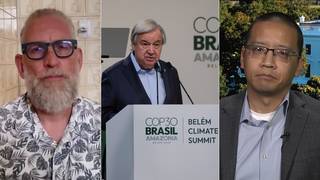
As Democracy Now! broadcasts from the COP30 U.N. climate summit, we speak with Kumi Naidoo, the longtime South African human rights and environmental justice activist who is president of the Fossil Fuel Non-Proliferation Treaty Initiative. He discusses U.S. absence from climate talks, Gaza, and wealthy countries refusing to take accountability for the climate crisis. “We’re not asking the rich nations for a charity here. We are asking them to pay their climate debt.”
Related Story
 StoryNov 24, 2025Climate Deal Excludes Fossil Fuel Phaseout as Wealthy Nations Place Burden “On the Backs of the Poor”
Transcript
AMY GOODMAN: This is Democracy Now!, democracynow.org. We’re broadcasting from the U.N. climate summit, COP30, from the Brazilian city of Belém, the gateway to the Amazon. I’m Amy Goodman.
We’re joined now by Kumi Naidoo, the longtime South African human rights and environmental justice activist, former head of Greenpeace International and Amnesty International, now president of the Fossil Fuel Non-Proliferation Treaty Initiative, a global effort to accelerate a transition to renewable energy.
It’s great to have you back with us, Kumi. It seems that at these U.N. climate summits, that’s kind of the only time we get to talk right now or see each other in person. Can you talk about the significance of this moment when it comes to the climate catastrophe in the world?
KUMI NAIDOO: So, the reality is, the science told us in Paris that we need to be below 1.5 degrees. We are already pushing there. We are seeing that there is a big disconnect between the words that political and business leaders say and what actions happen on the ground.
So, for the last week, let’s just have a quick recap what’s happened. So, one, we see that there’s absolute corporate capture here again. There was 1,600 fossil fuel lobbyists. And even though it’s a struggle to get the F-word said here — by the “F-word,” we mean fossil fuels. It took 28 years before 86% of the primary cause of climate change would be even mentioned in a COP outcome document. That’s like Alcoholics Anonymous holding 28 years of conferences before they can get a backbone to mention alcohol, which is the problem. And so, that’s one challenge.
But the big debate is right now around finance. We’re really stuck on finance. So, there’s two blocs that have emerged. So, China and the G77 are talking about a seriously funded mechanism called the Belém Action Plan. And the EU has put an alternative proposal on the table, which is about — basically, developing countries are saying this will be another talk shop with no money. So, like, if you take — the money is really a big, big issue here, because, like, you’ll remember a couple of years ago we finally got a Loss and Damage Fund set up, right? And the governments have just committed $250 million to this fund, when what is needed is $400 billion a year, right? So, there’s such a big —
AMY GOODMAN: And talk about why you think — I mean, many people in the U.S., certainly Trump himself, the president, would say: Why should they be putting money into these countries?
KUMI NAIDOO: So, basically, first and foremost, it’s in self-interest, right? That in the end, if developing nation — if the rich nations of the world don’t support poor nations to transition and survive, the end result is that there will be growing emissions from the Global South, which makes it worse, and more forest fires in California and more intense hurricanes and tornadoes in Florida and elsewhere.
But the historical issue is the facts are clear that this old process that started 30 years ago said that we should have common and differentiated responsibilities, that all nations need to work together because this challenge is so big. But it also differentiated. It said countries like the U.S. and Europe, who decimated the forests historically, that built their economies on dirty energy, and the historical emissions in the atmosphere are coming from those emissions. It’s not to say that developing countries are not rising, as well, right now, but the historical accumulated responsibility still exists. And so, basically, we’re not asking the rich nations for a charity here. We are asking them to pay their climate debt. It’s about, you know, compensation.
AMY GOODMAN: Well, I wanted to ask you about the historically number one greenhouse gas emitter, and that’s the United States. On Monday, yesterday, I caught up with the prince of the Netherlands, Jaime de Bourbon de Parme. He’s here at COP30 as the Dutch climate envoy.
AMY GOODMAN: I wanted to ask your thoughts on President Trump not sending a high-level delegation here, and what that means.
JAIME DE BOURBON DE PARME: So, it’s truly up to any government to decide who it wants to send in what conference, so I’m quite open to say, well, it’s his choice not to send someone here. I think we need all parties to be constructively thinking about the future. So I would like to see a constructive U.S. present at the COPs, as we’ve seen in the past, as well. And for the — for now, what it is is people are looking for new equilibrium to see who’s taking what role in the absence of the U.S. at this COP. So, we’re doing that. And we’re looking for new partnerships, working with new governments in different ways, because of the absence of the U.S.
AMY GOODMAN: What do you say to President Trump, who calls climate change a hoax, who says it’s a con?
JAIME DE BOURBON DE PARME: So, I would say, I always use the analogy of a doctor. If I’m sick, and I take temperature, and I’ve got facts and figures that I’m sick, I can ignore it or not. So, it’s up to him to listen to the doctor or not. But it’s wise to listen to the facts. And it’s truly — the science tells the story. I’m not telling it. It’s not my opinion. It’s just listening to the experts that tell us that climate is a fact.
AMY GOODMAN: Finally, can you just tell us what you announced today?
JAIME DE BOURBON DE PARME: So, we’re here with the NDC Partnership, a wonderful organization that is — that is helping countries write the climate plans and how to implement them. And so, we’ve added to what we’re really doing for NDC Partnership, another 10 million euros to work on water-food nexus to really focus on water management on these countries, because climate eventually affects water.
AMY GOODMAN: Thank you very much.
JAIME DE BOURBON DE PARME: Thank you, as well.
AMY GOODMAN: So, that was the prince of the Netherlands, Jaime de Bourbon de Parme, who is at COP30 as the Dutch climate envoy, speaking along with other climate ministers. I asked him about the Trump administration not sending a high-level delegation. Does that make it easier to get work done around limiting fossil fuels, or is there a huge problem with that? What do you think? And also President Trump saying that climate change is a hoax.
KUMI NAIDOO: I think the position that the U.S. administration is currently taking is not in the interests of the United States and its people, it’s not in the interests of the world, and it’s not in the interests of global cooperation. However, having said that, let’s be blunt about it: U.S. participation at these COPs have often been negative. They have held back progress. They have brought down ambition levels and so on.
So, the good news, though, is that it’s not that U.S. people are not here and are not represented. There are lots of governors that are here. There are lots of cities’ mayors that are here. There’s civil society here. So, you know, Gavin Newsom, for example, had a very prominent role here in the first couple of days.
And we would urge the U.S. people to convince the current Republican-led administration to recognize that we need them at the table. But if they’re not here, we’re going to move ahead, as we’re doing with the fossil fuel treaty. So, Colombia has called for a standalone diplomatic conference in April next year, after Easter. We will move to negotiate this treaty outside of the U.N. system, as the landmine treaty was done, and then we’ll bring it into the U.N. system for ratification. So, Global South countries are going to move ahead without the dominant polluters. And people should not assume that the old world order, where what the U.S. and a few rich countries do can hold everybody back — ideally, we want the U.S. at the table, but they cannot hold us hostage forever. We’re going to try and move ahead without them.
AMY GOODMAN: Kumi Naidoo, speaking here at COP30 last week, you said, “Today, the leaders of the fossil fuel industry occupy the same moral equivalent position that in a different era controlled the so-called slave industry.” Explain what you mean.
KUMI NAIDOO: Well, the leaders who were trading in human lives in slavery had the same political access to power as the fossil fuel industry has. They had the same ability to control the narrative by what they could spend in the media of that time, as we have the same domination by the fossil fuel industry to confuse people about the urgency of the situation. And basically, ethically, trading in human lives then and now was never morally acceptable. Banking on a energy system that is killing people, that threatens not the planet — let’s be clear: The planet will survive. This is threatening humanity’s capability to survive on this planet. And people must be clear that this is being done for profit and greed and that they are being called out now.
And thankfully, at this COP, the one progress — and, Amy, I think I met you at the Copenhagen COP for the first time in 2009. At that time, you’ll remember, you could hardly hear the word “fossil fuels.” Yeah, certainly on the streets, it’s all about “The root cause is fossil fuels. We need to turn the tap and stop the flow of fossil fuels.” So, no longer can they escape what the root cause is. And I think that we will come out here, because President Lula, in the first day, said we need a fossil fuel phaseout plan coming out of this. The appetite is not there. We’re still pushing. But whether we get it here or not, we certainly will push in April to do so in Colombia.
AMY GOODMAN: Kumi, before we go, I want to ask you about two other issues. I mean, you are from South Africa. That’s the country that brought the genocide case against Israel at the International Court of Justice. You have always lived at the intersection of human rights, also climate, and you were former head of Amnesty and Greenpeace. If you can comment on what’s happening now? I mean, yesterday, the U.N. Security Council approved a U.S.-backed plan for a so-called international stabilization force in Gaza. We still have the human rights situation where far less than half Israel’s letting of humanitarian aid come into Gaza, and people are still being killed and attacked, either in Gaza or the occupied West Bank.
KUMI NAIDOO: My experience of South Africa teaches me that when those in power in context of conflicts speak about stabilization, what they are talking about often is stabilizing injustice, stabilizing the status quo. And here, what we are concerned — obviously, we want the peace to return as best as it was, recognizing that the Palestinian people have not lived with peace for decades and decades. But having said that, of course we support a ceasefire and so on. But what we are concerned about is that the way this resolution potentially can be implemented, it will stabilize the occupation, stabilize militarization, stabilize the undermining of international law, which Israel, more than any nation in the world, has consistently done.
So, the world — the eyes of the world are watching this. We don’t think that people should read this resolution as fundamentally a good thing, because the devil is going to be in the detail about how it is implemented. And right now, since the so-called ceasefire, we don’t take comfort about the fact that lives are being lost, both in Gaza and also on the West Bank, as we talk.
AMY GOODMAN: And as we talk about hunger, I want to move to Sudan. In this last minute we have, if you can talk about the humanitarian catastrophe in Sudan, in your continent of Africa?
KUMI NAIDOO: So, I think it’s important to recognize that 12 million people, firstly, have been displaced. Twelve million. Most countries in the world don’t have 12 million population. Secondly, what has recently happened in Darfur? The numbers are not clear, but people are talking about bodies everywhere, absolute mass —
AMY GOODMAN: They’re talking about the RSF ravaging El Fasher.
KUMI NAIDOO: Ravaging through, yeah. We’re talking about — people are talking about tens of thousands of people. I don’t want to comment to the figure, because there’s a news blackout. But there is every reason to believe that that’s happening.
And let me just say, the global media has been pathetically complicit in their silence by just ignoring this. And that’s why many people in Africa are now saying this is not just a problem with mainstream media. This is also a problem with “whitestream” media, in the sense that Black lives don’t really seem to happen. If this was happening in North America or Europe, I mean, the whole world would be seeing saturation coverage.
We need RSF and the previous army to comply to a negotiation process to stop this immediately. And the U.N. and the international community must raise the visibility and the energy in addressing this, because history will judge this as bad as we judged Rwanda at the end of the day.
AMY GOODMAN: I want to thank you, Kumi Naidoo, for being with us, South African human rights/environmental justice activist, president of the Fossil Fuel Non-Proliferation Treaty Initiative, former head of Greenpeace International and Amnesty International.
Happy birthday to Iván Hincapié! Thank you to Charina Nadura, Denis Moynihan, Nermeen Shaikh, María Tarcena and Sam Alcoff, who are here on the ground with us in Belém, Brazil, at the U.N. COP30. I’m Amy Goodman.




 Top
Top
Media Options