









 Watch Full Show

Award-winning Palestinian reporter Mohammed Mhawish, who left Gaza last year, joins us to discuss his new piece for New York magazine about Israel’s surveillance practices. It describes how Palestinians throughout the genocide in Gaza have been watched, tracked and often killed by Israeli forces who have access to their most intimate details, including phone and text records, social relations, biometric data and more.
This all-encompassing surveillance system is “reshaping how people speak, how they’re moving, how they’re even thinking,” says Mhawish. “It manufactured behavior for people, so they shrink their lives to reduce risk, they rehearse what version of themselves feels safest to present, and that creates an enormous psychological burden.”
Mhawish also describes the terror of when his family’s house was bombed, killing two of his cousins and two neighbors in an attack he says was linked to Israeli surveillance of his reporting activities. “I was being watched and tracked,” he says.
Related Story
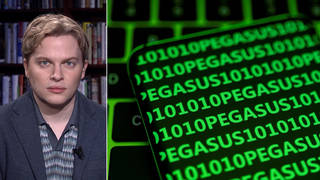
 StoryDec 05, 2024“Surveilled”: Ronan Farrow on the Spyware Technology the Trump Admin Could Use to Hack Your Phone
Transcript
AMY GOODMAN: This is Democracy Now!, democracynow.org, The War and Peace Report. I’m Amy Goodman, with Juan González.
We turn now to Gaza. Al Jazeera reports at least 12 Palestinians have died over the last day as a major winter storm devastates the besieged strip. There has been massive flooding across Gaza, where most of the population is living in shelters, makeshift tents, what remained of homes and buildings damaged by Israel’s relentless war. The storm victims include three children who died from hypothermia.
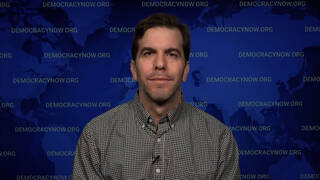
We’re joined now by the award-winning Palestinian reporter who left Gaza last year, Mohammed Mhawish. He’s written a new piece for New York magazine. It’s headlined “Watched, Tracked, and Targeted: Life in Gaza under Israel’s all-encompassing surveillance regime.”
Mhawish writes, quote, “Life in Gaza for the past two years has been a process of losing everything visible — our families, homes, streets. It also means losing what cannot be seen: the private space of the mind, the intimacy between people, and the ability to speak without fear of being monitored by a machine.”
Mhawish is a fellow at Type Media Center. The new piece was produced in partnership with the Palestine Reporting Lab. Mhawish is the recipient of several journalism awards, including an Izzy Award, the James Aronson Award for Social Justice Journalism and the Neal Conan Prize for Excellence in Journalism.
Mohammed, welcome to Democracy Now! This is a deeply moving, deep dive into the physical and psychological harm Palestinians are experiencing living under this unprecedented level of surveillance by the Israeli government. Can you lay out — I don’t think people understand the extent of what Palestinians live under — what you lived under in Gaza?
MOHAMMED MHAWISH: Thank you so much for having me.
At first, I think, you know, we’ve been living with a question for so long, even that goes long before this war started, and it’s been life under and inside, you know, a state of, like, where surveillance is constant. You know, it’s automated, and it’s largely invisible. And as a reporter, I’ve seen, like, a lot of coverage focusing on weapons and airstrikes and technology, but I think much less attention was paid to the systems that decide who is seen and how they’re doing this, in effect, to the human life and the civilian population in Gaza, and how they’re categorizing people, and how quickly and deadly life-and-death decisions can be made. And so, that was the reason I wanted to understand what that feels like from the inside.
And so, in the story, I tried to report this, you know, away from being political, technological or a military story, but as a human one. I spoke with families who described living with the sense that they were always being watched, they’re always being heard and scored, and even, you know, in moments that should be private and ordinary, and that constant awareness, how it’s reshaping how people speak, how they’re moving, how they’re even thinking.
And there was also a sense of urgency, because, like, you know, these systems are no longer experimental, right? You know, they’re being operational. They’re being scaled up. And they’re, you know, deeply embedded in life in Gaza. And once something like this becomes normalized in one place, it rarely stays there. And so, you know, as a result of my reporting, I have come to realize that Gaza, you know, has been the testing ground for how surveillance can be used, an entire population in real time.
JUAN GONZÁLEZ: Mohammed, could you talk about some of the specific examples? For instance, you write about a woman named Mary, a 26-year-old writer, who woke up in the middle of the night on July 27th with a drone flying in her room while she was sleeping. Give us some of these specific examples.
MOHAMMED MHAWISH: Of course. I mean, people, you know, some of them told me and described to me a kind of a permanent self-monitoring, you know, in the aftermath of encountering these decisions and these systems and these, you know, regimes of being watched. And, you know, they’re saying, like, you know, “Life starts to feel like you’re always leaving a trail, sometimes of words, movements, associations, that could later be misinterpreted.” So, in the story, people talk about, you know, changing how they speak on the phone, how they’re avoiding certain phrases, certain conversations, certain ideas or topics, even in private, and they’re limiting who they can contact and — you know, because sometimes even it’s true that they’re assuming that even silence can be suspicious.
What I’ve also learned through speaking with these people is that — you know, I had known, like, surveillance observes behavior, and it limits action. But it was also — for the people in Gaza, it produced different behavior. It manufactured behavior for people, so they shrink their lives to reduce risk, they rehearse what version of themselves feels safest to present, and that creates an enormous psychological burden, you know, especially —
AMY GOODMAN: Mohammed, in following up on what Juan said, this woman, Mary, 26-year-old writer, I don’t think people understand the specifics. You say, “A dark square hovered near the ceiling. She stared at it, motionless, until it drifted out of the room and exited through a window.” We’re talking about a drone. Mary said —
MOHAMMED MHAWISH: Exactly.
AMY GOODMAN: — “It is not death that we fear. It is the terror that comes before it.” A tiny drone hovering over her head?
MOHAMMED MHAWISH: Absolutely. That’s correct. It’s only one example of the many stories I’ve heard from people who had to encounter and who have come to experience this level of surveillance that is so deep in their lives, including, you know, a technological sort of a machine that goes inside the house and roaming, you know, what’s supposed to be a private or secure space for people.
So, this woman, who’s a writer in Gaza, she woke up one night during the war in Gaza, only to realize that there is a drone that was watching her and her family, and it was just, you know, freely roaming inside the house. And at some point, it exited through the window. And that was one defining and a very reshaping moment in her life and, like, in the family’s also behavior in the aftermath.
Some other people describe being encountered with cameras at checkpoints, for example, aside from, you know, their direct engagement with these drones that are hovering constantly overhead. And they were realizing that, you know, there is a massive file that was so deep, inclusive of information that they never imagined that would be known for others, you know, for other people, aside from private contacts, aside from family, immediate family, neighbors. And so, it was so deep, to the point that people were shocked to know that they were, you know, seen and watched for a long time, that goes beyond only a week or two or a month.
JUAN GONZÁLEZ: And, Mohammed, could you talk about the role of the major tech companies, like Microsoft, Palantir, Google, as well, in this surveillance state?
MOHAMMED MHAWISH: I think one of the central findings of my reporting, and, of course, of other investigations I reference in the piece, is that this surveillance ecosystem, it doesn’t exist without massive computational infrastructure, right? We’re talking about, you know, cloud storage, data processing, AI-assisted analysis. And that’s where large technology companies come in, including American firms that provide cloud and computing services with the Israeli government and the Israeli military.
And so, I was — in the story, I was very careful not, you know, to claim that any single company is pulling the trigger. But that’s also not, you know, I think, the right sense of urgency that we have here. The real issue is that the infrastructure, when companies provide the storage, the processing power, the scalability of these systems that allow population-level surveillance to function, they become part of the system that makes this kind of control possible, because I don’t think cloud services are neutral here in this, you know, question. They determine speed. They determine scale and persistence. And they allow massive data sets, phone metadata, location histories, social graphs, to be stored indefinitely and analyzed continuously.
What’s interesting is also, like, you know, most of these companies responded by saying they comply with the law, that they have internal safeguards and that they haven’t found evidence that their tools were used to directly harm civilians. But the problem is that much of this activity happens inside classified or opaque military pipelines, and, you know, which is like making the case that independent auditing is nearly impossible here. So the accountability gap is structural, and it’s really big. When harm emerges from a system rather than a single action, I think here responsibility becomes diffuse, and that’s exactly what makes it dangerous for people.
AMY GOODMAN: Looking at this harrowing excerpt of your piece, “On December 6, I went home to check on my family. Shortly after I walked in, a caller speaking Arabic introduced himself as 'David' from the Israeli military. He called me habibi — which means 'my dear' in Arabic — and said we had 20 minutes to evacuate our three-story house crowded with family and neighbors. … It felt like another form of harassment. … We [decided to stay. So,] next morning, around 7:30 a.m., I heard my son’s feet patter down the hallway as I was reaching for my tea. The blast came without warning. The house folded in on itself. I didn’t see the ceiling crack or the walls fall — just a sudden weight, concrete and metal pressing me flat. My arms pinned, … I called out for my wife, [for] my son, [for] my parents. At first, nothing. Then a small voice from somewhere I couldn’t reach: 'Baba.'” You talk about this happening to you as a Palestinian journalist in Gaza City. Can you continue? What happened that day?
MOHAMMED MHAWISH: The very early moments in the aftermath of the strike, where just I remember, you know, being buried under the rubble of the house, and, you know, just like hearing, a few hours later, after realizing that I had passed out, you know, rescue people, paramedics and first responders and neighbors were trying to pull us out from under the rubble and taking us to first aid treatment at the hospital that day. When we were, you know, sent back, because, like, we were dealing with a very — shortages of, you know, medical system and the collapse of the whole medical system in Gaza, so all we were offered at that day was first aid treatment. And we were sent back to stay at a neighbor’s place, before we started to bounce around the city across makeshift shelters.
It was a story of the many stories that I had, you know, to experience, but this time, it was happening to me as a result of my work as a journalist in Gaza. I’ve heard similar stories from colleagues and reporters and friends who were killed after they were being tracked and watched and threatened to stop their work. In my case, it was explicitly direct that I was receiving these threats to stop my journalism and reporting.
What made me realize that it is also very tied to surveillance, and I was being watched and tracked, is that, before, like, for a week before the bombing happened and my house was destroyed, I had been away a week or so, like, reporting from outside the house and running across the city with other colleagues and journalist friends. As soon as I set foot in the house, my phone rang, and I received this call from a stranger who identified himself as, you know, David from the Israeli military, and who urged us to leave the house.
I didn’t leave that day, and I think it was mainly because I didn’t really realize how serious he was. I mean, for someone calling me habibi, which is a very endearing way of calling friends and loved ones in Arabic, I didn’t realize that he was actually trying to kill me. And so, I thought maybe this was another harmful, painful call to stop me from my work and just silence me. And it was scary enough to make me realize that I have to stop reporting, at least for a week or two, in the coming, you know, days. But I didn’t really know that it was to the point that they were actually intending to bomb the house, including on top of all of us. Like, we were almost 30 people, or around that, in the house, including immediate and extended family members and neighbors and people who had fled from different parts of the city to seek refuge in the neighborhood. And so, this is a layer and this is a pattern of targeting that happened to me and to many others, as well, in Gaza.
AMY GOODMAN: Mohammed —
MOHAMMED MHAWISH: And that was — yeah.
AMY GOODMAN: I want to thank you for being with us. It’s an incredible piece, and I want to encourage people to read it. Mohammed Mhawish is a Palestinian journalist and writer from Gaza City. The piece is in New York magazine, headlined “Watched, Tracked, and Targeted: Life in Gaza under Israel’s all-encompassing surveillance regime.” We’ll link to it at democracynow.org.
Coming up, the Trump administration intensifies its immigration crackdown. Wealthy visa applicants can now buy a million-dollar “Trump Gold Card” or a $5 million “Trump Platinum Card” to live in the U.S., as others are deported. Stay with us.




 Top
Top
Media Options