













 Watch Full Show

Guests
- Maryse Balthazarformer journalist and a certified nursing assistant.
- Guerline Jozefco-founder and executive director of Haitian Bridge Alliance.
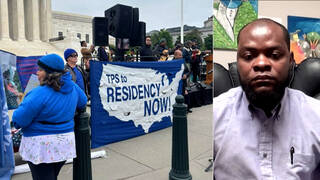
An estimated 350,000 Haitian immigrants are set to lose their temporary protected status, or TPS, on February 3, 2026, after President Trump signed an executive order to revoke their TPS shortly after coming into office. TPS holders live and work in the United States legally. During the 2024 presidential election, candidates Donald Trump and JD Vance spread racist invective about Haitian immigrants in Springfield, Ohio. Now ICE is reportedly planning to begin extensive raids on Haitian American communities like Springfield. “We are living under a cloud of terror,” says Guerline Jozef, the co-founder and executive director of Haitian Bridge Alliance. Her organization is mounting a legal challenge against the Trump administration’s revocation of TPS.
“I’m anxious every day,” says Maryse Balthazar, a former journalist in Haiti who fled the country after its devastating 2010 earthquake. She now works as an elder care nurse in Florida. She worries about being separated from her U.S. citizen daughter, and for the safety of her son, also a TPS holder, if he were deported to Haiti, a country currently struggling with organized crime and political unrest. Balthazar says that if she were to lose her TPS, “it will be like another earthquake to me.”
Related Story
 StoryJul 30, 2026Report from Springfield, Ohio: Haitians Brace for ICE Crackdown After TPS Protections End
Transcript
AMY GOODMAN: This is democracynow.org, The War and Peace Report. I’m Amy Goodman.
We turn now to Trump’s deportation campaign, with temporary protected status, TPS, for immigrants from Haiti scheduled to end next week, February 3rd. A federal judge in Washington, D.C., is expected to rule any day on a request to pause the termination of TPS for Haitians. An estimated 350,000 Haitians with TPS protections could face deportation. About 150,000 others still have pending TPS applications. That’s according to Haitian Bridge Alliance.
As Haitian communities and supporters nationwide continue to fight, local officials in Springfield, Ohio, are bracing for a surge in ICE agents to the city if TPS relief for Haitians is not extended past the February 3rd deadline. The city was at the center of President Trump and Vice President JD Vance’s racist smears against Haitians, when they said they’re eating cats and dogs.
This comes as a federal appeals court has ruled that Homeland Security Secretary Kristi Noem illegally ended protections for immigrants from Venezuela and Haiti. It’s yet to be determined how this will impact Haiti’s TPS case. The Supreme Court last year allowed Noem’s bid to end TPS for Venezuelans.
For more, we are joined by two guests. Guerline Jozef is co-founder and executive director of Haitian Bridge Alliance. And Maryse Balthazar is a former journalist and certified nursing assistant from Haiti who currently has temporary protected status. She was once president of the Haitian Women’s Journalism Association. She fled Haiti after the devastating earthquake in 2010.
We welcome you both to Democracy Now! Guerline, let’s begin with you. Explain what’s at stake.
GUERLINE JOZEF: Good morning, Amy.
What is at stake is that we have over — almost half a million Haitians living in the United States at risk of losing everything. That includes family separation through deportation, where we have children, U.S.-born children, at risk of losing their parents if TPS is not redesignated and extended for Haiti. As you mentioned, we are currently in the court fighting for the lives of over 350,000 Haitians, and we are hoping to get a favorable ruling from the judge in Washington, D.C. However, in order to cover half a million people, we need a redesignation and extension of TPS for Haiti.
AMY GOODMAN: So, you came into our studio, we spoke, and then you headed off to Springfield. That was a while ago, last year. Again, for people to understand, I remember watching the Republican governor of Ohio talk about going to Haiti a number of times. They were really recruiting Haitians to Springfield to enliven, to resuscitate Springfield, Ohio. And instead, you had the Republican Vice President JD Vance going after Haitians there, tens of thousands of people, as he talked about the Haitians in Springfield, Ohio, eating cats and dogs. Talk about what’s happened since.
GUERLINE JOZEF: We are back at it again, Amy. As I’m speaking to you, we have been coordinating to respond to what we are hearing will be a major ICE raid in cities like Springfield, Ohio, San Diego and others. We are heading to Springfield to make sure we are observing what’s happening within the community and also supporting our clients and our community members on the ground. So, we are hearing those things, and the community is traumatized. We are living under a cloud of terror, where we do not know what will happen, because from what we are hearing, there is a 30-day ICE raid that is being planned for major cities where Haitian Americans are, specifically targeting Springfield, Ohio; Charleroi, Pennsylvania; and others. So we are bracing ourselves. Not only are we fighting in the frontline to make sure that we secure safety for the people through the lawsuits, sending a letter to President Trump to ask him to reconsider and extend and redesignate TPS for Haiti, but also bracing ourselves for what can be catastrophic within the community, if indeed ICE descends on Springfield, Ohio, in New York City and other places that we are hearing right now.
AMY GOODMAN: I mean, it is —
GUERLINE JOZEF: We have —
AMY GOODMAN: It’s amazing that you have the governor of Ohio, Mike DeWine, talking about recruiting Haitians, the Haitian community, to come to Springfield to revitalize it, and at the same time, in Lewiston, Maine, you have the mayor having talked about recruiting Somalis, the Somali community, come and revitalize downtown Lewiston, and yet now the pressure on these communities. I wanted to bring in Maryse Balthazar, certified nurse from Haiti, living in the U.S., living in Florida. She was the former president of the Haitian Women’s Journalists Association. She’s a certified nursing assistant. Maryse, can you talk about what this means.
MARYSE BALTHAZAR: Good morning, Amy. Thank you for having me.
What this means to me, the end of TPS will mean that I will be probably deported, grabbed by ICE agents, and leave behind my daughter. She’s in college. She needs my backup for stability, to have a roof over her head. And I don’t know what’s going to happen. I’m anxious. Every day I’m thinking about it. And it’s not only me, my son, who — my son, who is 30 years old — he just turned 30 — is living with TPS also.
AMY GOODMAN: So, you have TPS, and your son has TPS. You’re very brave to come on the air, but you’re speaking for so many people. Are we talking about hundreds of thousands of Haitians in the United States? You came here after the horrific earthquake that took place in Haiti, what, like 16 years ago.
MARYSE BALTHAZAR: Yes, yes, I came here with my kids, and I’m still living in the United States. And I was never illegal here, because I — since 2010, I have TPS. They renew it over and over again. And I work. I pay tax. I’m a good citizen. I don’t bother nobody. I do what I have to do. During my time here, I take care of a gentleman who was a pilot during World War II, for seven years, and I’m still doing it, helping elders with activity of daily living. And the end of TPS next week, it’s like — it will be like another earthquake to me.
AMY GOODMAN: Guerline Jozef, the U.S. Embassy has removed 80% to 90% of its staff in Haiti due to security concerns in the country. Can you talk about the conditions on the ground there, if people like Maryse Balthazar, who has worked here in this country — and it’s a real question about what this means for healthcare, as you describe, for example, Maryse, taking care of this World War II vet — what this would mean?
GUERLINE JOZEF: This will mean extreme hardship, not only for the Haitians, but also for the United States as a whole. At the end of last year, the U.S. Embassy in Haiti had a webinar where they clearly stated that Haiti is currently at a stage four to not travel, like a war zone. And they have also said that they have removed about 80% to 90% of their personnel in Haiti due to insecurity. But at the same time, they are saying that it is safe enough for half a million Haitians to be returned.
And we also want to highlight that the Haitian TPS holders in the United States have invested $5.9 billion into the U.S. economy. They are, like Maryse, our nurses, our nurses’ assistants, our healthcare workers, our meat-packing industry, our agriculture, you know, workers, really centering and uplifting the life of people here in the United States.
And keep in mind, currently we have 1.4 million people who are internally displaced in Haiti. The impact of terminating TPS for Haiti not only will have a big sustainable failure here in the United States, but we have to understand that those people are the ones supporting over 4 million people back home in Haiti. It is in the best interests of President Trump and the U.S. government to redesignate and extend TPS for Haiti, both to make sure that Haiti is somewhat being taken care of with the remittance being sent, but also centering the fact that we, as Haitian Americans, specifically TPS holders, are investing over $5.9 billion in the United States, paying their taxes. They are homeowners and business owners making sure that we continue to move forward.
AMY GOODMAN: Maryse Balthazar, we just have 30 seconds. Are you afraid for your life? What kind of danger do you face if you’re deported to Haiti?
MARYSE BALTHAZAR: I was a journalist. And now I don’t have any control of corporates, because I haven’t been there for 16 years now. I don’t know what I will face for sure, because everything is upside down. I don’t know nobody anymore. All my contacts are living abroad, in the United States, in Canada, all over. And I don’t know.
AMY GOODMAN: Maryse Balthazar, I want to thank you for being with us, certified nurse from Haiti, living in the U.S. —
MARYSE BALTHAZAR: Thank you for having me.
AMY GOODMAN: — with TPS protections. Thank you so much. Her son also has TPS, her daughter an American citizen. And Guerline Jozef of the Haitian Bridge Alliance.






 Top
Top
Media Options