








 Watch Full Show

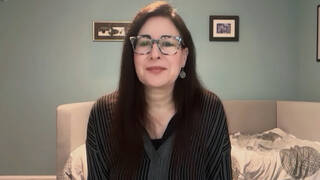
Democracy Now! recently sat down with Agnès Callamard, the secretary general of Amnesty International and a former United Nations special rapporteur, while she was in New York City to mark International Women’s Day and attend the U.N.'s annual conference on women's rights. Callamard responded to the assassination of Iraqi feminist Yanar Mohammed, U.S. sanctions against U.N. special rapporteur Francesca Albanese and the rise of Christian nationalism under the Trump administration.
Transcript
AMY GOODMAN: This is Democracy Now!, democracynow.org, The War and Peace Report. I’m Amy Goodman.
On Sunday, tens of thousands of women around the world marked International Women’s Day by demonstrating against gender-based violence and calling for an end to the U.S.-Israeli war on Iran. On Monday, a major United Nations summit, the 70th Session of the Commission on the Status of Women, began.
This all comes a week after Iraqi human rights defender and feminist advocate Yanar Mohammed was assassinated in Baghdad, in Iraq. She was killed in an attack on her home. She had just reportedly returned to Iraq from Canada a few days before her murder. She was killed by two unidentified gunmen who opened fire as she stood outside her home. Yanar Mohammed was the co-founder and president the Organization of Women’s Freedom in Iraq. In 2003, she founded the first women’s shelter in Iraq to protect women from trafficking and so-called honor killings, becoming the target of death threats over her activism.
She was a frequent guest on Democracy Now! following the 2003 U.S.-led invasion of Iraq. This was Yanar speaking on Democracy Now! in December of that year.
YANAR MOHAMMED: The story that does not reach to this part of the world is how the women are treated in the postwar Iraq, what happened to us, how our, let’s say, destinies were totally devastated by this war. What is told to everybody is that we got rid of a bloody dictator, which is a true story. But the part that nobody knows about is that we did have sort of a secure life. We did have our jobs. We did have some stability, that we totally lost with the first day of the war. Now our everyday life has abductions for women. We cannot go out in the streets safely. We are immediately a moving target on the streets, and we qualify for kidnappings, for rape and for killing, just because we are women. And on top of all of that, what the coalition did was hand over part of the authorities to religious fundamentalists that turned our lives to push us hundreds of years back in time.
AMY GOODMAN: That was Yanar Mohammed speaking on Democracy Now! in 2003, shot dead last week in Baghdad, Iraq, when she returned to Iraq.
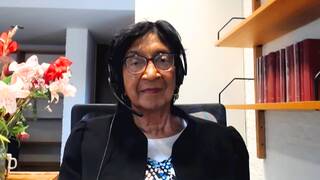
On Monday, I spoke to Secretary General of Amnesty International Agnès Callamard. I asked her about her reaction to the killing of Yanar Mohammed, a woman she knew well.
AGNÈS CALLAMARD: Lots of emotion to see her, because I met her. I was not as close to her as some of my friends in the field, but she was very, very important for us. She was an icon. She fought so hard. I met her in Iraq. I actually met her organization there. She was — you know, she was so strong and so determined. And she fought in the most incredibly cruel and violent environment, and she kept going, and she kept going.
You know, for all of us, we feel that she is one of the victims of the current war, because she became the symbol of, you know, this Westernized person, which she wasn’t, because, as you know, she took very strong position against all wars of aggression, as she took position against patriarchy and violence in Iraq.
AMY GOODMAN: You know, it’s so interesting you say you see her as a victim of this war, because you think of the similarities of the U.S. invasion of Iraq back in 2003, when I think it was the Defense Secretary Donald Rumsfeld saying, “They will greet us with flowers,” and you see what President Trump is saying, you know, “We are there to protect the protesters in Iran.”
AGNÈS CALLAMARD: Yeah.
AMY GOODMAN: And, of course, what’s happening now is hundreds, well over a thousand, people have been killed —
AGNÈS CALLAMARD: Killed in Iran.
AMY GOODMAN: — so far in Iran.
AGNÈS CALLAMARD: Yeah, and civilians. Look, I think we really need to reject any kind of binary proposal being brought to us. I want to be very clear that the regime in Iran is responsible for massive human rights violations. Probably thousands of people were slaughtered in January for protesting it, women in Iran being denied some of their basic rights. So that is a reality of the regime in Iran. But making it clear that this is a regime and a government that is responsible for crimes against humanity should not lead us, of course, to see in this act and these attacks anything else but an act of aggression which will also victimize people and civilians.
Right now there are hundreds of people who were arrested in January in the context of probably the most violently repressed protest. They are held in prison. Those prisons are either directly targeted by the bombing or are near areas where the bombs are falling, and we are very worried about what’s going to happen to these prisoners. We know what happened to the — during the 12 Days War, that Evin Prison was targeted. We also know that during times of war like this one, the Iranian government increases the repression. It has imposed an internet blackout, and there is likely to be more repression against anyone wanting to raise the alarm about the situation. So, at all level, people are the victims. And let’s be — let’s make no mistake: These attacks, the Israeli -U.S. attacks on Iran, are doing nothing to protect the Iranian protesters and those who have been at the forefront of fighting the government.
AMY GOODMAN: Well, I wanted to ask you about those prisoners a little more, like Narges Mohammadi —
AGNÈS CALLAMARD: Yes.
AMY GOODMAN: — the Nobel Peace Prize winner –
AGNÈS CALLAMARD: Yeah.
AMY GOODMAN: — who was just taken back into custody —
AGNÈS CALLAMARD: Exactly, yeah.
AMY GOODMAN: — as she protested the death of yet another Iranian, believing at the hands of the Iranian government.
AGNÈS CALLAMARD: Yeah.
AMY GOODMAN: And what happens to her and the others? Do you have any word? I mean, it’s hard to get word out of what’s happening on the streets, let alone in these prisons, like the notorious Evin Prison.
AGNÈS CALLAMARD: The words are alarming. First of all, she has been moved out of the prison where she was held to another location. She is unwell. She is — she has many health problems. She —
AMY GOODMAN: Which is why she was released the first time.
AGNÈS CALLAMARD: Exactly.
AMY GOODMAN: For medical reasons. And then she spoke out again and was reimprisoned.
AGNÈS CALLAMARD: Reimprisoned, moved to a new facility. And according to people who are close to her and to information that she managed to pass, to provide, she has been denied medical treatment, and she is under severe, I will say, circumstances. So, whether or not she’s being ill-treated or tortured, it’s hard to know. But the denial of medical services and medicine amounts to an inhuman and degrading ill-treatment.
AMY GOODMAN: You’re here in New York for the 70th Session of the Commission on the Status of Women. Women around the world are fighting for gender justice, which is so much under attack. Can you talk about what this session is about, and who attends it, and what you’re calling for?
AGNÈS CALLAMARD: Look, it could not be coming at a more urgent time. So, who comes? First and foremost, those who can get a visa. So, let me be very clear that it will be a smaller Commission on the Status of Women, because either people are afraid of coming to the United States or are not getting visas. It is a privileged few, like people like me, who are making it to the commission this year.
AMY GOODMAN: Well, wait, just one second. Can you explain this? Because I think a lot of people in this country may not understand the level of denial of visas of people from around the world. And here, the United Nations is, and there’s a whole question of whether it will be pulled from New York and —
AGNÈS CALLAMARD: Yeah.
AMY GOODMAN: — you know, brought to another country because of these restrictions.
AGNÈS CALLAMARD: As you know, the Trump administration has basically imposed visa vetoes on a large number of countries, mostly in Africa, so anyone coming out of these countries cannot get a visa to enter the United States. And it is most of Africa. So, already you are denying a large number of advocates and activists access to the United States.
We cannot minimize the fact that for many activists, the United States is becoming a scary place to come to. So, in addition to the fact that they cannot get visa, for whatever reason, including the fact that they originate from a country from which there is no visa, a number of them are not coming for fear — fear of ICE, fear of being targeted, fear of being arrested — fear, just fear. Why would you — why would you put yourself into such a situation when you don’t have to? So, the first thing to say about the commission this year is that it is going to be smaller in terms of the number of people or in terms of the number of diverse people coming from around the world.
That being said, it is a crucially important commission. It’s coming at a peak, the peak of the war against women, the war against gender. It is — I’m using the word “war” because it is coordinated. It is organized. It is well funded. It has its national component, and it has its international component.
Internationally, every CSW, every commission, there is a statement that is being released. Usually it is released with consensus. So far this year, consensus seems very unlikely, and a number of countries are using the environment and the fact that they are being emboldened by the Trump administration to argue over language, particularly in relation to gender rights, in relation to reproductive rights, in relation to women’s human rights defenders. They are trying to eliminate such language or to weaken it. Of course, there are, luckily, other countries that are pushing back, but it is a battleground. Those political statements and that particular political statement is going to be a battleground.
It is also happening, CSW, at a time when we’ve been receiving all this information coming out of the Epstein files. And let’s not minimize what it means for our global society. It is an international criminal network that was present at all level of governments, of finance, of culture. And at heart, it is about violence against women. That is the context within which CSW is taking place. This is why it’s so important. This is why we’re coming. This is why we’re marching, we’re rising, and we’re saying, “No way.” We’re going to stand up, and we’re going to say and push back. We’re going to resist the onslaught against women’s rights and against gender rights. We don’t have a choice. We’ve got to fight, and we’ve got to resist.
AMY GOODMAN: What about women’s rights being used as a pretext to go to war? I remember when the U.S. invaded Afghanistan, the first time the presidential radio address was given over to the first lady. In that case, it was Laura Bush —
AGNÈS CALLAMARD: Yeah.
AMY GOODMAN: — the wife of George W. Bush. And she said, “We’re coming in to save women.” And you think about this U.S.-Israeli attack on Iran, one of the first acts, and it looks like, from various investigations, is a U.S. strike on a girls’ primary school —
AGNÈS CALLAMARD: On a girls’ school.
AMY GOODMAN: — and 175 people died, the majority of them, we believe, little girls.
AGNÈS CALLAMARD: Look, I think no one is that naive, you know? There is a clear instrumentalization of women’s rights. I think we all know that this government could not care less. For the last 12 months, the Trump administration has done everything in its power to weaken the domestic protection for women’s rights. It is now moving to impose global gag rules over sexual and reproductive rights around the world. It is attacking any kind of narrative related to gender. It is erasing the notion, the principle of equality between men and women. There is no doubt that this government does not care about women’s rights, whether they are Iranian or, frankly, American.
AMY GOODMAN: And then, of course, non-Iran, not the U.S., looking at, for example, what’s happening in Gaza, what’s happening in Sudan, for example.
AGNÈS CALLAMARD: Yeah, yeah.
AMY GOODMAN: And as you say, so many people were denied visas from Africa, so they can’t even frame their own stories.
AGNÈS CALLAMARD: Yeah, absolutely. Look, we are at a critical moment for women’s rights, for the fight against racial discrimination, for the fight for LGBTQI around the world. What the Trump administration has done is not creating the anti-rights agenda, but it has emboldened it to a level that we had not seen before. It is using the seeds that have been planted now for a few years, and it is using them for its own advantage and its own purpose, which is to get rid of any kind of normative guardrails around the world to suggest that the rules-based order that we took 80 years to create, to build, including around women’s rights — it is now trying to pretend that this is an illusion and that there is no such thing as a rules-based order. That is what is at stake.
And fighting for women’s rights, including internationally, is how we demonstrate that the rules-based order is not an illusion, that over the last eight years women’s activists, feminists and a number of governments have worked together to adopt a convention for the protection of women against discrimination, for their protection against violence. This is what is at stake right now, and this is why we must resist this organized, coordinated onslaught against women’s rights.
AMY GOODMAN: Before you were secretary general of Amnesty International, Agnès Callamard, you were a U.N. special rapporteur —
AGNÈS CALLAMARD: Yeah.
AMY GOODMAN: — on extrajudicial, summary or arbitrary executions. I want to ask about another U.N. rapporteur. I wanted to ask you about Francesca Albanese and what it means when she reports on genocide in Gaza, being sanctioned —
AGNÈS CALLAMARD: Yeah.
AMY GOODMAN: — how investigators like her can get at the truth when they are then personally attacked.
AGNÈS CALLAMARD: Persecuted. It’s a form of persecution. It is a clear attempt by this administration to make international scrutiny, international justice a battleground. They went after ICC judges. They are going after — they went after Francesca, and they went after Palestinian organizations. It is an attack on justice. It is an attack on international scrutiny. It is sending a chilling message to everyone who dare stand up. It is potentially harming the entire international justice system. This is why resistance must be driving all people of conscience right now.
Some governments have spoken against those sanctions, but too few have done so. Francesca’s own government, Italy, is doing nothing to protect her. In fact, most of European — recently, the French government has also gone after her on the basis of what was clearly a truncated video. So, governments that have the political and the economic backbone to resist the United States, those are the governments that should stand up. Personally, I don’t think we should expect governments that are already battered by an unequal economic system to then stand up and say no to Donald Trump. But there are others. The European market is the biggest economic market right now, or one of the biggest in the world. Those countries together, or some alone, have the capacity to say no. Indeed, Spain is saying no. But where are the others? Where are the others?
So, you know, it is really crucial that European people call on their government to stand up and say no to the onslaught against the international order, against international law, against women’s rights, that is being driven right now by the Trump administration. We’ve got to stand up and say no. At many levels, it’s very simple. It is very simple: Just say no.
AMY GOODMAN: I want to end by asking you about what’s happening in Iran being framed as a holy war, and what exactly that means for women. Mikey Weinstein, the founder and president —
AGNÈS CALLAMARD: Yeah.
AMY GOODMAN: — of Military Religious Freedom Foundation, he said his organization has gotten over 200 calls from members of the military regarding religious comments made by U.S. commanders. One combat unit commander reportedly said the war is “part of God’s divine plan,” that President Trump’s been “anointed by Jesus to light the signal fire in Iran to cause Armageddon and mark his return to Earth.” And then you have Defense Secretary Pete Hegseth inviting this controversial Christian nationalist pastor, Doug Wilson, to lead the Pentagon’s prayer service. He opposes Muslims holding public office, does not believe women —
AGNÈS CALLAMARD: Yeah.
AMY GOODMAN: — should be allowed to vote. When you have these attacks framed as a holy war, how this disproportionately affects women?
AGNÈS CALLAMARD: Well, first, I want to say that a month ago, during the Munich Security Conference, Marco Rubio, in the speech he delivered, called on an alliance of Christian white people led by the United States. So, it has been in the making, this notion of a holy war, Christian war. We also hear it a lot in Israel in a different — in a different context.
Religion has never been a friend of women’s rights. Religion has been the primary driver through which women’s rights have been violated, and the violations have been justified in the name of a higher, godly principle. So, the comments that we are hearing right now, the incredible images that we have seen, I mean, should send shivers through the spine of every woman. And I think we cannot but escape wondering: How can they then accuse the Iranian government of being led by God, because, clearly, that’s also what they are trying to portray?
It is — you know, it is a terrible, terrible moment for our global society. That is why Amnesty International is here at CSW, and we’re here with a very clear message. We’ve got to resist what is happening.
AMY GOODMAN: That is Agnès Callamard, secretary general of Amnesty International.
That does it for our show. On Friday and Saturday, I’ll be in Mexico City at Festival Ambulante for two screenings of the new documentary about Democracy Now!, Steal This Story, Please! I’m Amy Goodman.



 Top
Top
Media Options