









 Watch Full Show

Killers of Roe is a new book by the reproductive rights journalist Amy Littlefield on what she describes as the death of abortion rights in the United States. The book is framed as a murder mystery, examining a “twisted alliance of believers and opportunists” in the years and decades before the Supreme Court overturned Roe v. Wade in 2022. “It started out as a murder mystery because it was a way to entice myself to tell a really difficult story about women dying preventable deaths as a result of anti-abortion policy,” says Littlefield.
Related Story
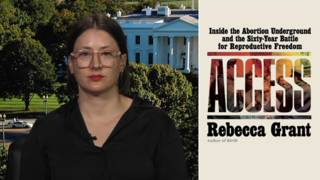
 Web ExclusiveJun 27, 2025Inside the Abortion Underground: Rebecca Grant on Why Outlawing Abortion “Does Not Make It Go Away”
Transcript
AMY GOODMAN: This is Democracy Now!, democracynow.org. I’m Amy Goodman.
We end today’s show looking at the Killers of Roe. That’s the title of a new book by reproductive rights journalist Amy Littlefield, on what she describes as the death of abortion rights in America. The book examines the movement to criminalize abortion in the years and decades before the Supreme Court overturned Roe v. Wade in 2022. This year marks the 50th anniversary of the Hyde Amendment, which banned federal funding for abortion, which has disproportionately impacted the poor and women of color. Amy Littlefield is The Nation magazine’s abortion access correspondent, also a former Democracy Now! producer.
Amy, welcome back to Democracy Now! Congratulations on the publication of your book. Why don’t we start off by you talking about the state of reproductive rights in the United States right now?
AMY LITTLEFIELD: Thank you. Amy. It’s great to be back on the opposite side. Usually I was in the control room.
So, abortion access today is a landscape that is defined by contradiction. Half of states have some form of restriction on abortion before 24 weeks. More than a dozen states ban abortion outright. And yet, in every year since the Supreme Court overturned the right to abortion, the number of abortions in this country has gone up, which is remarkable. And that’s because eight states allow providers anywhere in those states to ship abortion pills anywhere in the country, including into states where abortion is banned. And they’re doing so for free or for very cheap. And so, in a way, abortion, which was always —
AMY GOODMAN: And most abortions are done by these pills.
AMY LITTLEFIELD: Correct, today most abortions are by medication. And that’s the ones that we can count. There’s more community activists circulating these pills completely under the radar. But that means that today a woman in rural Mississippi can get an abortion sent to her through the mail by pills from a clinician operating in a blue state, like New York or Massachusetts, for free right to her door, someone who would have had to drive hours and endure waiting periods and all kinds of hurdles in the time before the Supreme Court overturned Roe v. Wade.
And so, in a sense, access has expanded, and yet choice has contracted — right? — because the options have narrowed. Often clinics are off-limits, because many of them have closed and are not operating in states where abortion is banned. And so, you know, we used to have a landscape where there was choice. There was a right to abortion legally, but access was curtailed because you needed the money to afford it. And now we see the situation where access has expanded, but people’s choices really have narrowed, especially when you factor in the legal risk and the fear that can define seeking an abortion in a state where it’s banned.
AMY GOODMAN: Talk about the attempts to stop pills being sent to women.
AMY LITTLEFIELD: Right. So, the most recent one that we’ve seen is the — you know, the Trump administration has not acted as quickly as abortion opponents would like to restrict medication abortion, and these pills are circulating freely through the mail. And so —
AMY GOODMAN: Why do you think that is, that they’re not acting as quickly?
AMY LITTLEFIELD: Because abortion rights are super popular, Amy. They are more popular than — maybe the New York mayor is one exception, but just about every politician, abortion rights are more popular. And that is a losing issue for Republicans, especially after the Dobbs decision. And so, that’s why many people think Trump is not touching this issue until after the midterm elections, which tells you everything you need to know about why abortion rights and democracy go hand in hand.
AMY GOODMAN: And talk about what states and what courts the issue of restricting pills are in right now.
AMY LITTLEFIELD: That’s right.
AMY GOODMAN: What’s the big decision you’re looking at?
AMY LITTLEFIELD: So, we should get a ruling any day from a federal judge who’s looking at Louisiana’s request to stop the mailing of abortion pills. And that, obviously, could disrupt this network that I’m telling you about that’s reaching people in corners of the country, in Texas and Alabama, where abortion wasn’t accessible before.
AMY GOODMAN: I want to talk about your book. Why did you call it Killers of Roe?
AMY LITTLEFIELD: So, Amy, I was a new mom when it became clear we were going to lose the national right to abortion. And about the only thing I could tolerate — this was COVID times, right? — was murder mysteries. That was all I was reading. And I knew that I was going to have to — you know, my years as an abortion reporter told me that people were going to die as a result of Roe v. Wade being overturned. I knew this was going to be a hard story to tell. And it started out as a murder mystery because it was a way to entice myself to tell a really difficult story about women dying preventable deaths as a result of anti-abortion policy. And I knew I was going to have to sit with the killers of Roe, with the men who had brought these policy changes about. And I knew that was going to be a hard task to do. And so, the murder mystery was a way for me to look at the hidden figures. It’s always the person you least suspect in a murder mystery. And I was talking to those people as I dug into the 50 years of how we lost abortion rights in America.
AMY GOODMAN: And what does Agatha Christie have to do with this?
AMY LITTLEFIELD: Agatha Christie is my comfort. She’s my escape. She got me through adolescence, and she got me through new motherhood. And then it just so happened she got me through the task of, you know, two years of reporting on this book to figure out who killed Roe and why.
AMY GOODMAN: Your first quote of Agatha Christie is Miss Marple: “The great thing in these cases is to keep an absolutely open mind. Most crimes, you see, are so absurdly simple.”
AMY LITTLEFIELD: Right. The crime was simple. They took away women’s right to bodily autonomy. And yet, the people, as I would learn, were so complicated, right? A twisted alliance of believers and opportunists is what I found as I dug into this history.
AMY GOODMAN: Let’s talk about one of those complicated characters in your book, former Oregon Senator Bob Packwood. Let’s go to a clip from 1985. This is the National Women’s Political Caucus presenting Packwood with the Good Guys Award.
SHARON PERCY ROCKEFELLER: Senator Packwood’s — Packwood is women’s number one ally in the Senate. … Senator Packwood, you have touched millions of American lives by your example, by your hard work, your legendary independence and courage. For all of that, we are grateful. So it’s my honor to present a Good Guys Award to you, a leader, a fighter, our ally and our friend, Senator Bob Packwood.
AMY GOODMAN: That’s Republican Senator Bob Packwood of Oregon, who would leave the Senate in disgrace, having detailed his crimes in his diaries?
AMY LITTLEFIELD: Right. Forty-eight women came forward to accuse Packwood, women’s greatest ally in the Senate, of sexual misconduct. Right? He wrote some really disgusting things in his diaries, which later came to light. The line that was seared into my mind was, “If she didn’t want me to feather her nest, why did she come into the Xerox room?” This was about a woman who had come into the Xerox room to photocopy some papers, presumably. Right? So, that was his attitude towards women. And yet he was such a staunch feminist and worked really hard to promote abortion rights and was an ally of Gloria Steinem. And so —
AMY GOODMAN: And attacked many Republican rights activists —
AMY LITTLEFIELD: Yes.
AMY GOODMAN: — who would come into his office.
AMY LITTLEFIELD: Right, accosted every — seemingly almost every woman who walked into his office, he would accost. Pro-choice Republican, super complicated person. In my chapter on Packwood, I flew out to Oregon to interview him. He’s in his nineties now, and I interviewed him with his wife. And my chapter starts out with my 5-year-old — now-5-year-old, Tully, asking me, “Is he a good guy or bad guy?” Tully had found my book with Packwood’s face on the cover. “Is he a good guy or bad guy?” And me trying to answer that question, because it’s complicated. You know, in cartoons, there’s good guys and bad guys, and it’s pretty straightforward. In murder mysteries, and also in real life, it’s a lot more complicated than that.
AMY GOODMAN: So, here’s a clip of another major character in your book, former Maryland Congressmember Bob Bauman, speaking on the MacNeil/Lehrer Report in 1977, when the Hyde Amendment was being renewed in Congress. He was asked about projections that renewing the ban could result in dozens of maternal deaths.
REP. BOB BAUMAN: To mourn the death of five or 90 is one thing, when 300,000 deaths, on the average, are being financed by federal funding. Seems to me somewhat disproportionate. A death is just as tragic whether it’s a mother or a child, in my view.
AMY GOODMAN: That’s former Maryland Congressmember Bob Bauman. Talk about him.
AMY LITTLEFIELD: So, he was one of the hidden figures that I was able to track down and interview, behind one of the most defining anti-abortion policies in our history. The Hyde Amendment cut off abortion access for poor women almost 50 years ago and shaped the abortion access landscape in ways that we take for granted today, forced activists to raise millions of dollars each year to pay for people’s abortions.
Bob Bauman was a super unpopular guy. He was a really conservative member of Congress. He’s the one who tapped his more popular colleague, Henry Hyde, on the shoulder and said, “Why don’t you introduce the Hyde Amendment?” It didn’t work when Bob Bauman did it, but he thought maybe Henry Hyde was this charming, popular guy, and he could get it through instead.
Now, in 1980, an FBI investigation found that Bauman had been cruising the streets of Washington, D.C., in a car with congressional plates, picking up men and paying them for sex, one of whom was allegedly a boy of 16. And so Bauman’s political career ended at that point. He’s been spending the years since writing treatises about offshore tax avoidance. And so, that felt very consistent with sort of the wider conservative project, right? The person who helped withhold federal taxpayer funding for abortion went on to try to work against, you know, the ultra-wealthy paying any taxes whatsoever.
AMY GOODMAN: I saw your book launch with Faye Wattleton, the first Black leader of — the first Black president of Planned Parenthood Federation of America, youngest ever. She was something like 33 years old when she took office. Her obsession, she said, was the Hyde Amendment because it targeted poorer women and women of color.
AMY LITTLEFIELD: That’s absolutely right. Faye Wattleton came in with a promise to try to repeal the Hyde Amendment. And she faced a huge backlash, including from within her own organization. And so, part of the story of who killed Roe is also about Democratic and pro-choice complicity in the fact that the policy that we knew was deadly almost from day one, the policy that cut off abortion access for poor women, endures to this day.
AMY GOODMAN: I want to talk about some of the victims. One of the deaths from abortion restrictions that you chronicle in your book is Becky Bell. Let’s go to a clip of Becky’s mother Karen testifying in the Indiana state Legislature in 2017, trying to stop Indiana from making it even harder for a minor to get an abortion in Indiana.
KAREN BELL: September 16th, 1988, my little girl, just 17, died of an illegal botched abortion right here in Indianapolis. They never found who did whatever they did to her with dirty instruments. It’s been all over the news for years. My husband and I haven’t talked for years, because it got so dangerous when we were out that people tried to kill us for speaking against this law. I would have voted for the parental consent law like that, being the mom I was back in 1988. I wasn’t educated to what it meant. I thought, “If my daughter, who I love more than anything in the world, doesn’t come to me, that law will make her come, and I’ll take care of her.” Well, it’s a law that the daughters that love you more than life, they’ll die for you.
AMY GOODMAN: Karen Bell, mother of Becky Bell. I remember covering her death. Boy, the bell tolls for you. If you’ll tell us about Becky Bell?
AMY LITTLEFIELD: Becky Bell was a 17-year-old who died because of a parental consent law in Indiana. She got pregnant and told a friend she loved her parents too much to tell them that she needed an abortion. She didn’t want to disappoint them. So she sought an unsafe abortion, died a horrible death from pneumonia resulting from a massive infection. And her parents, who were this, you know, Midwestern couple, unlikely activists, instead of keeping the secret their daughter had taken to their grave, they spoke out against parental consent laws.
But, Amy, what I want people to really understand about these laws, all but 14 states had some form of a parental involvement for abortion law on the books when Roe v. Wade was overturned. That includes blue states. And so, this was one of these policies that was popular, including in blue states, including among Democrats, and that the pro-choice movement didn’t fight as vociferously from day one.
And so, you know, looking at the death of Becky Bell, her death was preventable, you know? And that’s the word that echoes from the ProPublica stories about the more recent deaths. Tierra Walker — right? — her son JJ finds her slumped over her bed, dead, on his birthday, of preeclampsia, because she couldn’t get an abortion in Texas. Candi Miller, her husband finds her dead in bed next to her 3-year-old daughter, because she was too afraid to seek follow-up care when she had a rare complication from a medication abortion in Georgia. Right? Porsha Ngumezi, whose youngest child chases after women with braids on the street, yelling, “That’s Mommy!” because his mom is gone after she couldn’t get miscarriage treatment in Texas.
These deaths that are happening now could have been prevented if we had looked — if there hadn’t been, you know, decades of Republicans using abortion as a political opportunity, Democrats surrendering too early, and, you know, true believers, many of whom I talked to for this book, building alliances with the politicians that they needed to accomplish these deadly policies.
AMY GOODMAN: As we begin to wrap up, who was Rosie Jiménez?
AMY LITTLEFIELD: She was a 27-year-old Mexican American mom of a 4-year-old living in McAllen, Texas. She had two Medicaid abortions in Texas before that were paid for, but after the Hyde Amendment passed, she could no longer get her abortion covered, and so she sought an unsafe abortion and died — another horrible, painful death in Texas. She was with first victim of the Hyde Amendment. And I wrote about her first death and also her second death, which was the death that happened when the Hyde Amendment, the policy that killed her, was allowed to become such a mainstream, accepted part of our politics, renewed by every single Congress ever since.
AMY GOODMAN: Finally, Amy, as you researched this book, what surprised you most? You’ve been covering abortion access for decades.
AMY LITTLEFIELD: There were two motives that I found that many of the figures had that really surprised. One of them was this guy, Paul Haring, I talked to, who wrote a first draft of the Hyde Amendment, this former IRS attorney. He kept trying to convert me to Catholicism by telling me, “The most important thing is we go to heaven.” I heard that time and again. So many of these men were telling me that they worked against abortion because they believed it was going to help them get through the door of heaven. I thought, “Oh my gosh. They have put women through hell so that they can go to heaven.” And they have put the rest of us in hell, too, if you look at the news stories today, right?
And the other thing that surprised me is just how much the anti-abortion movement was a reaction to the civil rights movement. Jennifer Holland, the historian, writes about how they created a civil rights movement for white people, a way that they could use social justice rhetoric and the right to life to avoid thinking about whiteness, avoid confronting white supremacy, and instead save the fetus, who they always imagined as white.
AMY GOODMAN: Well, it is a remarkable book, Killers of Roe. It’s a revelation, and also funny at times. Killers of Roe: My Investigation into the Mysterious Death of Abortion Rights. The book has just come out. Amy is abortion access correspondent for The Nation magazine.
That does it for our show. Happy birthday to Georgia Troch!




 Top
Top
Media Options