





 Watch Full Show


As voters in the United States head to the polls, we take a look at what’s on the ballot with Chris Melody Fields Figueredo of the Ballot Initiative Strategy Center. “This is a consequential election, and voters are going to be able to vote on democracy itself, whether they can participate in elections, how congressional districts are drawn, whether they will have autonomy of their own bodies,” says Fields Figueredo, who previews some of the over 145 ballot initiatives being considered across the country, including California’s billionaire wealth tax and measures concerning reproductive, voting and LGBTQ+ rights.
Related Story
 StoryOct 27, 2026Trump Is Already Undermining Confidence in Midterm Election Results from Alaska to California: ACLU
Transcript
AMY GOODMAN: It’s Election Day across the United States, following the most expensive election cycle in U.S. history. The group Open Secrets projects spending will reach nearly $12 billion. The New York Times reports the trillionaire Elon Musk has spent almost half a billion dollars, $474 million, in an attempt to help Republicans keep control of the House and Senate. On the campaign trail, Texas Democratic Senate candidate James Talarico blasted Elon Musk’s role supporting his rival.
REP. JAMES TALARICO: I have a legislative record; Ken Paxton has a criminal record. That is the contrast in this race. This election is about whether you want a senator who puts money in your pocket or who puts money in their own. This election is about whether you want a senator who is for Texas or for himself. This election is about whether you want a senator who serves you or who serves megadonors. And Ken Paxton has the ultimate megadonor. Elon Musk is trying to buy this Senate seat in Texas.
AMY GOODMAN: While James Talarico spoke in Austin, Texas, his Republican rival, Ken Paxton, campaigned in Allen, Texas.
ATTORNEY GENERAL KEN PAXTON: That’s who he is. No matter how many commercials he runs lying about his record, James Talarico, simply put, is a democratic socialist, just like AOC and just like New York Mayor Mamdani. As a matter of fact, in his own words, he called Mandamini — Mamdani a template for future American politicians. I do not think that’s going to sit well with Bob Hall.
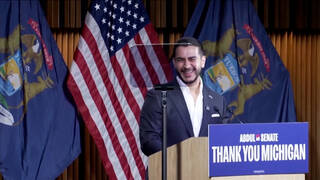
AMY GOODMAN: In Michigan, Democratic Senate candidate Dr. Abdul El-Sayed held a rally in Royal Oak Monday, one day after his Democratic primary challenger Haley Stevens endorsed Republican former Congressman Mike Rogers. Abdul El-Sayed focused in part on affordability.
DR. ABDUL EL-SAYED: Shouldn’t be this hard to afford a second bag of groceries. Shouldn’t be this hard to pay your rent. Shouldn’t be this hard to fill up your tank. And it shouldn’t be this hard to see a doctor in the richest, most powerful country in the world. Shouldn’t be this hard to pay your taxes and know that that money is going to be spent on you and your kids instead of dropping bombs on somebody else and their kids. It shouldn’t be this hard.
AMY GOODMAN: Meanwhile, Michigan Republican Senate candidate Mike Rogers campaigned in Rochester Hills.
MIKE ROGERS: This election was never about how someone prayed. Never. It was always about how you think and what your philosophy and what your ideology is. And we would defend that. My entire family would defend your right to pray the way you want, and I’d go to the ends of the Earth to make sure that happened. But what it wasn’t — what it was about is that angry divisiveness that decided a certain segment of our society is the cause of all the ills in our community.
AMY GOODMAN: While Senate, House and governor races have dominated news coverage, it’s not just candidates on today’s ballot. We’re going to turn first to look at some of the notable ballot initiatives, including a one-time tax on billionaires in California. It’s known as Proposition 40.
We’re joined by Chris Melody Fields Figueredo, executive director of the Ballot Initiative Strategy Center.
Chris, thanks so much for joining us. You know, people go to the polls. They’re hearing nonstop about the candidates. And then they’re faced, in some cases, with a number of ballot initiatives, and they’re not sure how to vote. But if you can talk about what are the ballot initiatives across the country? We’re talking about in, what, almost 40 states, over 145 ballot initiatives that people will be voting on, whether they understand them or not.
CHRIS MELODY FIELDS FIGUEREDO: That’s exactly right. You know, this is a consequential election, and voters are going to be able to vote on democracy itself, whether they can participate in elections, how congressional districts are drawn, whether they will have autonomy of their own bodies. And our economy is on everybody’s minds, and that is going to be before voters, too, especially tax revenue measures that will determine whether we have the funding for public schools, for public goods, for public transportation. It’s an incredibly important election, and voters have the opportunity to take power into their own hands and improve the material conditions of their lives.
AMY GOODMAN: You’ve said that what we’re seeing through the ballot process is part of rising authoritarianism. Can you explain?
CHRIS MELODY FIELDS FIGUEREDO: Yeah. So, what we have been seeing through the initiative process is an attack on the will of the people. And direct democracy itself is on the ballot this year. Quite frankly, politicians are not happy with the power that people have demonstrated at the ballot box, and they are retaliating against voters right now to prevent them from exercising their voices. In competitive authoritarianism, they don’t cancel democracy outright, but they change the rules. They rig the system in favor of extremist lawmakers and special interests to weaken the power that we have in our democracy. And that’s because we’re winning.
AMY GOODMAN: So, let’s talk specifics. You know, it’s very interesting when we look at the role of the world’s first trillionaire, Elon Musk, that he spent close to half a billion dollars on the election cycle across the country. And this record $12 billion is spent on the election, according to Open Secrets. Start in California, and talk about Proposition 40, and then talk about what are the efforts around the country to deal with money and money in politics.
CHRIS MELODY FIELDS FIGUEREDO: Yeah. So, Prop 40 is a one-time, like you said, 5% tax on the assets of billionaires, and it’s expected to generate an estimated $100 billion to fund the state’s public health programs, education, food assistance and more. That’s something that impacts people’s daily lives. And it’s intended to fill massive funding gaps that have let fall because of the federal funding cuts that we are seeing across the country. It applies only to Californians with a net worth of at least $1 billion. That’s about 200 individuals with a combined wealth of $2 trillion. We have heard all election cycle — right? — of how much people want money out of politics, and they want billionaires to pay a fair share so that all of us can benefit in this country.
AMY GOODMAN: Can you talk about what states are voting rights most contested? And talk specifically about specific ballot initiatives that you’re following in different states.
CHRIS MELODY FIELDS FIGUEREDO: Yeah. I mean, we are seeing this is the first election after the Callais decision, after 60 years of the Voting Rights Act, and so democracy itself is on the ballot. You know, we have campaign finance reform. Michigan has Proposal 2, that will ban regulated utilities and block corporations from political campaigns. We have voter ID on the ballot in states like California. We have proof of citizenship. In Missouri, we have redistricting and overturning that gerrymandered maps that we’ve heard in the news, and it has gone up to the Supreme Court, I think, three times.
So, really, across the country, democracy is on the ballot, including direct democracy itself. Like I said before, elected officials are not happy with us exercising our power, so in states like North Dakota, South Dakota are trying to raise the threshold so that we can exercise our ability to put issues on the ballot.
AMY GOODMAN: Talk about the number of ballot initiatives for campaign finance reform.
CHRIS MELODY FIELDS FIGUEREDO: So, we have Michigan’s Proposal 2 that I already mentioned. And then, Montana would also ban corporations, trade association and other, what they call, artificial persons from contributing to candidates, political parties or ballot measure campaigns themselves.
AMY GOODMAN: And can you talk about initiatives seeking to expand reproductive rights?
CHRIS MELODY FIELDS FIGUEREDO: Yeah. So, we are continuing the trend to protect our reproductive freedom across the country — Nevada, Virginia, Idaho. And it’s just really exciting that we are continuing to have this opportunity. And then, in one state, you know, it’s really important to really look at Missouri this year. Not only are they trying to overturn what the voters voted for in 2024 to restore reproductive freedom, they’re also going after gender-affirming care.
AMY GOODMAN: Well, let’s talk about gender-affirming care. Talk about trans rights around the country and how they’re being dealt with through the ballot initiative process.
CHRIS MELODY FIELDS FIGUEREDO: So, in five states, there are seven proposals that will attack transgender youth and their families. These are sports bans. These are bans on gender-affirming care. This is in Colorado, Arizona, Nebraska, Washington. And these are really, really important. This is our opportunity to ensure that we protect transgender youth and their families, and prevent government from really invasive procedures that will harm especially girls in our states.
AMY GOODMAN: Chris Melody Fields Figueredo, I look forward to talking to after Election Day to find out how these initiatives fared. Chris is the executive director of the Ballot Initiative Strategy Center.
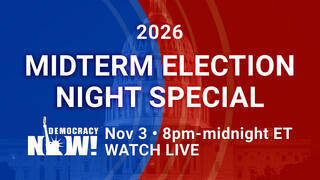
Oh, and tune in tonight for Democracy Now!'s four-hour live election night special, starting at 8 p.m. Join me and Juan González and Nermeen Shaikh and Anjali Kamat and many guests around the country as we stream live at democracynow.org and on our YouTube channel. And you can check your local Democracy Now! station for listings. That's 8 p.m. to midnight Eastern Time.
Coming up, we look at Election Protection. We’ll speak with the NAACP on the group’s attempt to block the Trump administration from deploying a thousand federal agents to polling sites across the country. Stay with us.
[break]
AMY GOODMAN: “I Only Ask God,” popularized by Mercedes Sosa, performed by the Chilean American musician and producer Nicolás Jaar in our Democracy Now! studios. To see our interview with him and his performance, go to democracynow.org.




 Top
Media Options