



 Watch Full Show


Topics
Guests
- Lina Attalaheditor-in-chief of Mada Masr, Egypt’s leading independent media outlet.
Links
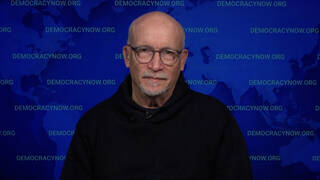
Lina Attalah, editor-in-chief of Egypt’s leading independent news outlet Mada Masr, faces a criminal trial this week on charges of “spreading false information,” just two weeks after being convicted of operating an unlicensed website and fined more than $50,000. A judge also ordered the publication to be shut down. The cases are part of a broader crackdown on independent Egyptian media under the government of President Abdel Fattah el-Sisi, including the arrest of the entire newsroom of another outlet, Matsadaash. More than 100 organizations, including Amnesty International, Human Rights Watch and the Committee to Protect Journalists, have condemned the arrests and prosecutions and called on Egyptian authorities to drop the charges.
“Putting us in jail is not going to solve the country’s problems,” Attalah told Democracy Now! in an interview Friday. “We need to be operating as journalists in our newsrooms as opposed to being defendants in courtrooms.”
Attalah says she and Mada Masr will appeal the ruling to shut them down, hoping to “use this crisis” as a way to fight censorship in Egypt and expand the space for independent reporting.
Related Story
 StoryOct 27, 2026“Dark Day for Journalism”: Egypt Shutters Independent News Site Mada Masr, Detains Editor
Transcript
AMY GOODMAN: This is Democracy Now!, democracynow.org, The War and Peace Report. I’m Amy Goodman.
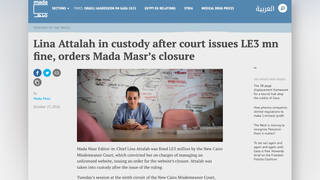
We turn now to the escalating crackdown on press freedom in Egypt. Lina Attalah, the editor-in-chief of Egypt’s leading independent media outlet Mada Masr, faces a criminal trial Wednesday on charges of, quote-unquote, “spreading false information.” Depending on the outcome, she could be imprisoned for a year. The criminal trial comes just two weeks after an Egyptian court convicted Attalah of managing an unlicensed website. She was detained for several hours, fined $50,000, Mada Masr ordered closed.
Mada Masr was founded in June 2013, a year before a military coup led to President Abdel Fattah el-Sisi taking office. Mada publishes in Arabic and English, is internationally recognized for its investigative reporting and editorial independence. It’s continued working over the past 13 years despite repeated website blocking, office raids, staff arrests and judicial harassment.
The attack on Mada Masr follows a crackdown on another independent Egyptian media outlet, Matsadaash, where authorities arrested the entire newsroom, accused them of belonging to the banned Muslim Brotherhood, and forced them to record false confessions under torture.
Over a hundred groups, including Amnesty International, Human Rights Watch and the Committee to Protect Journalists and Reporters Without Borders, have condemned the crackdown on press freedom and called on Egyptian authorities to drop the charges against Lina Attalah, release the Matsadaash journalists and allow independent media to operate freely.
On Friday, Democracy Now!’s Anjali Kamat and I spoke to Lina Attalah. We asked her about the charges she faces and her upcoming trial Wednesday.
LINA ATTALAH: Two weeks ago, I was summoned by the prosecutor for interrogations on accusations of running a website without a license. It is not unusual to be faced with this allegation, even though we’ve been going through the bureaucratic motions of trying to apply for a license and have simply been not getting any response from the licensing authorities.
The new thing that happened two weeks ago is that our case was swiftly referred to trial, and last week we had the first and the very quick verdict already pronounced in this first session. So, Mada Masr was ordered closed. We were fined over $50,000. And I was briefly detained until the fine was collected, which is, again, unusual practice.
The entire trial saw a lot of violations that we’ve been talking about, including the judge refusing all our defense team’s demands. The trial ended with the judge even appointing a lawyer on my behalf. And upon my objection, he already proceeded to pronouncing the verdict that basically closes Mada and charges us a fine of over $50,000, all while I was pulled violently by the cops to a detention spot until the fine was collected.
Upon my release that day, after a very long day, after everybody showed up in solidarity to help us pay the fine, I learned that I’m facing another — a trial, where there could be a charge of one year in prison. So, it does feel like the most violent legal campaign against us in the last years, where we faced other forms of challenges, legal challenges to our work, but we’ve never really reached that level before.
ANJALI KAMAT: And, Lina, are you going to have to shut down Mada Masr? How are you fighting these charges against you and this publication that you co-founded in 2013?
LINA ATTALAH: We are doing everything possible to challenge this verdict. I do not think it’s fair for a media that has served this country for over 13 years, doing what has become very scarce in the country, reporting bravely and independently about everything that’s been happening, not only in Egypt, but also in the region. I do not believe it can be shut down through a court verdict that did not last over an hour, or a court session that did not last over an hour.
So, our plan is to appeal. Our plan is to also try to apply for a license again. And our plan is to use this crisis, as has been our habit, to open up the conversation about how licensing cannot be a tool for censorship and control. Licensing can be a regulating mechanism, but it can be — it cannot be used to shut down independent media in the country. And this should be resolved not only for us, but also for all other media outlets that are trying to work independently in the country.
AMY GOODMAN: Can you tell us about what’s happened with Matsadaash, with the journalists there? Where are they right now? The entire newsroom was arrested?
LINA ATTALAH: An entire newsroom was arrested right before our own ordeal began, which, you know, easily signals how this is a crackdown on all independent voices. And that’s why the sentiment right now is that we’re not just fighting for Mada, but we’re fighting for that very space in Egypt today.
Matsadaash is a fact-checking platform. The newsroom is made up for six brilliant young journalists. I’ve worked personally with four of them as they were starting in their careers. The youngest of them is 21 years old. They are all young, promising journalists who dared to do this work with bravery, courage and curiosity.
They have been arrested over about a month ago, and they remain in remand detention. They are facing terror charges for doing their work. We are still hoping that their ordeal ends, as ours, too. We are hoping for them to be released from detention. They are in detention facilities in Egypt, again, like I said, remand detention. So, we are hoping for this crackdown to stop here and for the authorities to wake up to the fact that the young men of Matsadaash are not their problems, Mada Masr is not their problems. Putting us in jail is not going to solve the country’s problems. And the wise thing to do is to drop the charges against us and against them, and to release them right away.
ANJALI KAMAT: And, Lina, can you talk about the timing of this escalating crackdown on the press? This is coming as, you know, in the middle of this crackdown, we saw a surprise announcement from the Egyptian President Abdel Fattah el-Sisi that he would be stepping down in 2030, at the end of his third and current term. Never in Egypt’s modern history has the head of state chosen to hand over power voluntarily. What does this mean for the future of Egypt and the space for dissent?
LINA ATTALAH: It is a very charged moment in the country, politically and economically. Politically, we’re not just talking about what’s happening on the local level; we’re also talking about regional challenges with surrounding conflicts, the Red Sea conflict, the war in Iran, and Egypt is not isolated from that. It is — it is a pressuring situation on the country and on the authorities here.
At the same time, the announcements that you mentioned point to a certain shift that might be happening, that, unfortunately, we couldn’t get a chance to report on properly because we’ve been having to face all these legal ordeals ever since the announcements were made. But we do have the sense that something in the mode of rule is shifting. And that’s why we need to be operating as journalists in our newsrooms, as opposed to being defendants in courtrooms, to understand what is happening.
And then, you know, the other context in which this crackdown is happening is a major economic challenge. You know, Egypt has been heavily integrated in the global economy, especially after 2016. So it’s been heavily affected with global shifts, market shifts, having become, having turned into so-called an emerging market and being quite dependent on hot money. We have major debt service to commit to. We have a gas bill to pay. So the country is also going through an important economic challenge that is getting more and more pronounced on a day-to-day level. So, I would say this is the political and economic context under which these decisions against us are being made, and it’s important to note them.
AMY GOODMAN: I wanted to ask you, Lina, about the amount of money from the United States — I think it’s second only after Israel, U.S. sending Egypt one-and-a-half billion dollars in military aid each year — and the significance of the timing of U.S. Secretary of State Marco Rubio waiving this restriction on $320 million in military aid to Egypt that was previously withheld over human rights concerns. In the past month, he has waived this, the State Department citing Egypt’s, quote, “helpful role” in the war with Iran, and, said Rubio, signed off on the waiver in the interest of U.S. national security. Do you think this timing of your trial — as you said, you want to be reporting, not fighting in court — is related to your trial and the charges brought against you, to keep you quiet and a message to all the press in Egypt: “This is what you could face if human rights concerns are raised”?
LINA ATTALAH: So, Amy, we cannot, obviously, establish direct causalities. Again, we haven’t had the chance to report properly on this.
But also, it is not unprecedented that the U.S. administration does this, applies this mechanism of the waiver, you know, in previous cycles of the military aid of $1.3 billion. In recent years, it has always been pegged to the fact that Egypt is playing an important role, be it in negotiating a ceasefire in Gaza. Currently, it’s been pegged to its role in negotiations on the Iran front.
But all of this, if it’s signaling something, it’s signaling this rising belief amongst Western powers that have alliances and key alliances in Egypt that its — the stability of the country in the midst of so many regional wars and regional turmoils rests solely on the authority of those who are ruling. It’s a political calculus that has proven wrong in previous times, meaning that stability does not rest on how those in power rule alone, but also it rests on the political and economic health of the people. And we have a lot of issues there.
And we always say that the work of independent media is an important, actually, stabilizing factor, because instead of people having no outlets to ask questions, understand what’s happening, now all these spaces are being shut, and people are left alone to implode. So, I do believe that it continues to be the wrong political calculation, even though it has been prevalent in recent years.
ANJALI KAMAT: Lina, can you, you know, for our audience, that doesn’t — might not be so familiar with Mada Masr, can you talk a little bit about the history of Mada and how and why you founded it in 2013, and how you’ve managed to keep it alive despite so many attempts to shut it down? And talk also a little bit about the kind of investigative stories that Mada is known for.
LINA ATTALAH: So, we started publishing in the summer of 2013. We are a group of journalists. We had just been fired from another media, again because of political disagreements and economic restraints. And at the same time, it was a summer of major political transformation in the country. So, we had a Muslim Brotherhood elected leader to the presidency who was arrested or who was ousted from power by the military authorities. We had a military takeover. A year after, we have President Abdel Fattah el-Sisi taking over, and he was here to stay until today.
So, back then, we felt that this is going to be the beginning of a new era in terms of the mode of rule, in terms of the mode of authority that we are being subjected to. And we also saw that — or, foresaw that there won’t be any independent media out there who could report about that. So we thought maybe we should begin instituting an experiment that can house this kind of journalism, that can create a record on the goal of what is happening, what’s going on, to basically provide this companionship for the people in trying to understand what this transformation is looking like.
What kept us staying, up until today, is none other than the journalism itself. You create valued journalism — and this is something that we learned from Democracy Now! and other important independent media — and, you know, it provides you with the force and the power to stay even in the hardest of circumstances. I do believe that it is our journalism that kept us safe. The credibility of it is what kept us protected, because it also builds support around it, and it created this necessity.
Authorities rule with the understanding that people don’t need to know, and this is — this is not right. People do need to know. People who read Mada and other independent media, people who follow Matsadaash, are are not necessarily people who are aligned with us politically or people who know us. They are people who need to understand what’s happening at a moment where there are lesser and lesser spaces for independent media practice.
Our investigative work spans, you know, many areas and topics. We have started, for example, the investigation into Senator Menendez’s practices by reporting about the halal meat certification that he provided support for to an Egyptian businessman who is tied to the Egyptian authorities here. So, it was an investigation that we started in our Cairo newsroom, and then, you know, it sprang out into something much bigger, which you have followed very closely, amongst other American media. We’ve published investigations about, you know, how authorities have engineered different parliamentary elections since 2013 up until now, investigations into the current genocide in Gaza. So, yeah, the work we’ve done and the investigative work we’ve done spans different topics and areas.
ANJALI KAMAT: How can our audience do more to support independent media in Egypt and support you and Mada Masr?
LINA ATTALAH: We’ve been saying that whoever has any tools, they need to find them and use them. So, if you still live in a context where a democratic practice remains — and this is something that we have seen in the U.S. in the past days — then let’s use these tools. Let’s speak to representatives. Let’s make them aware. Let’s ask — let’s ask for statements. Let’s ask for support. Let’s write about these independent media.
And let’s write about and talk about these issues, not from the vantage point that these are distant newsrooms in the Third World, in Egypt, but this is a shared struggle for our right to independent media, which isn’t also something that’s far from democratic contexts. Independent media is struggling everywhere. And by choosing to support us and Matsadaash and other independent media in the region, one chooses also to support this kind of practice back at home.
AMY GOODMAN: And finally, Lina, Zazu Goodpup, one of the leading news hounds in the United States, wanted to express her support. She demanded to come into our studio, because she knows how much you care about little critters like her and that you have news hounds yourself at Mada Masr. I’m wondering, personally, how you’re preparing for this, you and your family.
LINA ATTALAH: First of all, all my love to Zazu and to our animals and our pets, friends who have been a massive source of affective support to us in this difficult time. My team and myself, we are busy with defense strategy, with support campaigns, with doing interviews. And in the evenings, we just spend time with our families to sort of calm them down and tell them that even though we are a little bit scared, but also we’re a little bit hopeful.
AMY GOODMAN: Lina Attalah, editor-in-chief of Egypt’s leading independent media outlet Mada Masr, which the government has ordered closed. She spoke to us from Cairo. She faces a criminal trial Wednesday on charges of, quote-unquote, “spreading false information.” If found guilty, she faces up to a year in prison.
And that does it for today’s show. Happy birthday to Diana Parra! Oh, and Steal This Story, Please!, the documentary about Democracy Now!, is now available on many streaming platforms in the U.S. and Canada, from Amazon Prime to YouTube to Apple TV and Google Play. Go to StealThisStory.org to see where you can watch it. And Democracy Now! — the film about Democracy Now!, Steal This Story, Please!, will be at the IFC in New York, 4:30 on November 11th, Wednesday. I’ll be speaking after in the Q&A with the film’s Oscar-nominated directors Tia Lessin and Carl Deal. I’m Amy Goodman. Thanks for joining us.



 Top
Media Options