











 Watch Full Show

As U.S. and Iranian officials continue negotiations over Iran’s nuclear program, President Trump has ordered a buildup of U.S. forces in the Middle East, including two aircraft carriers. “This is an extremely dangerous situation, which both sides are actually incentivized to escalate,” says Trita Parsi, executive vice president of the Quincy Institute for Responsible Statecraft. “Both sides actually believe that a short, intense war may improve their negotiating position.”
Related Story
 StoryJul 09, 2026“A Disastrous Development”: Trita Parsi on Breakdown of U.S.-Iran Ceasefire
Transcript
AMY GOODMAN: This is Democracy Now!, democracynow.org. I’m Amy Goodman, with Juan González.
We turn now to news from the latest round of talks between U.S. and Iranian officials, which took place in Geneva, Switzerland, Tuesday against a backdrop of heightened saber-rattling between the two nations, President Trump has ordered a buildup of U.S. forces in the region, including two aircraft carriers, dozens of warships, hundreds of fighter jets and multiple air defense systems. On Friday, President Trump told reporters regime change in Iran would, quote, “be the best thing that could happen,” unquote.
Shortly after the talks began, Iran temporarily closed the Strait of Hormuz, a key international waterway, and Supreme Leader Ayatollah Ali Khamenei warned, quote, “The strongest army in the world might sometimes receive such a slap that it cannot get back on its feet,” unquote.
After Tuesday’s talks, Tehran’s foreign minister cautioned more work still needs to be done on reaching a nuclear deal, but expressed some optimism about the negotiations.
ABBAS ARAGHCHI: [translated] I can say that in this round there were quite serious discussions and a more constructive atmosphere than in the previous round. Various ideas were raised, and these ideas were seriously discussed. And finally, we were able to reach a general agreement on a series of guiding principles. From now on, we will move based on those principles and enter into the text of a possible agreement.
AMY GOODMAN: Three unnamed Iranian officials told The New York Times Iran had indicated an openness to suspend nuclear enrichment for three to five years in exchange for lifting sanctions and the embargo on its oil sales. Vice President JD Vance, speaking on Fox News, painted a more mixed picture of the talks.
VICE PRESIDENT JD VANCE: I think the president has a lot of options. We do have a very powerful military. The president’s shown a willingness to use it. He also has a remarkable diplomatic team. He’s shown a willingness to use that, too. And so, what the president has been very clear with the Iranians — and, actually, I just talked to Steve Witkoff and Jared Kushner this morning about some of the negotiations — is the United States has certain red lines. Our primary interest here is we don’t want Iran to get a nuclear weapon.
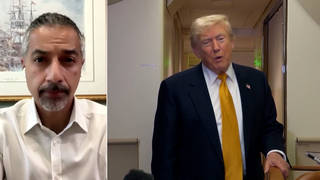
AMY GOODMAN: For more, we’re joined in Washington, D.C., by Trita Parsi, executive vice president of the Quincy Institute for Responsible Statecraft, author of several books, including Losing an Enemy: Obama, Iran, and the Triumph of Diplomacy.
Trita Parsi, talk about what’s happening in Geneva, the U.S. moving in aircraft carriers, one the largest in the world, the USS Gerald Ford, which he had just previously, Trump had, off the coast of Venezuela, where they attacked Venezuela and then abducted the president, Maduro, and his wife.
TRITA PARSI: We have a very dangerous situation, because both sides actually believe that a short, intense war may improve their negotiating position. The Trump administration, of course, believes that because of its overwhelming military power that it has now gathered in the vicinity of Iran, it will be able to take out Iran militarily rather quickly and then force it to capitulate. The Iranians have a different calculation. They believe that they have the ability to inflict significant damage on the United States in the short term, including on civilian oil installations in the region, closing down the Strait of Hormuz, that would shoot up oil prices, and the initial cost of this to the United States would be so immense, and the United States would recognize that it would have to go for a longer war, which it cannot afford, and as a result, it would get the United States to back off.
Essentially, the Iranians are counting on the U.S. having a much lower threshold for pain tolerance than what the Iranians have. And they’re basing this partly on how the Houthis fought back against the U.S. for several weeks, and eventually Trump, essentially, lost interest in it and did not want to have a prolonged conflict and backed off. The difference, however, is the Houthis never managed to kill an American soldier. They tried, but they didn’t manage. And we have not been in a situation in which 30, 50, perhaps 200 American soldiers are killed under Donald Trump’s watch, so we do not know how his psychology will react to that type of scenario. So this is an extremely dangerous situation in which both sides are actually incentivized to escalate, with calculations that are completely contradictory to each other’s.
JUAN GONZÁLEZ: And, Trita, what is your sense of the — if hostilities do resume again and the U.S. attacks, the impact on the wider region, the potential, let’s say, worst-case scenario for the region?
TRITA PARSI: Well, the region, by and large, with the exception of Israel and perhaps the Emirates, are completely against this for a variety of reasons. And they’ve played a very crucial role in trying to deescalate the situation and find a diplomatic solution. The talks in Geneva, for instance, were hosted by the Omani foreign minister at their embassy.
You know, you have several factors here. On the one hand, of course, these countries are very worried about the instability. They do not believe that there will be some sort of a clean regime change in Iran, but rather that it will be a state collapse, potentially civil war, massive amounts of refugees flowing into other countries in the region, secessionist movements on the borders that will take advantage of the situation, a scenario that would be very problematic for Pakistan with the Baluchis, for Iraq with the Kurds, for the Turks with the Kurds and with the Azeris. And as a result, they’ve really stepped in.
Now, one thing that is very important to understand is that these factors were present in the past, as well, and in the past, some of these countries were favorable towards a military confrontation, such as Saudi Arabia. They’ve changed their minds, not just because of these consequences, but because of a deeper geopolitical change that has occurred in the region. Right now Iran is much weakened, and Israel has become much stronger and completely unrestrained. The United States, since the time of the Biden administration, has essentially lifted all constraints on Israel. Israel is allowed to not only violate international law, but also violate American law, and then the governments or the administration of the Biden team, as well as the Trump team, have essentially violated American law by lying on behalf of Israel in Congress — at least the Biden administration did this.
This has now created a situation in which many of these countries in the region have now realized that their alliance with the United States does not protect them against Israel. Israel has attacked seven countries in the region since October 7th, including Qatar, who has some of the best air defense systems that the United States has put there. But apparently those American air defense systems were not activated when the Israelis attacked. So, if an alliance with Israel — with the United States cannot help balance against Israel, then these countries have concluded that they need to create their own arrangement to be able to balance against what they see an increasingly aggressive Israel that is seeking regional hegemony.
Iran is not part of that constellation, but it is a de facto buffer between these countries. And this is Turkey, this is Saudi Arabia, this is Qatar, this is Pakistan, perhaps Egypt. It’s a buffer between them and Israel. And as a result, they have this added reason to want to prevent this war, because they need that buffer; otherwise, they believe, they will be the targets, the next targets, of the Israeli state.
JUAN GONZÁLEZ: And I’m wondering — there’s been a lot of media attention in the U.S. and in Europe, interviews with the — Iran’s exiled Crown Prince Reza Pahlavi. I’m wondering your sense of why so much fixation on this almost relic of past institutions in Iran.
TRITA PARSI: Well, the son of the former shah has emerged as a voice that some people in the diaspora have surrounded, have lent their support to. He clearly has a tremendous amount of support from Israel. He has closely allied himself with the Israelis. He supported the Israeli war in June. He is calling for military intervention, either by Israel or the United States, in this case.
And what we have seen over the course of the last two decades is a dramatic radicalization of the population as a result of both the brutality, the repression of the Iranian regime, in which it has refused to meet the demands of society — by and large, there’s been a couple of exceptions, but in reality, Iran is more closed, more repressive today than it was 20 years ago — and, on the other hand, policies driven by the United States and the West, as well as supported by people like Reza Pahlavi, that have sought to sanction the Iranian economy to oblivion, to destroy much of its resources and wealth, and, as a result, impoverish the population and drive them to a point of desperation in which they now have become so desperate — not all, of course, but a portion of them, a very loud portion, have become so desperate — that they are even yearning for their country to be bombed as a way of getting rid of the current government there.
And this is a dramatic development, mindful of the fact that Iran is right next to Afghanistan, right next to Syria and Iraq, and have seen what these military interventions have produced in these countries, which is absolute disasters. But the combination of the repression of the theocracy and the manner in which the sanctions have destroyed the livelihood of ordinary Iranians have driven them to this point of desperation, in which some — again, not a majority, but a loud number of people — are now calling for this, and Reza Pahlavi has become the main channel for the demand for military intervention.
AMY GOODMAN: And we just have 30 seconds, but, Trita Parsi, we’ve talked to so many allies of the protesters who are anti-regime in Iran, but also anti-intervention.
TRITA PARSI: Absolutely. I would still say that there is a majority that are completely against invention, but their voices are more or less not being heard in the mainstream media. And I think this is very much because of the support of certain elements to elevate the voices for intervention. And we’re seeing exactly what we saw during the Iraq War, in which a large number of pro-intervention Iraqi voices were paraded through mainstream media in order to give the impression that not only is this something that is supported by the overwhelming majority of the Iraqi society, but also that this is the morally right thing to do. And I find that to be very, very questionable.
AMY GOODMAN: Trita Parsi, we want to thank you for being with us, executive vice president of the Quincy Institute for Responsible Statecraft, author of several books, including Losing an Enemy: Obama, Iran, and the Triumph of Diplomacy.
Coming up, we speak to Alexis Goldstein. She was just fired from the Consumer Financial Protection Bureau. We’ll also speak to New Jersey congressional candidate, labor activist Analilia Mejía. Stay with us.
[break]
AMY GOODMAN: “I Fly” by the late, legendary pianist and composer Randy Weston.



 Top
Top
Media Options