






 Watch Full Show

Cuban exiles on a U.S.-registered speedboat attempted to enter Cuba undetected but were confronted by border patrol in Cuban waters on Wednesday. According to the Cuban Interior Ministry, the Cuban nationals on the speedboat fired on the border agents, who then returned fire, killing four and injuring six of the men. This comes as the Trump administration’s blockade of fuel has triggered a severe humanitarian and economic crisis in Cuba, compounding the impact of the U.S. economic embargo in place since 1962. In response to the growing humanitarian crisis, activists are organizing a flotilla to deliver aid to the island. “We cannot allow us to go back to the days of gunboat diplomacy, where the U.S. thinks that it is allowed to violate sovereign nations and it can have hegemony over the hemisphere,” says CodePink co-founder Medea Benjamin, who is taking part in the flotilla. “These are sovereign countries. We must leave them alone.”
Related Story
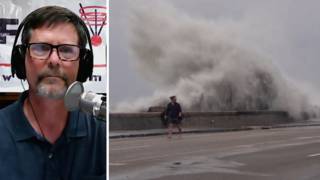
 StorySep 28, 2022Tampa Update on Hurricane Ian: Millions Prepare for Cat. 5 Storm Fueled by the Climate Crisis
Transcript
NERMEEN SHAIKH: Four Cuban exiles were killed Wednesday in a shootout between Cuban border troops and a Florida-registered speedboat carrying 10 Cuban exiles. According to the Cuban government, the men on the speedboat opened fire when Cuban border troops approached the boat for an inspection off the northeast coast of Cuba. The Cuban troops then fired back, killing four of the six men. Six others were injured and are now being held in Cuba.
AMY GOODMAN: The Cuban government says the men were attempting to carry out, quote, “an infiltration with terrorist ends,” unquote. Cuban media reports the men were carrying weapons, Molotov cocktails, bulletproof jackets and camouflage gear.
Cuban Foreign Minister Bruno Rodríguez said, quote, “Cuba has had to face numerous terrorist and aggressive infiltrations from the United States since 1959 with a high cost in lives, injuries and material damage. A rigorous investigation is being carried out to clarify the facts,” he said.
On Wednesday, U.S. Secretary of State Marco Rubio said the U.S. will investigate what happened.
SECRETARY OF STATE MARCO RUBIO: Suffice it to say, it is highly unusual to see shootouts in open sea like that. It’s not something that happens every day. It’s something, frankly, that hasn’t happened with Cuba in a very long time. But we’re going to find out. We’re not going to base our conclusions on what they’ve told us.
NERMEEN SHAIKH: Marco Rubio, who’s Cuban American, was speaking at a gathering of Caribbean leaders in Saint Kitts and Nevis. At the meeting, regional leaders expressed alarm about the growing humanitarian crisis in Cuba due to a U.S. oil blockade that has cut off the island from desperately needed fuel.
The Trump administration recently threatened new tariffs against any nation that sends fuel to Cuba, which has been under a U.S. economic embargo since 1962. The U.S. has been ratcheting up pressure on Cuba since early January, when U.S. forces attacked Venezuela and abducted Venezuelan President Nicolás Maduro and his wife Cilia Flores.
AMY GOODMAN: On Wednesday, the Treasury Department announced it would partially ease the blockade and allow Cuba’s private sector to import Venezuelan oil, but restrictions remain on the Cuban government. The U.S. move is widely seen as another attempt by the Trump administration to weaken the Cuban government.
We go now to Medea Benjamin, co-founder of CodePink. She was in Cuba two weeks ago providing humanitarian aid. She was also just in Venezuela. CodePink, the Progressive International and other organizations are planning to launch a land, sea and air humanitarian solidarity mission to Cuba in late March.
So, if you can deal with this breaking news, the 10 Cuban men, apparently, in a speedboat headed to Cuba? Explain what you understand happened. At this point, four are now dead, six have been taken by Cuba.
MEDEA BENJAMIN: I understand that a boat that was carrying weapons and people who were going to infiltrate Cuban waters — and somehow escaped the U.S. Coast Guard, because they’re not allowed to even go to Cuba — managed to get within one mile of Cuba’s northern province of Santa Clara, and that they were approached by a Cuban coast guard that wanted their identification. The U.S. boat opened fire, and in the shootout there were four Cubans living in the United States who were killed, and six were wounded.
I should say that when the U.S. blows up boats in the Caribbean, when there are people in those boats that weren’t killed, it goes back to kill them all. Instead, Cuba took the six to a hospital for treatment. I also want to say that the brother of one of those murders said — it was quoted in the AP story today — that his brother had fallen into a diabolical and obsessive quest to change the Cuban government. A diabolical and obsessive quest. And I think that characterizes U.S. policy for the last 60-plus years.
NERMEEN SHAIKH: So, Medea, could you say a little bit more — what is known about these 10, the four killed, the six detained? Were they all Cuban nationals? Any of them American citizens?
MEDEA BENJAMIN: They were all Cuban nationals living in the U.S. in Florida. Two of them were on a Cuban wanted list for prior criminal activities, attempts at terrorism. And we are learning as the time goes by about the others of them.
This has happened before. While Marco Rubio said it’s unusual to have a shootout in the seas, that’s true, but it is not unusual to have terrorists infiltrating Cuban territory. In fact, there are in the history blowing up of tourist hotels, so that tourists would be afraid to go to Cuba, and constant attempts to infiltrate. Of course, there were hundreds of attempts to kill Fidel Castro.
The southern Florida Cubans are obsessive and diabolical. And they must be stopped. And unfortunately, they are represented in our government, in our Congress, by people like Representative Maria Salazar and also by Carlos Giménez and Díaz-Balart. And they’re represented at the highest level of government by our U.S. Secretary of State Marco Rubio.
NERMEEN SHAIKH: Well, let’s go to Secretary of State Marco Rubio, who is, as we mentioned earlier, Cuban American, speaking on Wednesday.
SECRETARY OF STATE MARCO RUBIO: What the Cuban people should know is this, that if they are hungry and they are suffering, it’s not because we’re not prepared to help them. We are. It’s that the people standing in the way of us helping them is their Communist Party. That’s who’s standing in the way. If they move out of the way, we’re more than happy to work with individual Cubans so they can have an opportunity to feed their families and build their economy. But we are not the impediment. They are.
NERMEEN SHAIKH: So, Medea, that is Marco Rubio. If you could explain? You were just in Cuba a couple of weeks ago. I mean, Cuba has been under sanctions — sorry, a U.S. embargo since 1962. But explain what’s happened in the last months, when sanctions have been so tightened that prices are so high for basic items — I mean, as he mentioned, people are hungry — that they’re totally out of reach, and also the food scarcity that there is now in Cuba.
MEDEA BENJAMIN: Yeah, what Marco Rubio said would be laughable were it not so tragic. On January 11th, Donald Trump said that no oil and no money would be going to Cuba. Zero. This is, as you said, a policy that has been going on for over six decades now, and it has been tightened in such a medieval siege type of way by Donald Trump.
To stop all oil from going to Cuba has created a terrible crisis, where workers don’t have transportation to get to work. When they get to work, there’s no electricity. Students are having a hard time getting to school. The hospitals are having a hard time functioning. There’s a terrible scarcity of medicines. The food is scarce and high-priced. Farmers now don’t have access to irrigation or fuel for tractors. This is a tragedy that’s been going on and has been exacerbated since COVID.
And with U.S. policies of putting Cuba on the state sponsor of terrorism list, which is something Donald Trump did — and, unfortunately, Biden waited 'til the last week of his presidency to lift, and then it was put on right again — this means that Cuba can't function in the world trade system. It can’t use the international banks. These sanctions that the U.S. put on are not just to stop U.S. companies. They’re designed to stop other countries and companies around the world from dealing with Cuba.
And so, you don’t have fuel. The garbage piles up in the streets. The mosquitoes proliferate. Mosquito-borne diseases proliferate. There’s not the ability in the hospitals to take care of people. Cuba, once known for a lower infant mortality rate than in the United States, now infant mortality rate is rising. This is a tragedy. It’s condemned every year by the world community, by everybody except the United States and Israel, and yet it keeps going on. And I think now, finally, the world community, and especially in Latin America, is rising up to say, “No, we cannot let this keep going on.”
AMY GOODMAN: Canada has announced $8 million in funding for Cuba as the country grapples with President Trump’s oil embargo, as the U.N. warns of a humanitarian catastrophe in Cuba. Can you talk about what CodePink, Progressive International and other groups are doing? Talk about what you plan for the next weeks.
MEDEA BENJAMIN: Yeah, we are excited to announce that on March 21st, there will be a convergence in Havana of people arising, getting there by boat, by plane. There are also a group, The People’s Forum, that will be collecting and is collecting lots of solar panels, taking them through Mexico to ship to Cuba. And people can also come on their own. We have chartered a plane from Miami that will fit a hundred people. And we will be going — the delegation that is CodePink, Progressive International and Global Health Partners — leaving on March 20th to 23rd. You can join us. Go to the CodePink.org page, and it’s the first thing that will pop up.
This is a time actually to go to Cuba. The Cubans have asked people to come in solidarity, to see the conditions there for themselves. We have to, especially in the United States, where we have such a responsibility for this catastrophe that is going on right now. We have to go there, we have to raise money for Cuba, and we have to protest Cuba policies in Congress. Call your congressperson. We have to show Marco Rubio that the U.S. community is absolutely opposed to a policy designed to create hunger and desperation.
AMY GOODMAN: Finally, you also just came back from Venezuela. We’re in New York, not far from where the Venezuelan President Nicolás Maduro and his wife are imprisoned at the detention center in Brooklyn. The USS Gerald Ford, the largest aircraft carrier that was used in that attack and the abduction, is now nearing Iran in a massive military buildup. Not clear if Venezuela, the U.S. attack there, will be the model for perhaps an attack on Iran. But tell us about, in this last minute, what you found in Venezuela.
MEDEA BENJAMIN: We found that people are horrified by what the U.S. did of coming in and abducting their president and the first lady on bogus charges. People also are horrified that the U.S. people don’t even know or care that over 120 people were killed in that operation, also that there has been this economic warfare against Venezuela, as well, designed to create hunger and designed — and led to a mass migration that then the U.S. doesn’t want the Venezuelans here anymore. They create the problem and then go in and say, “OK, we’re going to fix it. We’re going to take Venezuela’s oil and rev up production.” But it was the U.S. that led to the decline of the production by not allowing the spare parts to come in, by not allowing the companies to actually work there.
So, we’re calling for the freedom of Nicolás Maduro and Cilia Flores. We’re calling for a lifting of the sanctions, because they haven’t been lifted. We’re calling for the U.S. to recognize the government now of acting President Delcy Rodríguez so that there can be diplomatic relations.
But I just want to say, to close, that this is a time of the Monroe Doctrine being accelerated now to the “Donroe Doctrine,” where the U.S. thinks that it can go into any country in Latin America, and now they’re focusing on Venezuela and Cuba, but they have their sights set on Colombia, on Mexico, on other places. And that we cannot allow us to go back to the days of gunboat diplomacy, where the U.S. thinks that it is allowed to violate sovereign nations and it can have hegemony over the hemisphere. These are sovereign countries. We must leave them alone.
AMY GOODMAN: Medea Benjamin, co-founder of CodePink, was just in Cuba providing humanitarian aid. CodePink, along with Progressive International and other groups are leading a land, sea and air humanitarian solidarity mission to Cuba later in March. We’ll link to your new article, “Suffocating an Island: What the US Blockade Is Doing to the People of Cuba.”
Coming up, an 11-month investigation by Forensic Architecture and Earshot has uncovered how Israeli forces killed 15 Palestinian aid workers a year ago, then tried to cover it up. Back in 30 seconds.
[break]
AMY GOODMAN: The New York City Palestinian Youth Choir performing “Ounadikoum,” “I Call Out to You,” at the historic Riverside Church.




 Top
Top
Media Options