









 Watch Full Show

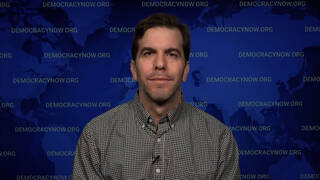
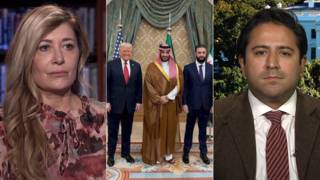
We speak with Kareem Shaheen, Middle East editor at New Lines Magazine, about the regional response to the U.S.-Israeli war against Iran. He says the Gulf countries are in a no-win situation, stuck between a belligerent Israel that has no qualms about using violence to achieve its strategic aims and a desperate Iran lashing out against U.S. allies in the region as it tries to survive. He says that no matter which side prevails, Gulf states have realized how vulnerable they are despite U.S. security guarantees. “In either scenario, I don’t think that the Gulf states will be happy with the outcome,” he says.
Shaheen’s recent article is “The Gulf Fears Whoever Wins This War.”
Related Story
 StoryMay 14, 2025U.S. & Saudis Sign $142B Arms Deal as Trump Meets with Syria’s New Leader & Drops Syrian Sanctions
Transcript
AMY GOODMAN: This is Democracy Now!, democracynow.org. I’m Amy Goodman, with Juan González.
As we continue our coverage of the U.S.-Israeli war on Iran, we turn now to look at how Gulf nations are responding. Earlier today, Iran reportedly fired drones toward Saudi Arabia, Kuwait and United Arab Emirates, where a large fire broke out in an industrial area home to petrochemical plants. A suspected Iranian missile also hit a residential building in the capital of Bahrain, killing one person and injuring eight others.
We go now to Kareem Shaheen, Middle East editor for New Lines Magazine. His recent piece is headlined “The Gulf Fears Whoever Wins This War.” He grew up in Dubai, joining us now from Montreal.
Why don’t you explain that headline, “The Gulf Fears Whoever Wins This War,” Kareem?
KAREEM SHAHEEN: Thank you for having me, first of all.
I think whether — if we’re looking at these different scenarios of how this war ends, first of all, we can see a scenario where the Iranian regime survives in the guise of Mojtaba Khamenei, the son of the former ayatollah, which will persist in its policies towards the Gulf. Only now it realizes that it can sway American policy, that it can expand its target list in the Gulf from what everyone expected it to be, which was American military bases, to various economic assets, to various diplomatic assets, embassies, consulates, to energy infrastructure, to desalination plants, to the broader way of life in the Gulf that has for the past few decades tried to market itself as this haven for people from the region and for expatriates from the West to come and work and do business and live their life in isolation almost, in a silo, from all the instability and chaos that’s been going on in the Middle East for the past few years and for the past few decades, and where you can be peaceful and multicultural societies. And that’s what Iran ultimately targeted through its extensive barrages and missiles and drone strikes that have taken place all across the Gulf. Only now it’s going to be this glowering Iran that has managed to survive this American and Israeli onslaught, knows that it can target all of these different assets belonging to the Gulf and not really face any major consequences and be able to sway American policy with it.
Now, on the other hand, if Israel is the one that emerges victorious out of this conflict, and the U.S. emerges victorious, as well, unlikely as it may be in the case of regime change — we’ve never seen regime change in the region without a ground invasion, without ground troops, and based on Donald Trump’s comments yesterday, the U.S. doesn’t seem to have the appetite for that sort of invasion. But if Israel does win and the Iranian regime and the system overall gets obliterated, then Israel emerges as the hegemon in the region. And Israel has proven over the past few years that it does not mind deploying force and an aerial power to achieve its political objectives in the region against its enemies, first and foremost. But if these conflicts continue to persist and Israel continues to seek out enemies in the region to neutralize, whether that’s Iran today and perhaps Turkey tomorrow, it’s shown that it’s willing to deploy its enormous military power and force, with the U.S. cheering in the background, to carry out these objectives.
And I don’t think that the Gulf states are — the Gulf states would like to replace one hegemon with another. But for now they’re focused on the regional power that has been bombing their energy infrastructure, that has been bombing their real estate, that has been bombing, you know, civilians, and they’re trying to sort of focus on minimizing the risk there, which is why all of the messaging that has been coming out of the Gulf has been “We are not involved in this war. We will defend ourselves if we have to, but we are not involved in this war. We’re not giving over our airspace and bases over to the Americans to launch attacks on Iran. We want nothing to do with this.” And obviously they lobbied the U.S. prior to the conflict, predicting that this is exactly what would happen if the U.S. was to bomb Iran. And we’re seeing all of these scenarios play out right now.
But what the end point is, obviously, nobody knows. Only Donald Trump knows. But we’ll get to that eventually. But whichever scenario emerges out of this, whether it’s an ascendant Iran that is very confident in its ability to strike at its neighbors with very little consequence, or if it’s an Israel that’s empowered by the absence of any regional rivals that can compete with it or that can push back against its objectives in the region — in either scenario, I don’t think that the Gulf states will be happy with the outcome.
JUAN GONZÁLEZ: But, Kareem, I wanted to ask you about — a little further on this issue of where the Gulf states will land after the conflict. Everything that was happening before this indicated that, especially in the wake of the so-called Abraham Accords, that the Gulf states were trying to maneuver in a way to reconcile with Israel and to be able to continue to conduct business in the region. But I was struck especially by this open letter that one of the billionaire CEOs, the chairman of Al Habtoor Group in the UAE, Khalaf Al Habtoor, posted publicly this past week, where he — a direct open letter to President Trump. And he wrote — I quote — “Who gave you the authority to drag our region into a war with #Iran? And on what basis did you make this dangerous decision? Did you calculate the collateral damage before pulling the trigger? And did you consider that the first to suffer from this escalation will be the countries of the region itself!” So, clearly, it seems that many people within the Gulf states are now questioning to what degree they expose themselves by being so close to the United States and allowing all of these bases to be put on their soil in terms of this now-developing conflict. I’m wondering your thoughts on that.
KAREEM SHAHEEN: Correct, yes. I mean, the entire security arrangement in the Gulf was based on U.S. security architecture, that America was going to protect all of these Gulf countries from Iran in the event of a conflict. This scenario of missiles raining on Gulf cities has been envisioned, obviously, for a very long time, and they’ve been trying to create some sort of precautionary measures against it. The UAE in particular has been the target of the vast majority of Iran’s missile capabilities, outside of Israel. They’ve been — they’ve had to intercept so many drones and missiles using American-provided systems, you know, THAAD and Patriot, as well as some locally developed systems, in order to protect themselves. But the reality that they’re realizing right now is that it’s this American security architecture that is the cause of the instability, that is the cause of the war that has started and that they’ve lobbied so hard against.
Khalaf Al Habtoor, the businessman you’re referring to, he’s one of the icons of Dubai’s real estate. He was one of the people who truly built the modern — the modern city of Dubai, one of its chief architects, and is incredibly close to the ruling families in Dubai and Abu Dhabi. And so, you oftentimes expect that these sorts of messages that come out of these prominent figures, public figures, tend to be proxies of what the governments and the people who actually wield power in these countries — the messages that they want to deliver to the U.S., but, you know, without the directness of leader-to-leader statements. They obviously have to, you know, maintain a cordial relationship with the American president, no matter who it is, because that’s what their security depends on. But, ultimately, what they’re realizing is that this security architecture itself has, in fact, brought this war upon them.
Now, this does not say that Iran is not at fault. These Gulf countries feel immensely betrayed by what Iran has been doing, particularly, you know, countries like Qatar, which has had strong diplomatic relations with the Iranians. They’ve, in fact, you know, suffered isolation from other Gulf countries because of this close relationship. Qatar has mediated the end of conflicts between Iran and the U.S. in the past. And during the previous war, in June last year, Qatar got bombed while it was in the middle of negotiating a truce between between the U.S. and Iran. And they continued to — they were very angry about it, obviously, but they continued to negotiate in good faith, and they continued to try and bring peace to the region.
But in the meantime, this security architecture is itself the cause of instability and the cause of danger for these Gulf states. They’ve tried very hard to push back against and to lobby against the U.S. involvement in this war, which nobody is entirely clear as to the rationale behind doing it in the first place. But yeah, over the past few years, the Abraham Accords suffered the major setback with the war on Gaza and with the destruction of the Palestinian people there. And that has made it incredibly unpalatable for a country like Saudi Arabia, which had a lot of interest in pursuing peace with Israel, to do so, given the immense public distaste and anger at the violence that was taking place in Gaza. And now —
JUAN GONZÁLEZ: And, Kareem —
KAREEM SHAHEEN: Yeah.
JUAN GONZÁLEZ: Kareem, I wanted to ask you one other thing. There’s been a lot of a focus on, obviously, the shutdown of oil transport through the Strait of Hormuz. But I wanted to ask you about another aspect of this war that has not gotten much attention, is that the Strait of Hormuz is also the pathway through which an enormous portion of undersea cables for the communications and the internet worldwide, between Europe and Asia, pass through. Have you looked into or could you give us some thoughts on the danger posed in terms of worldwide communications if these cables are cut as a result of continuing conflict in that part of the world?
KAREEM SHAHEEN: Yeah, so, I mean, the Iranians have not indicated that was something that they’re aiming to do, but, obviously, the issue is oftentimes not the immediate conflict itself. Iran has threatened to close the Strait of Hormuz before many times, and they’ve said that they will provide unlimited access to it to any country that evicts American and Israeli diplomats, which was obviously not going to happen. But the Iranians have threatened this many times in the past.
The key component is whether there are any indications that the war is about to end, in which case these issues with oil prices and with potential communication challenges are going to disappear. As you saw yesterday, as soon as Trump indicated that the war may be a short excursion, as he described it, immediately oil prices went down by a significant amount, that that regained some of its losses. And that’s ultimately what seems to be moving the American president, is this realization that the markets are responding to the war in a negative way.
But from the Iranian side, communication has been cut off for most people on the ground for a very long time. We’ve been trying through our Iranian correspondents, who have been, you know, writing about the conflict and trying to talk to people on the ground — is that there’s very limited communication, very limited coverage. It’s very difficult to get a hold of people there and actually be able to tell the stories about the humanitarian suffering that they’re going through.
And at the same time, on the Gulf side, there’s this constant — these constant attacks against energy infrastructure over there, including desalination plants, which have been critical to providing water and, you know, fresh potable water to the local populations. And deliberate targeting of those facilities is, in and of itself, a war crime.
So, I think, in terms of the Strait of Hormuz specifically, ultimately what’s going to happen is that Iran, nor the Gulf states, nor the U.S., nor any of the countries in the region actually have an interest in maintaining closure for a very long time, and as soon as there are indications that the war is about to be over, this will not pose a problem, I think.
AMY GOODMAN: Very quickly, I wanted to ask you about this changing response to the killing of over a hundred girls, 175 girls, at the girls’ school in southern Iran, Trump continuing to deny the U.S. carried out the strike last week. Most of the victims were children. Multiple investigations found direct video evidence contradicting Trump’s claims. Video shows a U.S. Tomahawk missile striking the school, which is located near a naval base. I want to go to the news conference on Saturday Trump and Defense Secretary Peter Hegseth held on the plane, when they were asked by reporters aboard Air Force One about the girls’ school strike.
REPORTER: Did the United States bomb a girls’ elementary school in southern Iran on the first day of the war and kill 175 people?
PRESIDENT DONALD TRUMP: No, in my opinion, based on what I’ve seen, that was done by Iran.
REPORTER: Is that true, Mr. Hegseth, that it was Iran who did that?
DEFENSE SECRETARY PETE HEGSETH: We’re certainly investigating.
REPORTER: Still investigating?
DEFENSE SECRETARY PETE HEGSETH: But the only — the only side that targets civilians is Iran.
PRESIDENT DONALD TRUMP: We think it was done — we think it was done by Iran, because they’re very inaccurate, as you know, with their munitions.
AMY GOODMAN: So, Trump says it was Iran. Then he’s asked again about the strike on the girls’ school Monday.
SHAWN McCREESH: Mr. President, you just suggested that Iran somehow got its hands on a Tomahawk and bombed its own elementary school on the first day of the war, but you’re the only person in your government saying this. Even your defense secretary wouldn’t say that when he was asked, standing over your shoulder on your plane on Saturday. Why are you the only person saying this?
PRESIDENT DONALD TRUMP: Because I just don’t know enough about it. I think it’s something that I was told is under investigation. But Tomahawks are used by others, as you know. Numerous other nations have Tomahawks. They buy them from us. But I will certainly — whatever the report shows, I’m willing to live with that report.
AMY GOODMAN: So, Kareem, New Lines Magazine has published investigations into the strike on the girls’ school, as well as a separate strike on an Iranian emergency medical base in Shiraz that killed 20 people. In the last two minutes we have left, can you talk about both, and President Trump first saying it was Iran and now saying he can live with it if it wasn’t?
KAREEM SHAHEEN: Yeah, it’s nonsense. I mean, we were among the first to investigate the initial strike on the school, and we showed that there was no evidence that Iran could have actually carried out the strike, based on the available open-source evidence. In the second strike, there was — it was a clear case of bad targeting. Instead of striking a Revolutionary Guard base that was about 200 meters away and was quite large, they instead struck an EMT center, center for first responders, and killed between 20 and 30 civilians and first responders. And this is a — this is a base that has existed, that has been known publicly that it exists for the past seven years. So it’s clear there are problems with the targeting protocols, with that process, and they’re failing at protecting civilians. And this is not even to talk — and this is not even to mention the strikes on the oil facilities that are now poisoning millions of people who live in Tehran. So, it’s clear that Donald Trump is just trying to evade responsibility for this.
And I think, you know, you had on your — your previous guest was talking about the failures leading up to the Iraq War. You know, I grew up in the lead-up to the Iraq War, and I remember it very well, and I’m going crazy watching everything that’s going on right now. But it’s really important for the media to also avoid the same failures of the Iraq War the political class went through, which is to take the words of people like Donald Trump, who are clearly lying, at face value and to just simply go with it and publish it as though it’s just the other side of the story. We need to be constantly doing the sort of work that we’ve been doing by conducting open-source investigations, by verifying these claims and proving to the American people and to audiences around the world what is actually happening, through these factual investigations. Just because Trump said it doesn’t make it true.
AMY GOODMAN: Kareem Shaheen, Middle East editor for New Lines Magazine, we’ll link to your piece, “The Gulf Fears Whoever Wins This War,” and the other investigations of New Lines.
Coming up, investigative journalist Antonia Juhasz, long documented wars for oil, in 15 seconds.
[break]
AMY GOODMAN: Chicano Batman in our Democracy Now! studio.




 Top
Top
Media Options